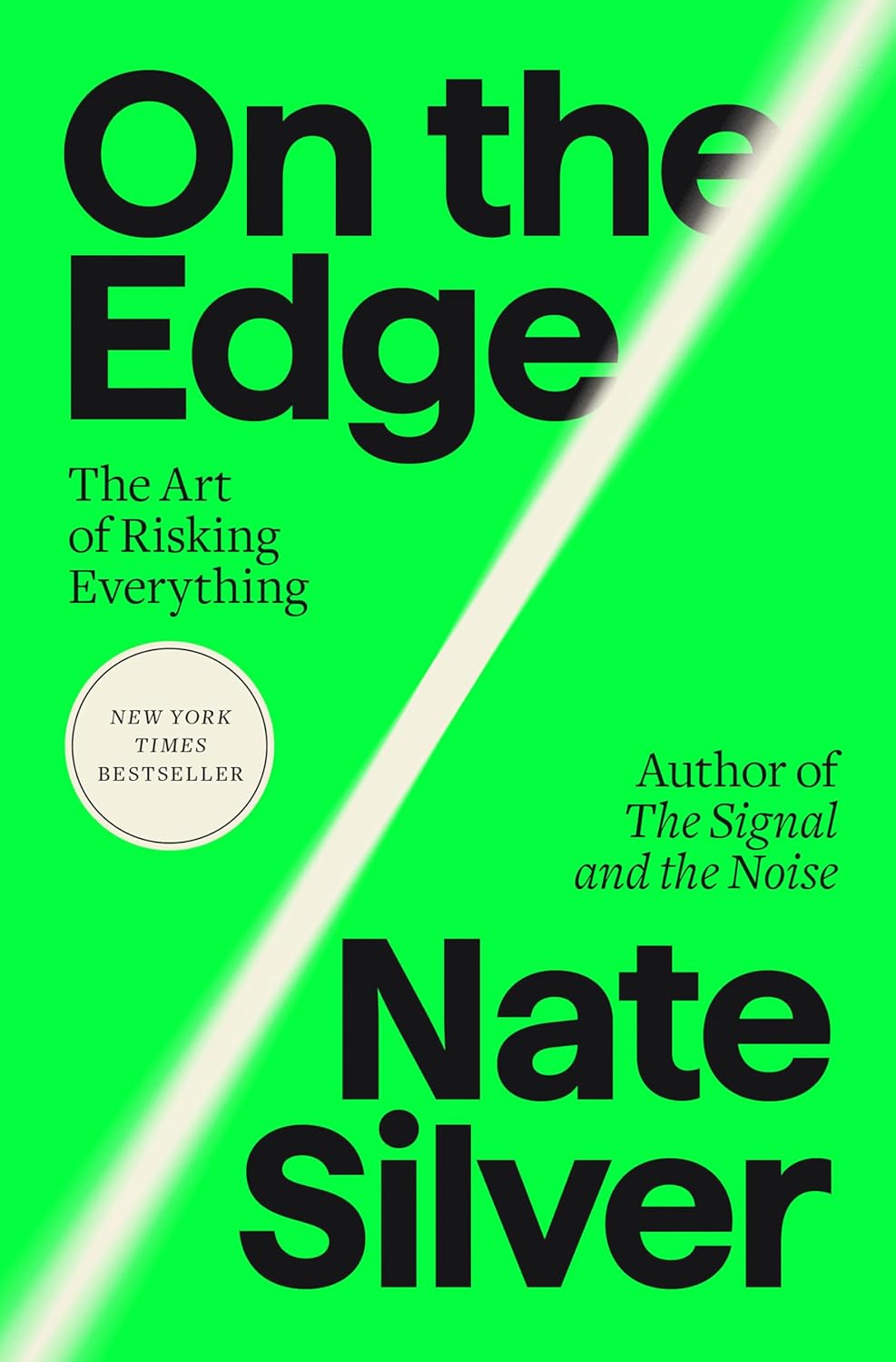
On the Edge
Calculated Gamble: Understanding Risk in the Modern Economy
In 'On the Edge', Nate Silver explores the lives and strategies of professional risk-takers, ranging from poker players to hedge fund managers, offering a comprehensive analysis of how risk shapes the modern economy.
Silver delves into the mindsets of these individuals, shedding light on the complexities of decision-making in uncertain environments and examining what their actions reveal about the future of finance, technology, and society.
The Allure of Risk: Navigating an Uncertain World
Risk has always been a defining characteristic of human progress.
Just as ancient explorers ventured into uncharted lands, modern investors navigate volatile markets. Embracing uncertainty can lead to great rewards or catastrophic losses.
Silver's book deeply examines the relationship between risk and reward, exploring environments where this dynamic is most pronounced, such as poker tables, cryptocurrency markets, and high-stakes investment firms.
He takes readers into the sensory-rich world of elite casinos, where the allure of risk is most vivid.
Casinos like Florida’s Seminole Hard Rock Hotel & Casino are designed to overwhelm the senses, captivating players while subtly impairing their focus.
The dazzling lights, noise, and opulent ambiance contrast sharply with the grim realities of traditional casinos, offering a glimpse into how modern risk environments blur the lines between pleasure and danger.
This physical setting serves as a microcosm of the broader societal context Silver investigates. Risk is omnipresent and increasingly normalized in daily life.
The Mindset of Risk-Takers
A central theme of 'On the Edge' is the distinct mindset that sets professional risk-takers apart from the rest of society.
Silver identifies several key traits that define these individuals, including a high tolerance for risk, comfort with numbers, and a profound skepticism of conventional wisdom.
These characteristics enable members of what Silver calls the "Rivers" group to thrive in uncertain environments where most would hesitate.
What stands out about these players is their rational approach to risk. Unlike the general public, who often make emotional decisions in uncertain situations, these individuals remain calm and calculated.
For example, in poker, the ability to exclude emotions from decision-making is critical.
The poker players Silver encounters do not gamble merely for the thrill but make calculated bets based on a deep understanding of probabilities, strategy, and opponent psychology.
This mindset is equally applicable to cryptocurrency investors, hedge fund managers, and high-risk art collectors.
Although the stakes may differ, the fundamental approach remains the same: evaluate risks, weigh potential rewards, and make decisions with a clear awareness of possible failures.
Risk, Reward, and Power
As Silver digs deeper, he reveals that these risk-takers are not confined to niche fields.
Their influence extends far beyond poker tables or investment firms, shaping critical decisions in global finance, technology, and even politics.
Members of the Rivers group often wield immense power, with their ability to navigate uncertainty playing an outsized role in shaping the modern world.
Figures like Peter Thiel and Sam Bankman-Fried, profiled by Silver, exemplify this trend.
They represent a new breed of power brokers who leverage risk to generate and control vast wealth and influence.
Silver’s exploration of these individuals is particularly timely. As the world grapples with advancements in artificial intelligence, cryptocurrency, and decentralized finance, the ability to manage risk effectively in these uncertainty-dominated fields can be the difference between collapse and success.
The Dark Side of Risk
However, Silver does not shy away from examining the darker aspects of this world.
While those within the Rivers group skillfully navigate uncertainty, their methods and successes often exacerbate social inequality and economic instability.
The wealth and power amassed by these risk-takers can have detrimental effects on society, as seen in cases like cryptocurrency bubbles or hedge fund bankruptcies.
Silver also argues that while risk-taking can spur innovation, it can also create unsustainable systems where short-term gains come at the cost of long-term stability.
The fact that "the house always wins" serves as a fitting metaphor for this reality, mirroring the dynamics of many financial systems run by risk-takers.
Similarly, in poker, as Silver notes from his own experience, the odds tend to work against players over time.
The tension between risk and reward, success and failure, is a recurring theme throughout the book, providing profound insights into the forces shaping the modern economy.
Lessons on Managing Risk in Modern Life
One of the most valuable lessons from 'On the Edge' is the practical insight it offers everyday readers.
Most people will never sit at a high-stakes poker table or manage a billion-dollar investment portfolio, but Silver’s analysis provides a blueprint for thinking about risk in their own lives.
The principles guiding Rivers players - rational decision-making, skepticism of conventional wisdom, and tolerance for uncertainty - can help navigate an increasingly unpredictable world.
Silver’s work also emphasizes the importance of recognizing, rather than avoiding, risk.
In a world where change is constant, the ability to embrace uncertainty and make calculated decisions is a skill applicable to personal finances, career choices, and everyday life.
By learning from the experts who have succeeded through risk, we can develop our own strategies for managing uncertainty and increasing our chances of success.
The Stakes of the Future
In 'On the Edge', Nate Silver presents a compelling narrative about the players who skillfully manage risk to reshape the world.
By guiding readers through the high-stakes world of poker, venture capital, and cutting-edge technology, Silver provides not only an engaging story but also a deep analysis of the role risk plays in modern society.
As we look to the future, Silver’s work serves as both a cautionary tale and an invitation to critically consider how we manage uncertainty in our own lives.

.jpg)
.jpg)
.jpg)