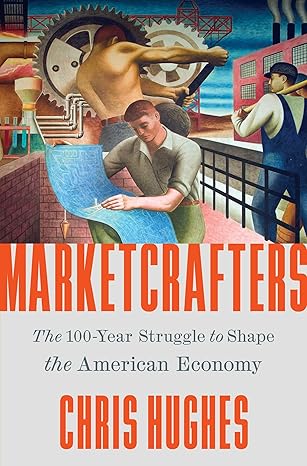
Marketcrafters: The 100-Year Struggle to Shape the American Economy
The Invisible Hand of Government Shaping Market Order
Today, the concept of the free market is often regarded as a fundamental framework for understanding the economy. The autonomous interaction of supply and demand, minimal government intervention, and the efficiency generated by competition are accepted almost as natural laws. However, in reality, markets are not spontaneous orders but structures designed through political will and policy decisions. The formation and collapse of various industries, price-setting mechanisms, and competitive environments among firms have all been continuously adjusted by government decisions and interventions.
The past 100 years of the American economy have been a continuum of such "market design." During the oil crisis, the government intervened to control energy supply and stabilize fuel prices. In the Great Depression and financial crises, governments rescued credit systems and imposed rules on financial markets. Market balance has not emerged spontaneously?it is the deliberate result of numerous policy choices. In other words, markets have been designed and managed as tools to achieve public goals, beyond merely allowing competition.
This recognition goes beyond simply emphasizing the necessity of government. When the term "market" is perceived as a neutral and apolitical space, we overlook the underlying power and intentions. Markets are always someone's choice, and that choice is a political judgment about which values society should prioritize.
Industrial Policy: The Invisible Planning That Determines Success and Failure
Behind the rise of major American industries to global prominence lies sophisticated planning and coordination. The aviation industry grew through government subsidies and defense industry demand, while the semiconductor industry was nurtured as part of national security strategies. The clean energy industry, aimed at combating climate change, would have struggled to emerge without strategic government interventions such as tax incentives, regulatory policies, and technological investments.
Industrial policy goes beyond mere provision of subsidies or imposition of tariffs. It involves decisions and implementations about which industries to define as future cores and which technologies to invest in as public resources. Especially in a structure where private companies are compelled to focus on short-term profit pursuits, only the government can undertake long-term risks and consider shifts that benefit society as a whole.
Such policy interventions have led to failures as well as successes. Ill-timed regulations, excessive favoritism toward certain companies, and misjudgments about technological changes have sometimes distorted markets and caused imbalances across industries. However, even these failures demonstrate how complex and meticulous market design is, and how many variables and choices are involved. Markets are not automatic adjustment mechanisms. They are always imperfect, and attempts to coordinate that imperfection are the essence of industrial policy.
The Boundary Between Politics and Markets Is an Illusion
The dichotomy that politics and markets are separate realms does not hold in reality. Markets are always products of politics, and politics seeks to realize social intentions through markets. All activities in the market?employment, prices, industrial safety, labor conditions?are connected to the outcomes of political judgments. Adjusting interest rates to lower unemployment, deregulating to protect small businesses, and implementing antitrust policies against platform companies are all ways politics is realized through the market.
Within the capitalist system, politics and markets interact and balance each other. The issue is that depending on how this balance is defined, the nature of the market fundamentally changes. The belief that everything becomes optimized by removing regulations and leaving the market to its autonomy is merely an ideal. Rather, side effects such as deepening inequality, strengthening monopolistic structures, and ecological destruction become more extreme when markets operate without any control.
Markets function only on the foundation of institutions, laws, regulations, and values. This foundation is created by politics. Therefore, markets are the result of political choices, not independent natural orders. Attempts to separate politics and markets rather conceal the power hidden in the background of markets and lead to evasion of responsibility.
Economic Imagination Beyond Myths
The myth of the free market is a powerful ideology in itself. This myth reduces the role of the public sector through the dichotomy that "government is incompetent and the market is wise," weakens social solidarity, and shifts inequality onto individual responsibility. However, this myth does not align with empirical reality and rather becomes a shackle that limits the imagination of economic policy.
To move beyond this myth, new economic imagination is necessary. Recognizing that markets can be politically organized and that such organization must operate democratically is important. Through this, we can seek public strategies to respond to major issues such as technological change, climate crisis, aging populations, and inequality.
Artificial intelligence and clean energy are key pillars of the future economy. These fields also cannot realize the interests of the entire society if left solely to market autonomy. To consider fair competition, technological ethics, resource distribution, and environmental sustainability, strong public design and intervention are essential. In other words, new marketcrafting is required.
Markets Are Constructed
Now, it is necessary to understand markets not as "things as they are" but as "constructed entities." Markets are structures formed by the accumulation of value judgments, policy choices, institutional designs, and historical experiences. They are not products of chance or nature but of intentional and repetitive design.
This recognition fundamentally changes the perspective on the economy. Markets can be adjusted, their directions changed, and their purposes set diversely. Markets that prioritize long-term stability over short-term profits, the welfare of all citizens over the interests of a few companies, and inclusiveness over innovation are also possible.
Such possibilities have existed in the past and still exist today. The question is whether we are prepared to envision markets in such ways and plan their directions. The moment we recognize markets as spaces of political imagination, we stand at a point where we can design a better economy.

.jpg)
.jpg)
.jpg)