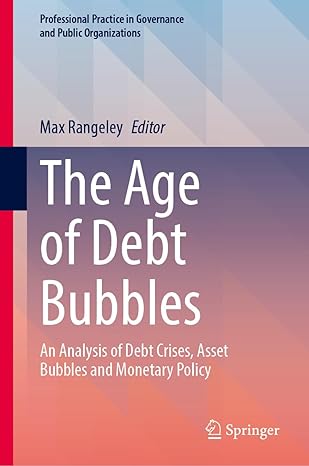
The Age of Debt Bubbles: Anatomy of a Systemic Economic Risk
Introduction: The Debt-Driven Economy
The modern global economy is increasingly characterized by an ever-growing reliance on debt. From household mortgages and student loans to corporate bonds and sovereign borrowing, debt has become the essential lubricant of financial growth. However, this dependence has also spawned a new economic era marked by frequent and devastating debt bubbles. In *The Age of Debt Bubbles*, Max Rangeley and contributing economists offer a comprehensive examination of the causes, structures, and consequences of debt-fueled economic cycles.
The Mechanics of Modern Debt Bubbles
Debt bubbles occur when the volume of credit expansion surpasses the productive capacity of the economy. Financial institutions, encouraged by low interest rates and favorable risk environments, extend excessive credit that flows into speculative assets?real estate, equities, or even cryptocurrencies. These assets experience rapid inflation in value, attracting more investors and compounding the bubble.
According to the authors, the root cause lies in fractional-reserve banking systems, where banks are permitted to lend out multiples of their reserves. This system, while effective at catalyzing growth, is prone to excess. In periods of loose monetary policy, especially after crises, central banks inject liquidity into the system, inadvertently encouraging risk-taking and leverage.
The book illustrates this dynamic with historical examples: the Japanese asset bubble of the 1980s, the U.S. housing bubble in the 2000s, and the Eurozone sovereign debt crisis. In each case, abundant credit and poor risk assessment set the stage for sudden collapse.
Central Banks: The Enablers of Leverage
A critical argument of *The Age of Debt Bubbles* is that central banks have evolved from guardians of price stability into de facto guardians of asset prices. The authors contend that by slashing interest rates to near-zero and employing quantitative easing (QE), central banks have distorted market signals and made risk mispricing systemic.
By attempting to avoid recession at all costs, monetary authorities may instead be planting the seeds for deeper future crises. The so-called “Greenspan put,” followed by the “Bernanke put,” and now the generalized “central bank put,” has created moral hazard in financial markets. Investors operate on the assumption that major institutions will not be allowed to fail, encouraging reckless behavior.
The book questions whether such policy tools are sustainable, especially as debt-to-GDP ratios in many advanced economies approach or exceed historical extremes. It warns that central banks may eventually face a credibility crisis if inflation re-emerges or if their balance sheets become untenable.
Sovereign Debt and the Illusion of Safety
While private sector bubbles receive much attention, sovereign debt is also central to the book’s thesis. Governments, operating under the illusion of monetary sovereignty, continue to borrow beyond sustainable levels. They rely on central bank bond purchases to fund deficits, which can crowd out private investment and weaken currency value.
The authors highlight the paradox of modern sovereign debt: in the short term, it is seen as the safest asset class; in the long run, it can trigger systemic breakdown. Japan’s debt exceeds 250% of GDP, while the U.S. national debt crossed \$34 trillion in 2024. Emerging markets, meanwhile, suffer from debt denominated in foreign currencies, increasing default risk.
The book argues that reliance on debt postpones necessary structural reforms and transfers burdens to future generations. Political actors, bound by short election cycles, are incentivized to spend without discipline, while long-term consequences are left unaddressed.
Financial Deregulation and the Shadow Banking Sector
Another contributing factor to debt bubbles is the growth of the shadow banking system?non-bank financial intermediaries like hedge funds, private equity firms, and asset managers. These entities operate with less oversight and often engage in risky leverage strategies. They are also significant players in the derivatives market, adding layers of opacity to the financial system.
Rangeley and colleagues argue that financial deregulation since the 1980s has created an environment where financial innovation outpaces regulatory capacity. The 2008 crisis was a stark example, where mortgage-backed securities and credit default swaps masked risk until it was too late. Despite reforms like Basel III, the book suggests that systemic risk has merely shifted rather than diminished.
The Policy Dilemma: Between Growth and Stability
The Age of Debt Bubbles does not offer simple solutions but presents a sobering policy dilemma. How can economies sustain growth without resorting to ever-increasing debt? The authors suggest a range of reforms: tightening lending standards, restoring central bank independence, imposing fiscal rules, and increasing transparency in financial markets.
They also advocate for a reassessment of GDP as the sole measure of progress. True economic health should be evaluated by sustainability, equity, and resilience?not just by growth metrics. Moreover, financial education should be prioritized to reduce household overleveraging.
However, the authors acknowledge the difficulty of implementing reforms in democracies prone to populist pressures and lobbying. They warn that without systemic change, future debt bubbles will be larger, more complex, and harder to defuse.
Navigating the Debt-Laden Future
This Book provides a rigorous and unsettling analysis of modern financial systems’ fragility. It challenges the prevailing orthodoxy that debt-fueled growth is benign and suggests that the foundations of the global economy are more brittle than they appear.
By tracing the interplay between central banks, sovereign debt, private leverage, and regulatory gaps, the book serves as a clarion call for rethinking how we manage economic cycles. Whether policymakers heed this call remains to be seen?but the warning is clear: the next bubble may be bigger, more global, and less manageable than any before.

.jpg)
.jpg)
.jpg)