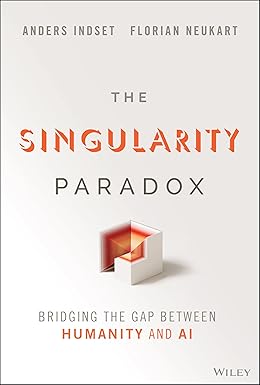
In the Age of Singularity, Is Humanity Ready to Transcend Technology?
- A new paradigm is emerging to bridge the gap between AI and human nature
The Technological Singularity: Humanity's First Question Beyond the Boundary
The concept of the technological singularity is no longer a fantasy of the distant future?it is rapidly becoming a real and pressing issue. As artificial intelligence (AI) approaches the threshold where it surpasses human intelligence, humanity will face questions not merely about technological progress, but about the very definition of existence.
Human intelligence goes beyond simple computation and data processing. Humans act through context awareness, the capacity to endure uncertainty, and the integration of empathy and intuition. These capabilities reflect a uniquely human cognitive architecture that current AI struggles to replicate.
When the singularity arrives, the essential question will not be, “Do machines surpass humans?” but rather, “Do humans truly understand who they are?” Technology becomes a mirror. Through technology, humanity comes to see itself more clearly.
“We don't need machines that are more human; we need humans who understand what it means to be human in the age of machines.”
This boundary is not a threat, but an opportunity for reflection. Rather than being chased by the pace of technology, humanity must find a new path of self-reconstruction in harmony with it.
Human-Centered AI: From Engineering to Ethical Design
The concept of Artificial Human Intelligence (AHI) does not call for machines that imitate humans, but signals a fundamental shift in how we approach technology?moving from function-driven design to value-centered architecture.
Conventional AI systems have focused on efficiency, accuracy, and optimization. However, humans tolerate error, interpret meaning, and construct identity within a social context. Human-centered AI is not about datafying these traits, but about designing systems that can absorb and respond to human context.
For example, in legal AI, it is not sufficient to merely analyze case law data. It must understand and consider moral dilemmas and social background, requiring a form of technological empathy. In such a framework, humans no longer serve merely as users of machines but become co-designers.
“Technology must serve not as a problem-solver but as a mirror through which humans understand themselves.”
The era is shifting from the tension of machine replacement to the harmony of human-guided technological design.
Redefining Labor and Education in the Post-Singularity World
A society shaped by the technological singularity will not simply be governed by automated systems. This transformation demands a fundamental restructuring of labor, education, and economic systems. The core capabilities in such a society will no longer be what machines can do?but what they cannot.
Rote memorization and answer-driven education lose meaning. Future education must be structured around emotional regulation, ethical reasoning, and collaborative intelligence. In particular, situational awareness and emergent thinking will remain distinctly human domains.
The concept of labor will also shift?from production-centric to relationship-centric. While repetitive labor and calculations can be performed by AI, building trust, mediating conflict, and shaping identity remain exclusively human tasks.
“Technology can replace human work, but it cannot replace being human.”
Society must prepare for this transition through policy, institutional frameworks, and educational systems. Without preparation, technological advancement risks deepening social inequality and existential anxiety.
Ethics Is Not Code?It Is Sensibility
Ethics is a uniquely human sensibility that cannot be replicated by algorithms. It is not a collection of data but a mode of survival and a social contract that integrates context, empathy, and judgment. No matter how sophisticated AI becomes, it can never truly feel why a choice is right.
Machines may simulate ethical behavior, but they do not possess responsibility, remorse, or self-reflection. This is the fundamental distinction between human and machine. Humans do not process others’ pain as “information,” but react to it as “emotion,” and can revise their judgments through reflection.
Ethical decisions are always accompanied by imperfection and ambiguity. It is within that ambiguity that humans become true members of a community.
“What makes us human is not just what we know, but how we fail, forgive, and begin again.”
This is not the age of machines calculating morality?it is the time for humanity to preserve the value of sensing it.

.jpg)
.jpg)
.jpg)