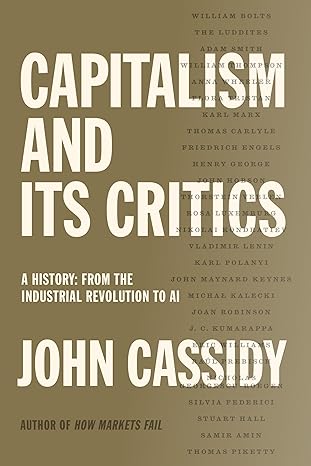
Capitalism as a History of Criticism: From the Industrial Revolution to AI
Following the Shadows of Capitalism
Capitalism, now the dominant framework of the global economy and politics, has faced constant criticism throughout its development. It is not merely an economic system but the outcome of historical decisions, power relations, and social struggles. Rather than uncritically praising its success, it is essential to ask how capitalism has transformed human lives?and whether that transformation has always been for the better.
"To understand capitalism fully, we must take its critics seriously ? not merely as dissenters, but as essential participants in its evolution."
Criticism is not an external assault on the system, but a key internal force for reflection and reform. Capitalism has never evolved along a single path; it has been continuously reshaped through layers of critique and resistance.
The Discontent of the Industrial Era: Progress in Technology, Decline in Life
The Industrial Revolution, beginning in the late 18th century, brought rapid increases in productivity through mechanization and mass production. Yet for the working class, this transformation meant a decline in quality of life. Critics focused not on the technology itself, but on how it was used to threaten human dignity and livelihood.
"The Luddites didn’t hate machines ? they hated how the machines were used to undercut their livelihoods."
Machines were neutral tools, but when used as instruments of exploitation, resistance erupted. Early cooperativists and utopian socialists argued for the democratic control of the means of production, seeking human-centered alternatives. Rather than relying on market competition, they advocated for cooperation and mutual aid to restore the community.
Marxism and the Theorization of Critique
In the mid-19th century, a new approach emerged to analyze capitalism structurally. It was understood not as a simple market order, but as an exploitative system centered on the accumulation of surplus value. This perspective provided the philosophical backbone for various forms of social movements and established a theoretical foundation.
"Capitalism was not eternal but historical ? a system with a beginning and, perhaps, an end."
This view dismantled the notion of capitalism as a natural order. Through concepts like class structure and labor alienation, it explained how humans became objectified by the system, and opened the intellectual space to consider its potential end. This critique influenced not only revolutionary practice but also gradualist reformism.
Keynesianism and "Managed Capitalism"
The Great Depression of the 1930s revealed the internal instability of capitalism. As markets failed to self-regulate, new approaches were sought to ensure economic stability. The accumulation of capital and rising unemployment legitimized state intervention.
"Keynes didn’t want to abolish capitalism; he wanted to save it ? from itself."
This approach materialized in expanded welfare programs, public investment, and labor market coordination. A belief emerged that capitalism could be stabilized without a full overhaul, leading to the so-called Golden Age of mid-20th century capitalism. However, this stability contained seeds of new crises, ultimately giving rise to the backlash of neoliberalism.
The Neoliberal Backlash and the Era of Deregulation
In the 1980s, neoliberalism rose as a reaction against state intervention. It redefined capitalism in terms of market autonomy and sought to minimize the role of the state. Privatization, deregulation, and financialization expanded, entrenching inequality and concentrating wealth.
"What disappeared wasn’t just regulation ? but the very idea that capitalism needed managing."
Economic policy was reoriented toward growth, but the results were polarization and unstable employment. Even after the financial crisis, the system fundamentally remained the same, and criticism of the existing order was pushed to the margins. Attempts to recalibrate the system were either unsuccessful or highly limited.
A Global Perspective: The Global South and Colonial Critique
Capitalism is not the product of a single country’s experience but part of a global system. Spreading through colonialism, it destroyed local diversity and created globally uneven development. Critics from various regions began to question the very paradigm of growth.
"True economy is based on values, not volume."
Local communities, self-sufficient economies, and ecological sustainability were presented as alternatives to Western production-centric discourse. Intellectuals in the Global South argued that capitalism was not just an economic model, but a totalizing structure that also governed culture and consciousness, thereby expanding the imaginative horizon for alternatives.
Contemporary Critique: AI, Automation, and Degrowth
Today, capitalism is evolving into a new form?technological capitalism. Artificial intelligence and automation dramatically boost productivity while simultaneously reducing the need for human labor, reshaping social structures. In this process, the meanings of labor, production, and value are fundamentally redefined.
"AI doesn’t just displace jobs ? it redefines what counts as productive labor."
This shift destabilizes not only traditional distribution systems but also the social roles and existential value of human beings. Responses such as degrowth, basic income, and the restoration of public goods are emerging. These new critiques aim not to reject the system outright, but to reconstruct it in a better direction.
Re-Choosing Capitalism
Capitalism is not a fixed system; it is the outcome of numerous choices, conflicts, and negotiations. Criticism does not destroy the system; it is a creative force that leads it toward a better version.
"Criticism isn’t destruction ? it is construction by other means."
Historically, critique has served as a mechanism for capitalism to survive as capitalism. Even now, the system retains the potential to reshape itself through criticism. The task before us is not whether to choose capitalism, but what kind of capitalism to choose.

.jpg)
.jpg)
.jpg)