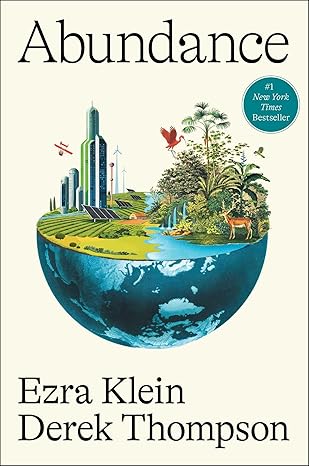
Abundance: From the Politics of Scarcity to the Politics of Plenty ? A New Path for an Era of Transition
Why We’ve Stopped Building
Today, America suffers from unprecedented resource shortages?but these are not due to natural limits. Homes exist yet remain unbuilt, people want to work but immigration is restricted, and clean-energy technologies are available, yet the infrastructure does not exist. This is the result of not building.
“The crisis that’s clicking into focus now has been building for decades?because we haven’t been building enough.”
We have dramatically improved our ability to identify problems, yet our capacity to solve them has declined. This isn’t a matter of technology or resources, but of willpower and systems. In the past, bold national projects were possible; today, even constructing a single road or railway can take years?and often fails altogether.
“Our capacity to see problems has sharpened while our ability to solve them has diminished.”
A society that stops building stagnates. Citizens become accustomed to scarcity, politicians avoid risk, and public institutions get trapped in defensive procedures. The root of the crisis isn’t incompetence?it’s political paralysis. We must return to being a society that builds.
When Good Laws Become Shackles for the Next Generation
Many institutions and regulations were once created to solve real problems. In the environmental crisis of the 1970s, the U.S. enacted strong environmental laws that helped reduce emissions from factories and cars. But over time, those laws have unintentionally hindered today’s clean-energy transition.
“Rules and regulations designed to solve the problems of the 1970s often prevent urban-density and green-energy projects that would help solve the problems of the 2020s.”
Though well-intentioned, laws have become rigid frameworks over time. Without flexible adjustments, laws that once solved problems now obstruct innovation. Our challenge today is having too many “good” laws.
Laws designed to ensure government considers consequences have made it too difficult for government to act consequentially.
Laws and institutions need to evolve with the times?but politics to change laws is missing. If this continues, yesterday’s success will produce tomorrow’s failure in an inevitable cycle.
Between “Government Is the Problem” and “Government Is the Answer”
For too long, American society has oscillated between extremes: conservatives insisting “government is the problem,” and progressives declaring “government is the solution.” But the truth lies somewhere in between?the question is what government should do, and how.
“It means, for liberals, recognizing when the government is failing. It means, for conservatives, recognizing when the government is needed.”
Today, government must do more than expand or contract its budget; it must precisely design and calibrate its role. In areas like roads, housing, and energy?where public good is paramount?strategic government involvement is essential. In fields requiring innovation and creativity, the private sector’s autonomy yields greater value.
Liberals and conservatives alike must recognize that sometimes government is too big, and other times it’s too small?a balanced approach is the starting point for a prosperous society.
An effective government is not simply large or powerful; it reads the times, acts flexibly, and maximizes communal welfare. We must rewrite this new doctrine of government’s role.
Plenty Is a New Imagination
Modern politics often falls into a “zero-sum mindset”?the belief that someone’s gain must come at someone else’s loss. In this framework, politics becomes a fight over dividing fixed shares. True abundance requires imagining beyond this framework.
“Abundance is not merely a material condition. It is a mindset. A way of seeing the world not as a zero-sum conflict but as an open field of possibility.”
For too long, we’ve been accustomed to dividing limited shares. Now, we must focus on how to increase the share itself. This demands imagination across technology, institutions, and social cooperation.
The imagination of abundance emerges from envisioning future cities, designing sustainable infrastructure, and adapting technology to human life. It’s an integrated way of thinking across science, politics, culture, and philosophy.
“If you can’t imagine what can be built, political action cannot exist.” The moment we believe in abundance, new policies and possibilities open. Politics must spread that belief among citizens.
For the Politics of Plenty, the Time Is Now
Across the globe, the politics of scarcity are gaining power?reducing immigration, cutting welfare, controlling resource use. But this only amplifies anger without solving problems. In contrast, the politics of plenty offers solutions through production and expansion.
“At a time when movements of scarcity are gaining power in country after country, this is an answer that meets the challenges of the moment.”
Politics for plenty is a new political philosophy that creates more resources, rebuilds social trust, and enables collective investment in the future. It calls for a comprehensive realignment of society, beyond mere budget allocation.
We must now ask again: Why have we stopped building? What stopped us? And how do we start again?
Abundance is not an ideal?it’s a strategy. It becomes real when society regains confidence and forms a shared sense of possibility. Imagination starts the journey, but political will makes it happen.
We must choose to be a building society again?constructing homes, energy infrastructure, rethinking education, and designing the public good for future generations. That is how politics can come alive again, and it is the only way we can transcend this era.

.jpg)
.jpg)
.jpg)