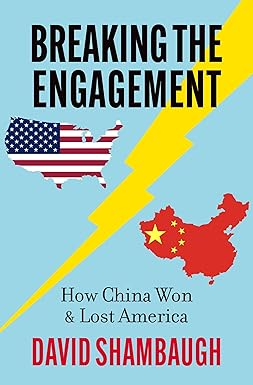
The Gap Between the Ideal and Reality of the Engagement Strategy
President Richard Nixon’s historic visit to China in 1972 represented a strategic move by the United States to draw China into the existing liberal international order. This “engagement strategy” was not merely a diplomatic posture, but a long-term design aimed at inducing political and social change in China through economic integration and cultural exchange.
At the time, not only the U.S. government, but also interest groups like Wall Street, Silicon Valley, academia, the arts community, and NGOs supported this strategy. There was widespread optimism that once China joined the WTO and became integrated into U.S. stock markets and production networks, political freedom would naturally expand.
However, reality did not follow these expectations. Shambaugh rigorously analyzes how the high hopes at the early stages of the engagement strategy were structurally misplaced. China accepted economic integration, but in contrast, used it as a tool to strengthen its internal authoritarian regime.
In particular, after Xi Jinping came to power, the authorities expanded internet control and censorship, revoked Hong Kong’s autonomy, and formalized human rights abuses in Xinjiang and Tibet, accelerating the entrenchment of the regime. Shambaugh points out that this strengthening of authoritarianism shook the very essence of the engagement strategy.
“Engagement was not merely a diplomatic policy but a structural cornerstone of America’s worldview?one that was undermined by a failure to grasp China’s reality.”
Thus, the engagement strategy began with excessive optimism that assumed economic growth alone would automatically bring about political change, completely ignoring the unforeseen political and cultural differences. Ultimately, this led to a fundamental divergence in perceptions between the two countries.
Declaring the Collapse of the Engagement Strategy
Shambaugh clearly announces that rupture, citing:
“Engagement strategy has failed miserably and is D?E?A?D.”
This declaration doesn’t signal a mere tweak in policy?it formalizes that engagement itself has ceased to function. Public sentiment in the U.S. shifted dramatically in the mid-2010s. Business leaders, scholars, and diplomats who once supported engagement began to lower their voices, even suggesting it might be time to reconsider. Surveys showed that over 80% of Americans no longer held favorable views toward China?evidence that the social and political underpinnings of engagement had rapidly eroded.
As economic sanctions and tech restrictions followed, the U.S. officially adopted a hardline stance. The Trump administration launched a trade war with China, addressing IP issues, banning high-tech exports, and imposing sanctions on companies linked to top officials. In this context, Shambaugh explicitly diagnoses engagement not merely as a moral failure, but as a collapse of a strategic paradigm.
The Four Premises of Engagement and Their Collision with Reality
Shambaugh outlines the key premises underpinning the once firmly held engagement strategy:
1. Economic modernization and global integration: If China enters the world economy, it will automatically adopt market mechanisms and norms.
2. Gradual political change: Exposure and learning will lead to embracing democratic values and institutions.
3. Institutionalized international cooperation: China will participate actively in the WTO, climate agreements, and global governance systems.
4. Interpersonal exchange effects: Increased exchange among students, tourists, and businesspeople will foster cultural understanding and build trust.
By the 2010s, however, these premises began to clash with reality.
First, while China embraced the digital and hardware dimensions of economic globalization, it did not permit changes to its political or decision-making systems.
Second, although China participated in institutions, it used them more to strengthen its own capacities than to contribute to global governance.
Third, although exchanges increased, they became tools for enhanced control and patriotic propaganda rather than for cultural integration.
“China treated engagement not as a catalyst for freedom, but as a means to reinforce regime stability.”
When the anticipated changes failed to materialize, the engagement strategy swiftly collapsed into a reality much different from expectations.
The Era of Strategic Competition and “Managed Coexistence”
The collapse of engagement did not imply hostile decoupling. Shambaugh argues that what followed was an era of “comprehensive competition.” This is not full separation or outright animosity?instead, it entails maintaining limited cooperation in economic, technological, and environmental fields, while pursuing clear competition in security, ideology, and military domains.
This strategic shift goes beyond economic sanctions or diplomatic measures. It leaves room for cooperation on global public goods like climate change, pandemic response, and nuclear non-proliferation. At the same time, countries are implementing policies to reduce dependency in areas like high-tech industries, the military, and cyberspace.
“China and America are no longer friends or overt adversaries, but they must recognize clearly where to compete and where to cooperate.”
Shambaugh sees this as a key diplomatic lesson from the Cold War era, one that is likely to shape relations for decades to come.
South Korea’s Historic Challenge
South Korea is a crucial testbed in this era of strategic coexistence. Having long relied on the U.S. for security and China for economics, Korea can no longer just pursue a balance. Shambaugh emphasizes that Korea must move beyond “political neutrality” and secure strategic autonomy.
He outlines three essential actions:
1. Multi-layered diplomatic framework: Clearly define cooperation and competition with China and the U.S. by sector, aligning strategic intentions with
national interests.
2. Strengthen risk management in strategic industries: Ensure supply chain resilience and diversification in semiconductors, batteries, AI, data, vaccines, etc.
3. Reconfigure exchange structures: Maintain cultural and academic exchanges, but integrate education and tech cooperation with strategic sectors. Civil society interactions should aim at mutual understanding, not politicization.
“South Korea must evolve beyond neutral mediator into a strategic architect shaping the order around it.”
This statement encapsulates a spirit of the times: countries must actively shape order, not passively choose safety between superpowers.
The Balance of Personal Experience and Analysis
Shambaugh draws on decades of observing China?from his time as a U.S. student in the 1970s, through the post?Tiananmen cutoff, to post-2010 reconnections. This allows him to go beyond logical analysis, portraying the psychological terrain of the post-engagement era through lived memories and insights.
This approach lends the book its power: using personal narratives to transcend policy explanations and cultivate an experiential, non-deterministic understanding.
“A Readiness for Transition”
This book is not merely a policy analysis?it is a declaration of the demise of the engagement paradigm and a redefinition of post-engagement reality through managed competition. The book offers not just a U.S. reckoning but a foundational guide for middle powers like Korea, the EU, India, and Japan to redesign order and formulate response strategies.
Korea’s strategic choice must go beyond siding with the U.S. or China?it must carve out a sovereign, balanced, forward-looking strategic national identity. This book is a highly valuable resource for taking that first step.

.jpg)
.jpg)
.jpg)