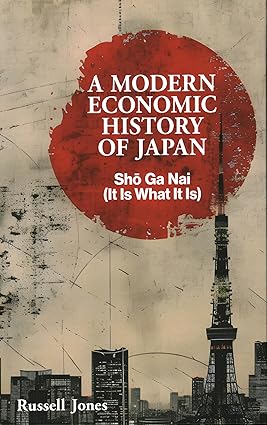
Escaping Sho Ga Nai: Modern Economic History of Japan and the Future of Korea
Why Read Economic History: Understanding the Rhythm of Systems
Economic history is not merely the study of numbers, dates, or past policies. It is a collective record of how a society has made choices, how it has responded to crises, and how it has recovered from them. This record serves as an essential reference for shaping future decisions and strategic responses. Russell Jones’s 'A Modern Economic History of Japan: Sho Ga Nai' is a representative work that clearly demonstrates the practical value of economic history. He unpacks Japan’s modern economic trajectory not just through statistics but by decoding historical rhythms and cultural patterns.
Jones particularly analyzes how Japan’s economic system evolved from high growth to prolonged stagnation and limited recovery, and how politics, finance, corporations, and households interacted throughout this process. He argues that one of the key goals of studying economic history is to identify recurring “rhythms” within historical developments.
"History doesn’t repeat itself, but its rhythms return."
This book is not limited to Japan’s economy. Through broader themes such as institutional design, crisis response, policy failure, and cultural reactions, it offers important insights for countries around the world facing economic challenges today.
The Myth of High Growth: State-led Compressed Development
After World War II, Japan rapidly rebuilt its devastated land and collapsed industrial base. Particularly from 1955 to 1973, the roughly 20-year period known as the “high-growth era” is considered the most dazzling chapter in Japan’s economic history. During this period, Japan maintained an average GDP growth rate close to 10%, emerging as one of the world’s fastest industrializing nations.
This success was not coincidental. The government led industrial policy by fostering strategic heavy industries, while corporations ensured stability through vertically integrated supply chains and lifetime employment systems. At the same time, households maintained a high savings rate, contributing to the accumulation of domestic capital.
"Between 1955 and 1970 Japan’s GDP growth averaged 10% per annum. Such impressive export-led growth furnished an alluring development model to the rest of Asia."
This model of “compressed development” became the prototype for economic growth strategies in East Asian countries such as South Korea, Taiwan, and Singapore. However, the excessively rigid industrial structure and government-dependent capital allocation foreshadowed structural vulnerabilities for the future.
The Peak of the Bubble and the Lost Decade: Collapse of the System
In the late 1980s, Japan experienced an unprecedented surge in asset prices. Real estate prices in Tokyo were said to exceed those of all of Manhattan, and the Nikkei stock index approached 40,000 points. Corporations took out massive loans using real estate as collateral, while banks abandoned risk management in favor of aggressive lending.
However, this so-called “bubble economy” was built on illusions. Corporate sectors were overly optimistic, households reduced their savings and increased consumption, and financial markets were swept up in speculative sentiment. The bubble eventually burst in 1991.
"The bubble economy was built on increasingly rocky foundations, underpinned by overly optimistic corporate sentiment and a declining household savings ratio."
Japan subsequently entered a long-term stagnation known as the “Lost Decade.” Banks were burdened with non-performing loans, and zombie firms continued to drain economic efficiency without being eliminated. Despite multiple fiscal stimulus attempts by the government, the recovery was delayed due to entrenched deflationary sentiment.
"The banking sector was paralysed. Non-performing loans remained unaddressed, and zombie firms absorbed valuable resources without contributing to growth."
Jones sees this period as the most critical turning point in Japan’s economic history. The failure was not merely one of policy but a comprehensive crisis caused by the system’s lack of flexibility and the conservatism embedded in its culture.
The Abenomics Experiment: Boldness and Limits
Following the 2008 global financial crisis, Japan’s economy suffered a new shock. A combination of reduced exports, yen appreciation, and domestic consumption stagnation led to prolonged deflation. In this context, Prime Minister Shinzo Abe launched the economic policy package known as “Abenomics” in 2012.
Abenomics was based on three arrows: First, aggressive monetary easing by the Bank of Japan to stimulate inflation expectations; second, fiscal expansion to boost infrastructure investment and demand; and third, structural reforms including labor market flexibility and expanded employment opportunities for women.
"Abenomics was a decisive regime shift designed to boost Japan’s economic fortunes via ‘three arrows’: monetary easing, fiscal stimulus, and structural reform."
Initially, positive signs appeared, such as increased exports due to a weaker yen, a revitalized stock market, and a drop in unemployment. However, the structural reform component yielded limited results. Problems like population decline, labor shortages, and regional economic stagnation remained unresolved, and the growth effects of Abenomics gradually diminished.
"The results of Abenomics were mixed. While financial markets responded positively, the underlying structural problems remained largely unresolved."
The Shadow of “Sho Ga Nai”: Cultural Fatalism and Institutional Limits
The term “Sho Ga Nai (しょうがない),” which appears in the title of the book, literally means “it can’t be helped” in Japanese. This is not just a casual phrase but a deeply embedded cultural sentiment in Japanese society. Jones interprets this phrase as a key to understanding how Japan responds to crises. Rather than confronting problems head-on, it reflects a tendency toward resignation and adaptation.
"Sho ga nai is more than a phrase ? it represents a deep-seated cultural disposition to accept adversity rather than to confront it head-on."
Jones argues that this cultural attitude delayed bold policy responses during crises and ultimately reduced economic vitality. Since institutions reflect culture, and culture can restrict institutional flexibility, “Sho Ga Nai” functioned as a psychological barrier hindering Japan’s recovery.
Lessons for Korea: Beyond Resignation, Toward Transformative Politics
The book offers profound implications for Korea.
How do we respond in times of crisis?
Do we passively accept structural problems such as entrenched inequality, demographic decline, and industrial polarization as “inevitable”?
Japan’s Lost Decade was not simply an economic downturn; it was the result of failed institutional reforms and a culture of resignation.
Korea today faces its own structural challenges, including rapid aging, youth unemployment, real estate disparity, and technological imbalance. If we approach these issues with the mindset of “it can’t be helped,” we may well follow Japan’s trajectory.
Jones’s economic history asks us:
What rhythms are we repeating?
And how can we break them?

.jpg)
.jpg)
.jpg)