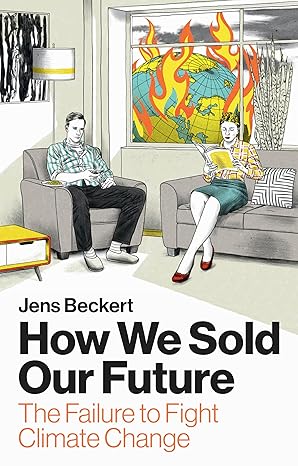
How We Sold Our Future: How Growth and Capital Stole the Climate's Time
The Failure of Climate Action Is Not an Individual Problem: A Shift in Framing
The failure to respond to climate change is still widely attributed to individual laziness or ignorance. But personal actions?like using a tumbler, reducing plastic, or cycling instead of driving?are repeated in vain without structural change.
Society encourages the ethical choices of "good citizens" while ignoring the fact that the very systems they live within often undermine those efforts. The essence of the problem lies not in individual morality but in the political, economic, and cultural structures that make sustainable choices difficult or disadvantageous.
Climate change, as a long-term and complex issue, is difficult to feel in everyday life. It inevitably clashes with a system that prioritizes immediate gains. In a society where stability and growth are the highest values, the abstract idea of future survival rarely influences actual decision-making.
Structural forces overwhelm individual goodwill and promote widespread apathy and resignation. Without changing those structural conditions, no personal action can transcend the system's boundaries. The failure to address climate change is a failure of the entire society.
Moreover, this structure blinds us to the very horizon of solutions. The more emphasis placed on individual action, the weaker the demands for structural reform and policy change. This imbalance benefits those in power and functions to dilute transformative pressure.
Education, media, and consumer campaigns demand ethical responsibility from citizens while evading political and structural responsibility. This leads us to ask:
"Are we truly seeing the causes of climate change clearly, or have we trapped ourselves in the comfort of symbolic actions?"
"Social structures must not obscure or restrict the space in which climate problems can be thought. Economists and politicians design preferences, but those preferences are shaped by the system."
Why Is the Capitalist System Hostile to the Climate?
Modern capitalism upholds growth and profit as its core values. Markets invest in profitable resources, and governments are judged by growth rates. In such a structure, long-term goals like environmental protection and climate stability are inevitably sidelined.
Policies aimed at building a sustainable society are criticized for discouraging investment, and regulations are treated as obstacles to economic activity.
The close ties between politics and finance worsen the issue. Capital has the power to evade or neutralize unfavorable institutions, and politics, fearing backlash, becomes reluctant to regulate.
Within these revolving interests, climate action is tolerated only so far as it doesn’t interfere with growth. Declarations abound, but action lags; plans exist, but impact is absent. This failure is no accident. It’s a predictable and systemic result of a growth-centered society.
"Climate policies that do not generate profit are rendered ineffective by the logic of capital. What matters is not the policy itself, but the institutional basis that makes it possible."
The pursuit of profit and the ideology of growth persist even in the face of crisis. Rather than change, capitalism absorbs climate issues into new markets. Do carbon trading, green finance, and ESG management sound progressive? In reality, they often serve to turn structural causes of the climate crisis into new profit models.
This adaptability allows capitalism to absorb crises without transforming its underlying order. Market logic, not planetary sustainability, remains in control.
Consumption Is Not a Choice, but an Identity
Consumption today is more than fulfilling desires?it defines identity and social belonging. What one consumes equates to who one is. Thus, reducing or rejecting consumption can threaten one’s cultural ties and self-image.
The idea of sustainable consumption sounds ideal, but in practice, it remains a contradiction: solving problems within the very system that creates them. Even eco-friendly goods create a new identity?"the ethical consumer"?and market morality itself becomes commodified.
Addressing climate change requires a shift from asking "what should we consume?" to "how must we reconstruct consumption itself?" Consumption, before being a moral choice, is a survival mechanism imposed by society.
"Even so-called 'ethical consumption' remains a variation embedded within the logic of market-based consumer society."
This leads us to the issue of unequal consumer power.
The wealthy consume more and emit more, yet the most vulnerable bear the brunt of climate impacts. This structural imbalance has been masked by the rhetoric of consumer freedom.
Consumption is not freedom but survival?and some classes are guaranteed more means to survive. True climate justice begins by exposing this inequality in consumption and responsibility. Only when we view consumption as a structural issue?not a personal choice?can we truly begin to confront the climate crisis.
The Myth of Technology Is Not a Solution, but a Deferral of Responsibility
Technology has long been seen as a solution to human problems. But in the climate crisis, it increasingly functions as a myth that delays accountability and creates false hope. Technologies like carbon capture, solar radiation management, and AI-driven efficiency are still experimental or unproven, yet often presented as ready-made solutions.
This technological thinking enables us to remain optimistic without altering the system. The illusion of solving everything through science weakens political will and pushes uncomfortable decisions aside.
"Technological optimism delays political responsibility and reduces the climate crisis to a matter of technical management."
In truth, technology may be necessary but is never sufficient. Climate change is not just a technical problem, and new technologies bring new risks and costs. Technology is not neutral?it is shaped by and shapes power. We must not merely bet on innovation, but critically examine and reframe it within political, economic, and ethical contexts.
Why Has Civil Society Become Powerless?
Civil society is often invoked in climate discourse, yet rarely does it function as a real agent of change. The issue is not lack of information or will, but the structural conditions that disempower it.
Modern civil society is far weaker than political and economic power and lacks the resources and channels to exert influence. Even large NGOs depend heavily on state or corporate funding, limiting their advocacy. Meanwhile, climate movements often focus on individual ethics or minor campaigns, weakening structural critique and political activism.
In this process, civil society shifts from watchdog to collaborator, losing its critical function.
"Citizen action for sustainability is absorbed into symbolic consumption or limited participation, functioning as a mechanism to suspend systemic change."
In the digital age, civil society is fragmented and short-lived. Online outrage does not translate into sustained organization. Hashtag movements have clear limits. For structural and long-term crises like climate change, reactive emotion is not enough. Institutional intervention and long-term alliances are essential?but civil society often lacks the capacity to build them. This reveals the asymmetry of power at the core of the climate crisis.
Is Politics for the Future Still Possible?
The essence of the climate crisis is the failure of politics to represent future generations. Democracy is based on the will of the living?those not yet born have no rights, no votes. Thus, long-term climate policy is repeatedly pushed aside in favor of present-day interests.
This is a matter of political time. Four- or five-year election cycles are too short to support decades-long climate plans. As a result, climate policy becomes political rhetoric rather than real vision. Under these constraints, politics rarely produces meaningful outcomes.
"Contemporary democracy lacks institutional mechanisms to represent the interests of future generations. The political incapacity to address climate change is rooted in the temporal structure of democracy."
If politics cannot think about the future, who will fill the gap? Experiments like citizens' climate assemblies, intergenerational funds, or constitutional rights for future generations are important?but still peripheral. Real change will require imagination and practice that can reconstruct democracy itself. Without such political innovation, the climate crisis cannot be overcome.
The Fight to Reclaim the Future Begins Now
The key questions are clear:
"Why do we remain stuck in symbolic action instead of pursuing structural change? And how is this state maintained?"
Growth and profit, consumption and technology, politics and civil society?all have conspired to sacrifice the future. The climate crisis has become a "managed crisis," unresolved but controlled.
Its solution demands more than technology or policy?it requires a fight to reorganize our sense of time, political structures, economic directions, and cultural norms. This fight is uncertain and uncomfortable, requiring us to change how we live. But change is possible?and urgently necessary. The future has already been sold, but it can still be reclaimed. That struggle must begin here and now.
What we need is an imagination for the future. We must face the essence of the climate crisis, demand political and social decisions that go beyond short-term gains, and confront every structure that delays change. Now we must ask and decide:
"What kind of future do we want to live in?"

.jpg)
.jpg)
.jpg)