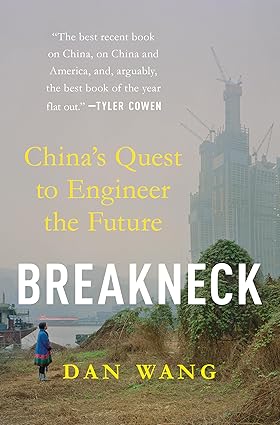
The Engineering State and the Lawyerly Society: The Speed of Two Worlds
A New Perspective: The Clash of Speed and Procedure
The most striking contrast when comparing China and the United States can be compressed into the expressions “engineering state” and “lawyerly society.” China builds everything quickly, while the United States moves slowly amidst procedures and debates. This difference is not simply about construction speed but reveals a fundamental difference in how societies are operated.
Dan Wang makes this point clearly:
“China is an engineering state, which brings a sledgehammer to problems both physical and social, whereas the United States is a lawyerly society, where everything is gavelled to a halt.”
This sentence is not a simple rhetorical flourish but an expression that summarizes the trajectory the two countries have shown over the past several decades.
China’s Engineering Speed
When one thinks of China’s development, the words “speed” and “scale” inevitably come to mind. From highways and high-speed rail to massive factories and urban infrastructure, China has transformed its world in a short period of time. The fact that it took the United States 18 years to build a highway network, while China recreated one of the same scale in only nine years, is emblematic.
“China took 18 years to build a motorway network… Then China did it again in nine years.”
The reason such speed is possible in China is not simply technological capacity but lies in its centralized system and results-oriented decision-making. The method of solving problems places efficiency and outcomes as the top priorities, while risks and side effects are deferred. As a result, dazzling achievements have appeared, but at the same time, social experiments such as the one-child policy and zero-COVID lockdowns were implemented in the same manner. The tendency to treat even social issues as engineering problems reveals a cold aspect of viewing people as just another resource.
The fact that most of China’s top political leaders were engineers further underscores this national orientation.
“By 2020 all nine members of the Chinese Politburo’s standing committee had trained as engineers.”
When the country’s highest decision-makers share the same mindset, it is only natural that the whole society moves according to the logic of technology and construction.
America’s Procedures and Freedom
The United States moves in an entirely different direction. Change and reform must always pass through a web of laws, regulations, and lawsuits. Environmental reviews, administrative assessments, local opposition, and legal battles follow in succession, and large-scale projects sometimes cannot reach a conclusion for decades.
This process slows down speed but guarantees individual rights and freedoms. Procedural democracy has become the soil for emergent ideas and diverse cultural achievements. Silicon Valley’s entrepreneurial ecosystem, Hollywood’s cultural industry, and the world’s leading universities and research institutes have all grown under this freedom and rule of law. Yet at the same time, the United States suffers from the irony of being shackled by the very rules it created.
Dan Wang summarizes this succinctly:
“The United States … has a government of the lawyers, by the lawyers, and for the lawyers.”
The dominance of law is central to the identity of American society, but excessive proceduralism paralyzes execution. Even when it is clear what needs to be done, situations frequently arise in which not a single step can be taken amid endless processes.
The World These Two Models Show
The contrast between China and the United States can be explained along the axes of speed versus procedure, collective versus individual, and tangible achievements versus emergent innovation. China changes the world through the power of building, while the United States sustains society through debate and procedure.
Dan Wang compresses this difference into a single sentence:
“China builds, America debates.”
Within this concise contrast are contained both the present and the future of the two countries.
The Choices Facing the World and Korea
These two models offer options to the rest of the world. Developing countries see the Chinese model as attractive because they want fast and inexpensive infrastructure results. The fact that China’s Belt and Road projects are underway across Africa and Southeast Asia is in the same context. Conversely, in societies that value institutional stability and individual rights, the American model of procedure is still accepted as the standard.
Korea must find a balance between these two paths. It must raise its execution and speed like China, while also protecting the values of freedom and procedure like the United States. In strategic industries such as semiconductors, batteries, and artificial intelligence, what Korea is required to secure is both engineering efficiency and rule-of-law-based trust. Reconciling the two models to pioneer a new path is the true key to 21st-century competitiveness.
A Future in Tension
China’s engineering state model makes dazzling achievements possible but carries with it the risk of instrumentalizing human beings. America’s lawyerly society model is slow but guarantees freedom and rights, enabling long-term innovation. The future will be shaped in the tension between these two models.
Dan Wang emphasizes clearly the direction the United States must take:
“America needs an engineering culture to build homes, build mass transit, and build the energy systems necessary to decarbonize.”
China builds, and America debates. Yet the world of the future will demand both the power to build and the power to debate. Korea, along with many other nations, must carve out its own path within this tension.

.jpg)
.jpg)
.jpg)