The Wrong Bet and the Cost of Globalization
The Promise of Optimism and the Reality of Inequality
At the end of the 20th century and the beginning of the 21st, globalization was seen as the gateway to a new economic golden age for humanity. With the end of the Cold War, cross-border flows of trade and capital promised freedom and prosperity, and expectations were high that both developed and emerging economies would enjoy a “win-win” outcome. In particular, the United States and Europe reaped the benefits of cheap imports that suppressed inflation, while China rose as the “world’s factory,” lifting hundreds of millions out of poverty.
Yet reality did not distribute this optimistic promise evenly. In developed countries, manufacturing jobs vanished at breakneck speed, and some regions collapsed as industries disappeared entirely. Detroit’s automobile sector, Ohio’s steel industry, and the coal mines of northern England are emblematic examples. Cities that once thrived on industrial competitiveness became filled with abandoned houses, mass unemployment, and despair.
“We gained cheaper consumption, but at the cost of losing industrial foundations.”
As this quotation symbolizes, consumers enjoyed lower prices, but workers lost the jobs and sense of dignity that sustained their lives. Globalization’s promised prosperity ultimately intensified internal polarization, leaving inequality as its most painful legacy.
The Shadows Left Behind by Globalization
The greatest paradox of globalization is that it expanded economic performance while simultaneously amplifying political instability. By economic indicators alone, GDP grew, trade volumes exploded, and capital markets became deeply interconnected. Yet the fruits of this growth concentrated in elite classes and major cities.
As the middle and working classes were left behind, resentment flowed into political extremes. In the United States, Trump’s “America First” rose to prominence. In Britain, the Brexit referendum delivered an unexpected result. In France, far-right parties gained traction, while in Germany, anti-immigrant and anti-EU parties emerged. The expectation that globalization would strengthen democracy crumbled; instead, democracy faced retreat.
“The cracks of globalization nurtured political extremes.”
This was no coincidence. Communities that experienced economic loss cultivated political vengeance, and that anger was directed outward. Immigrants, trade agreements, and multinational corporations were scapegoated for inequality. Ultimately, the shadow left by globalization was not just economic inequality, but political instability that shook the very foundations of democracy.
The Alliance of Politics and Markets, and the Cost of Silence
Globalization’s failure cannot be explained by market forces alone. Politics was an active accomplice in this process. Since the 1990s, both Democrats and Republicans supported free trade, leaving those in the shadows of trade agreements abandoned. When factory workers lost their jobs, governments promised retraining and safety nets, but in practice those measures remained symbolic at best.
The collusion between politics and corporations idolized “growth numbers” while ignoring inequality. Rising GDP and soaring stock indices were paraded as signs of prosperity, even as the middle class grew increasingly precarious. When policymakers raised alarms internally, their warnings were ignored or dismissed.
“When inequality is ignored, the state becomes an accomplice.”
This is not mere rhetoric. Political silence legitimized market irresponsibility and drove society as a whole into crisis. Moreover, the fact that backlash against globalization funneled into far-right populism is evidence that politics failed to fulfill its responsibility.
The Paradox of Free Trade and the Retreat of Democracy
The ideal of free trade was always framed as freedom and prosperity. Yet in practice, that freedom functioned as a privilege for multinational corporations. Companies that relocated production to low-wage countries reaped massive profits, while workers in high-wage nations endured layoffs and wage stagnation.
“When freedom turns into inequality, democracy retreats.”
Democracy rests on the premise of equal opportunity for all. Yet when free trade disproportionately enriched corporations and elites, that foundation collapsed. This was not just an economic issue, but a crisis of political legitimacy. The anger manifested in elections and referenda was a warning signal of democracy’s retreat.
The Tasks Facing Korean Society
South Korea is one of globalization’s greatest beneficiaries. Semiconductors, shipbuilding, automobiles, and smartphones have all grown deeply embedded in global supply chains. The export-driven model elevated South Korea into the ranks of advanced economies, but it also carried vulnerabilities. Amid U.S.-China tensions, instability in semiconductor supply chains, reliance on specific industries, and youth employment insecurity have become increasingly apparent.
In particular, South Korea experiences globalization’s “dual nature” simultaneously. On one hand, it enjoys prosperity through global markets; on the other, it remains highly vulnerable to external shocks. Additionally, political polarization fueled by social media and digital networks reflects another shadow of globalization. South Korea must learn lessons from globalization’s failures.
Thus, the tasks facing South Korea are clear. Supply chain diversification and independence in core technologies, reinforcement of social safety nets, and the expansion of education and retraining programs are essential. The question is not merely whether to participate in globalization or retreat from it, but rather to craft a 'strategic choice that seeks a new balance within globalization.'
Seeking Balance for the Future
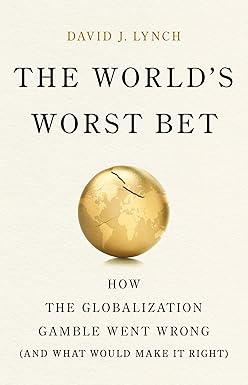
Globalization was a grand gamble. Author David J. Lynch traces how this gamble went wrong, but he does not simply conclude that “globalization has failed.” Instead, he emphasizes that globalization can only be sustained if fair distribution and institutional safeguards are in place.
“What we lost was not just jobs, but the belief in the future.”
The future promised by globalization has not entirely disappeared. Yet the path forward is not straightforward. Far-right populism or protectionism cannot serve as fundamental solutions, and in fact may amplify new conflicts. What is required are 'social safety nets, transparent institutions, and responsible international cooperation.'
The future world cannot be sustained by speed and efficiency alone. Only when responsibility, fairness, and democratic procedures accompany them can enduring prosperity be achieved. South Korea and all nations must find this balance, and that will define the true competitiveness of the post-globalization era of the 21st century.

.jpg)
.jpg)
.jpg)