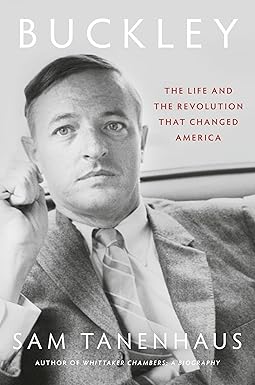
The Man Who Rewrote the Language of Conservatism- William F. Buckley and America’s Intellectual Revolution
The Birth of a Heretic ? From Elite to Anti-Elite
William Frank Buckley Jr. was born in 1925 in New York. The son of a wealthy oil entrepreneur, he grew up traveling between Europe and Latin America, developing a cosmopolitan sensibility. When he entered Yale University, he already possessed every mark of the elite, yet he became an intellectual rebel who cracked that very order from within.
His first book, 'God and Man at Yale' (1951), was a bombshell aimed directly at his alma mater. He accused Yale of “teaching freedom while spreading atheism.”
He wrote:
“The duel between Christianity and atheism is the most important in the world ... and the struggle between individualism and collectivism is the same struggle reproduced on another level.”
That single line captures the core of his intellectual world. Buckley fused faith and freedom to fight left-wing collectivism. Freedom, to him, was not an economic term but a moral responsibility grounded in faith, and faith was the pillar that sustained individual moral liberty. This vision later became the intellectual framework defining Cold War conservatism.
Tanenhaus describes Buckley at this stage as “the anti-elite born inside the elite world.” By mastering the language of intellect, he sought to redistribute knowledge itself. His conservatism was not the defense of ignorance but a revolution through reason.
The Revolutionary Who Commanded Page and Airwave
In 1955 Buckley founded the magazine 'National Review'. Its opening motto became the emblem of his movement:
“Stand athwart history, yelling Stop.”
He believed America was trapped in the ideology of “progress” and “historical acceleration.” His conservatism was not nostalgia for the past but a moral resistance to speed itself.
'National Review' was more than a magazine. Buckley united anti-communists, market libertarians, and religious traditionalists into a single conservative coalition. He declared, “Freedom in the market and freedom in the soul cannot be divorced,” developing a philosophy that joined economy and faith.
In 1966 he launched the TV talk show 'Firing Line', confronting left-wing intellectuals every week and bringing conservative thought onto the public stage. He once told an opponent,
“I won’t insult your intelligence by pretending you really believe what you just said,” a line that defined his debating style. He never shouted; instead he dismantled arguments with elegant vocabulary and razor logic. For him, politics was not violence but a war of language, and the real battlefield lay in culture’s depths.
His television presence marked both the 'popularization' and the 'intellectualization' of conservatism. To the public he offered polish; to the elite, legitimacy. By the late twentieth century, conservatism had evolved from the politics of anger into a movement fluent in the ''language of persuasion''.
The Three Pillars of His Creed - Anticommunism, Market, and Faith
Tanenhaus summarizes Buckley’s philosophy in three pillars: 'anticommunism', 'the free market', and 'Christian moral order'.
During the tense 1950s and ’60s, his anticommunism was both ideological conviction and civilizational thesis. He warned,
“Communism is not a political system but a system of the soul.”
For him, the loss of freedom was not an economic failure but a collapse of human dignity.
His faith in markets drew from the Austrian School?Hayek and Friedman?but he extended it into moral territory:
“The market is a moral arena; freedom cannot exist without responsibility.”
This claim pushed conservatism beyond economics, into culture and ethics.
Faith, the third pillar, was the heartbeat of his political language. For Buckley, Christianity was not a slogan but the transcendent framework that upheld liberty:
“Freedom without God is license; a nation without God is lost.”
Together these three fused into a distinctive system?'moral market economy', 'faith-based individualism', 'cultural anticommunism.' Buckley was the first conservative intellectual to recast politics from economics or ideology into 'questions of culture and language'.
Fracture and Reflection - Race, the CIA, and the Shadow of the Times
Buckley’s conservatism was far from flawless. Though he preached “rational conservatism,” it often intersected with the prejudices of his time, especially on race.
In the 1950s, when segregation still ruled the American South, 'National Review' editorials defended the “orderly maintenance of society.” He wrote,
“Civilization cannot be run at the pace of mass emotion.”
To many, it sounded like a defense of white order.
Later he publicly admitted his mistake:
“We defended freedom from the wrong side.”
He acknowledged the legitimacy of the civil-rights movement.
Tanenhaus notes, “His ideas did not change, but his conception of humanity did.” From his Yale years Buckley had connections with intelligence agencies, and during the Cold War he embraced the “intellectual front” of that conflict. He did not hide it, saying,
“Knowledge is a weapon; information is the shield of liberty.”
For him, conservatism was not just politics?it was a civilizational intelligence war.
These contradictions blurred his ideal of “pure conservatism,” yet Tanenhaus argues that they made him 'a conservative of moral agony.' Torn between the pragmatism of power and the idealism of conviction, Buckley’s tension itself became the essence of his thought.
The Reagan Era ? Political Fulfillment of Buckley’s Ideas
In the 1980s Ronald Reagan realized the political revolution Buckley had long imagined. Reagan translated Buckley’s moral and rhetorical framework into mass politics, proclaiming,
“Government is not the solution to our problem; government is the problem.”
It perfectly embodied Buckley’s philosophy.
Buckley praised him as “a conservative who speaks not from ideology but conviction,” yet warned,
“When we win, our greatest enemy will be ourselves.”
His prophecy proved true. By the 1990s conservatism had slid toward populism and religious fundamentalism, and the 'intellectual dignity' he prized began to fade. Tanenhaus called him “the man who foresaw the decline of conservatism after its renaissance.”
After Buckley ? The Shadow of the Trump Era
In the twenty-first century, Donald Trump gave the American right a completely different face. Buckley’s intellectual conservatism was replaced by politics of rage?something he had already sensed in his lifetime:
“Anger cannot be politics. Anger destroys civilization.”
He did not despise the public, but he warned that when emotion replaces reason, conservatism destroys itself. Tanenhaus writes, “Post-Trump conservatism stands opposite to Buckley’s vision.” Buckley had pursued dignified debate, linguistic order, and intellectual grace; today these have been replaced by outrage, demagoguery, and algorithm.
In his time, politics was fought with pen and debate; now it is fought with hashtags and YouTube. Buckley’s sentences sought persuasion through print, whereas today’s political language seeks clicks. His conservatism has become like classical music?forgotten, yet still the 'standard of lost dignity'.
Legacy and Contemporary Meaning, Re-examining the Ethics of Conservatism
Buckley’s greatest legacy was his belief that conservatism must never lose its dignity. He said,
“Knowledge divides men, but culture reconciles them.”
The statement still resonates today.
He did not cast conservatism merely as progress’s opposite. Rather, he defined it as “the self-defense of civilization,” while progress was “its experiment.”
“Without defense, civilization collapses; without experiment, it stagnates.”
That balance offers insight for modern societies, including Korea’s, where ideological polarization and verbal hostility erode the language of persuasion. Buckley’s life reminds us that conservatism is not merely the defense of order?it is the 'ethical responsibility of intellect.'
In his final interview, he said,
“Civilization is not maintained by belief. It is maintained by civility.”
That line summarizes his life most precisely.
Politics of Dignity Beyond Left and Right
This book is not merely a biography of one man but a study of the 'civilizational history of an idea.' Buckley turned conservatism from a political stance into a cultural form. He believed,
“Freedom endures when the intellectual and the citizen understand each other.”
His thought restores the virtue lost in today’s antagonistic politics. What, then, is conservatism? He answered,
“Conservatism does not reject change; it seeks to govern it with dignity.”
Though long gone, his language remains the conscience of American conservatism.
And the question he left still faces us today:
"Can we preserve a civilization that has lost its dignity?"

.jpg)
.jpg)
.jpg)