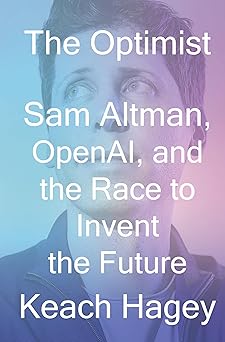
The Optimist: Sam Altman, OpenAI, and the Race to Invent the Future
Reading AI Power Through the Life of One Man
Since ChatGPT, artificial intelligence has moved beyond being a topic for tech news and become a force that changes the language of politics, the economy, and everyday life. At the center of that change, almost always, the same name appears: Sam Altman. The biography written by Wall Street Journal reporter Kitche Hedge follows this figure and becomes a long roadmap showing on what structures and emotions power in the age of AI actually moves.
As you turn the pages, what stands out more than the success story of a brilliant developer is “the process by which technology, capital, conviction, and anxiety all pass through one person’s body and congeal into decisions.” From there, it follows almost naturally that simply knowing the internal architecture of AI models is not enough to understand today’s AI civilization. Only when you read the human layer ? what kind of person, with what kind of sensibility and worldview, is operating these systems ? does the larger map begin to come into view.
From Anxious Boy to “The One Who Sets the Board”
The story does not begin in Silicon Valley, but in St. Louis in the American Midwest. A boy of few words, who preferred immersing himself in computers over socializing with those around him, first gets his hands on a Macintosh, “a tool to construct his own world.” The experience that the only place he can escape other people’s gaze and his own anxiety is the screen becomes the seed of a later feeling that “reality, too, can be engineered to some extent.”
Loopt, the first startup he launched after dropping out of Stanford, raised tens of millions of dollars in investment on the idea of a location-based social network, but ended not in a smash hit but in something closer to “an unremarkable failure.” Looking back on this period, he says, T“he way to get things done is to just be really fucking persistent.” A mindset that trusts persistence more than genius, an insight that the world responds more to endurance than to talent, takes shape here.
The sale of Loopt might look like a side road in one person’s career. But judging from the choices that follow, it becomes clear that this experience was the turning point that shifted him from being “the one who makes things himself” to “the one who sets the board.” He grows more interested not in writing code but in “weaving people, capital, and ideas together into a single ecosystem.”
The Sense of an Ecosystem That Y Combinator Taught Him
After joining Y Combinator, his role changes completely. He is no longer the founder applying for funds, but the one who evaluates and helps countless founders. He watches up close which teams grow, which ideas flash and then quickly disappear, and which people get back up even after they fail.
In the process, his attention shifts from any single company’s product to “the overall flow of the ecosystem.” He learns in his bones how investors and founders, regulators and the press, users and fandoms intertwine to create the “story” of an era. That experience later seeps directly into the way he handles artificial intelligence. Instead of moving only in response to the technology of AI models, he cultivates a view that tries to see, all at once, the movements of the people, nations, and companies surrounding that technology.
His thoughts on organizational culture also become clear during this time. He says, “If you’re the founder of the company ... most other people you hire ... have other lives.” This is an awareness that what is needed is not a startup hero myth, but a “system that can bear the rhythms of ordinary people.” He comes to feel that those who understand the gap between the speed of technology and the speed of human beings, and who can mediate that gap, are the ones who can keep the board in play for a long time.
OpenAI: An Experiment Where Public Interest, Capital, and Religious Imagination Mix
The next stage is the AI research organization OpenAI. At its starting point lies a short but powerful sentence: the promise to develop artificial intelligence for the benefit of all humanity. But high-performance AI models cannot be sustained by declarations alone. They require endless inputs of electricity, GPUs, data centers, and researcher salaries, and that money ultimately comes from capital and markets.
This is where a peculiar structure appears, stacking a for-profit company on top of a nonprofit foundation ? the so-called “capped-profit” model. The explanation follows that the structure opens returns to investors and employees, but designs things so that profits above a certain multiple flow back toward the public interest. On one side, people hail it as an “unprecedented experiment”; on the other, critics dismiss it as “Silicon Valley-style moral packaging.”
The excerpt published in Wired devotes many pages to explaining the mental background of this organizational experiment. Eliezer Yudkowsky’s doomsday thinking, Peter Thiel’s technological elitism, and ideas such as singularity and transhumanism all intertwine, unfolding a landscape in which artificial intelligence has become a kind of object of religious imagination. From there emerges a sentence along these lines: “If you want to save the world, you must first obtain the means to end it” ? a kind of paradox.
The ideal of helping humanity, the desire to seize dangerous tools first, and the politics of capital and power surrounding those tools all overlap in one place. As an organization, OpenAI becomes at once a research lab, a startup, and something akin to a religious movement.
The Five-Day Coup: What the Firing and Return Revealed
In November 2023, the OpenAI board pushed its CEO out of his role with a single short sentence: “He was not consistently candid.” The announcement landed with almost no public explanation of why, or in what context, such a conclusion had been reached.
Within days, the situation flipped. Hundreds of employees lined up to sign a letter saying, “If he does not return, we will leave with him,” and strategic partner Microsoft declared that it would bring over Sam Altman and his key staff wholesale. In that moment, the true center of power was exposed in raw form. On paper, ultimate decision-making authority rested with the nonprofit board, but in reality, power pooled where “control over talent, capital, and product” resided.
Five days later, the firing was reversed. Altman returned as CEO, and the directors who had tried to oust him stepped down. Outside observers even described the episode as “a moment when one man bent reality to his will.” But it is hard to accept this scene purely as a triumph.
In an organization handling an infrastructure technology like artificial intelligence, the nonprofit governance structure proved helpless in the face of an alliance of employees, investors, and big tech. In other words, the board that was supposed to guard the public interest possessed less bargaining power than the public interest itself demanded. The five-day coup is less an episode proving the strength of one individual than “an event that exposed the fragility of institutional design.”
The Language of an Optimist: Dreams, Simulation, and Receipts
On the book’s cover, the word “Optimist” is emblazoned in large letters. Here, optimism is not just a personality trait but a frame for looking at the world. A sense of the future is compressed into a single sentence.
“This is all a dream. And in the dream, anything is possible.”
A way of thinking that regards reality as a kind of simulation appears again and again. It is an attitude that perceives the world as modifiable code, as a system that can be redesigned. The idea that “if the reality we live in is a gigantic simulation, then it should be possible to alter that simulation’s rules bit by bit” undergirds his dogged investments in artificial intelligence, nuclear fusion, and longevity technologies.
But from the same mouth comes another line:
“You don’t get to be the Optimist forever. Sooner or later, the future asks for receipts.”
The point is that technologies and leadership that promise a better world must someday be judged by their actual outcomes. In the face of people pushed out of the labor market, citizens surveilled by data, and groups harmed by algorithmic bias, one cannot simply keep repeating, “It’ll all work out someday.”
In the end, the optimist becomes “the one against whom the receipts will eventually be claimed.” Stories about the future alone cannot sustain things; concrete mechanisms are needed to mitigate today’s inequalities and risks. This line reads as an assignment given to every tech leader living through the age of artificial intelligence.
The Reordering of Labor and Capital: Imagining the Post-AI Economy
In his mind, artificial intelligence is not just a tool but a kind of energy that will reorder the structure of the economy.
“Software that can think and learn will do more and more of the work that people now do.”
Layered on top of this forecast is another conviction: “Power will shift further from labor toward capital and technology.” As AI grows, tasks previously handled by human labor are replaced by code, and ownership of that code concentrates in the hands of a small number of companies and investors. That implies that the inequalities baked into existing capitalism may be sharpened into an even more extreme form.
This is why ideas such as basic income, data dividends, and collective ownership are brought up in all seriousness. If the wealth generated by AI cannot be redistributed across society, then the progress of technology itself may trigger political catastrophe. Yet the proposed solutions remain within the bounds of “more growth, faster innovation, more sophisticated policy.” Rather than altering the basic structure, the approach is to use policy to cushion the shocks caused by growth.
A question arises here: “Whom do we place in the position of designing redistribution?” Where, on the spectrum of democracy, does a structure belong in which AI company leaders and investors themselves create funds and design welfare programs? Can we really leave something as profound as resetting the balance between labor and capital to the self-regulation of technological elites? The biography offers no direct answer, but leaves a long aftertaste.
AI Utopia and Dystopia: An Alliance of Two Fears
Circling around the story at all times are two extremes. One is the utopian claim that “AI will save humanity”; the other is the dystopian fear that “AI will wipe humanity out.” The Wired excerpt traces the debates of the Singularity Institute, the Extropy movement, and early transhumanists, and in doing so outlines the intellectual lineage that shaped today’s DeepMind and OpenAI.
What is striking is that these two extremes, while denying one another, nonetheless reinforce the same basic structure. The persuasion that “a superintelligence will soon arrive and open up heaven,” and the warning that “a superintelligence will soon arrive and destroy us,” both lead to the conclusion that we must pour enormous resources into AI right now. The only difference is how they justify speed and scale; in both cases, “the core narrative is one that funnels privileged control over AI to a small group.”
Sam Altman’s position sits somewhere between these two poles. He does not deny the risks, yet he repeatedly sends the message that an elite group capable of managing those risks must not slow down but press ahead. In scenes where fear and longing for the future operate side by side, the optimist’s face becomes at once the symbol of hope and the face of concentrated power.
Implications for Korean Society: Who Should Govern Technological Power?
Though this long story revolves around a single American CEO and a particular organization, its questions cross borders. In Korea as well, the introduction of AI into administration, education, healthcare, and finance is being seriously discussed. Chatbots, automated screening systems, AI teachers, and medical image analysis services have already moved beyond pilot phases and into commercialization.
At such a moment, the easiest question to ask is, “When will we be able to have services like that too?” But the more important question lies elsewhere:
“What kind of structure should we place a technological system with that level of power under?”
In the case of OpenAI, the tensions between nonprofit and for-profit, public interest and capital, founders and the board, partner big tech firms and civil society all surfaced in stark relief. Korean public institutions and companies are likely to face similar crossroads. How will they choose partners to whom they entrust public data? To what extent will they retain sovereignty over AI infrastructure? What kinds of oversight mechanisms will they install when privately designed algorithms intervene in administration and welfare? Many of these questions have yet to be properly debated.
This biography, which follows Sam Altman’s actions in close detail, serves as a useful mirror for posing such questions. By tracking the choices of a specific individual, it lets us practice “imagining not the technology itself, but the systems and power structures surrounding the technology.” As AI systems learn our language, it becomes natural to realize that citizens, too, must learn the language of AI governance.
For Citizens Preparing for “A Future That Demands Receipts”
Optimism is the key word that runs through this story. If no one believed a better future were possible, no one would dive into AI research, startups, or policy experiments. At the same time, if we fail to see upon whom that optimism shifts the costs, the future will almost inevitably become less fair than the present.
The line “someday the future will ask for receipts” is not a warning aimed only at those who develop and sell AI. The same question turns back on users who happily consume convenience and efficiency without asking where the bill is being paid. It is a question about whose hands data is being concentrated in, whose interests algorithms reflect, and how the gains and losses of automation are divided up.
The narrative that unfolds around Sam Altman does not demand that we decide whether to like or dislike him. Instead, it assigns us a different task:
“How will we handle this colossal optimism?”
Will we trust it unconditionally, reject it outright, or lock it inside a cage of strong institutions, oversight, and civic participation?
Now that AI has become part of civilization’s infrastructure, this is no longer an issue pertaining to a particular CEO or company. It is a matter of civic literacy: the capacity of citizens to monitor technology and power. And in precisely that respect, this biography of Sam Altman, along with the quotations and narratives drawn from it, can be reborn as one long knowledge essay. For readers who want to imagine, in advance, the receipts that the optimist will someday have to submit, this story is well worth their time.

.jpg)
.jpg)
.jpg)