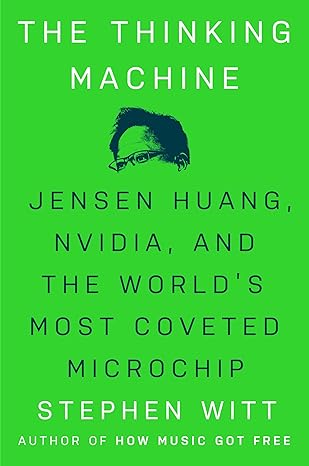
The Thinking Machine, Jensen Huang Nvidia and the Worlds Most Coveted Microchip
Reading a vast map of power through a single microchip
Nvidias chip began life as a component that simply made game graphics fast and smooth. Now this tiny piece of silicon functions much more like the beating heart of artificial intelligence and data centers. Massive language models image generation services autonomous driving systems and scientific simulations all run their vast calculations on the same kind of chip. Following the rise of Jensen Huang and Nvidia reveals how power in the age of AI moves along particular structures and emotions. It becomes less a simple success story of one man and more a long narrative about how technology capital states and markets converge on a single point.
"we are in the iPhone moment of AI."
This short line compresses the mood of the era. Just as the smartphone once rewrote almost every scene of daily life AI is now quietly redesigning civilization in deep layers of infrastructure that are hard to see. Looking at the world through the lens of this single microchip makes that transition feel concrete rather than abstract. One person and one company turn into a prism through which the transformation of an entire technological system becomes visible.
From game chip company to AI infrastructure giant
The starting point of this story is not a supercomputer but video games. In the early days Nvidia made graphics chips that drew the world inside the screen more vividly and dynamically. When its first commercial product clashed with what the market actually wanted and the company faced a crisis that could have closed its doors Jensen Huang and his colleagues went back to the drawing board. In the process of retracing what went wrong it became clear that people did not simply want flashy images they wanted low latency and natural motion at the same time. At that moment a habit took root inside the company scrutinizing where bottlenecks appeared and where parallel processing became crucial.
That initial failure did not remain a small mishap. Huang and his team decided that their strengths did not have to stay inside the narrow market of games. The ability to process countless calculations at once could be applied beyond graphics to scientific computing data analysis and eventually AI. Regardless of the markets fixation on short term numbers they placed a long bet on parallel processing as the axis of future computation. When the boom in generative AI finally arrived many companies and researchers were already experimenting on top of Nvidias chips and tools a sign that the earlier decision had reshaped the conditions of competition.
Cuda as a language and the image of a thinking machine
To understand Nvidias shift it is not enough to look only at the chip. The development environment called Cuda redefined what had been regarded as a purely graphics chip as a general purpose computing device. As researchers startups and major tech companies began to use this environment Nvidias chip turned from a mere component into a kind of language. Anyone who wanted to build a new AI model naturally found themselves thinking first of this language and these tools.
"accelerated computing is the path forward."
This line which Jensen Huang has repeated on many occasions symbolizes the strategic center of gravity. Instead of pushing the speed of a single central processing unit ever higher it asserts that the future of computation lies in moving countless small compute units simultaneously. Research and development investment product roadmaps and customer education are all pulled toward that principle. The outward forms of AI services differ wildly but inside them similar computation structures flow and the company that designed those structures in effect sets the basic rules of the AI era.
"the more you buy the more you save."
This phrase thrown out half jokingly condenses the economic logic of the data center age. The more a firm brings in chips and systems specialized for AI compute at scale the more its unit cost of computation falls and the harder it becomes for competitors to catch up. It can be read not as a throwaway joke but as a metaphor for a structure in which companies that already possess capital and infrastructure can surge further ahead. The seeds of inequality surrounding AI infrastructure are already contained inside this way of calculating.
An empire built from the anxiety and obsession of an immigrant youth
Jensen Huang often appears less as a cold calculating engineer and more as someone shaped by the long shadow of an anxious immigrant youth. Growing up in a foreign country life in boarding schools restaurant work and similar experiences left him with the sense that he could be pushed out at any time. When the company ran into crisis he tended to imagine the worst case scenario first watching competitors technological change and customer churn with an almost exaggerated vigilance. That near pessimistic imagination became a force that pushed the company to the next level rather than a handicap.
Inside Nvidia Huang is known as a leader who demands very high standards and a strong presence at the same time. In meetings his habit of digging into design details and numbers to the very end produces a mix of respect and fear. When results are good generosity and confidence wrap around the organization but when crisis approaches sharp pressure comes to the front. Behind the achievements of a giant company leading the AI era flows a very human rhythm fatigue bursts of anger and moments of genuine excitement and these emotional currents help explain the culture around the chip.
AI chips colliding with geopolitics
As the amount of computation required for AI models explodes high performance chips are no longer mere commercial products. States see these chips as strategic assets tied directly to military power intelligence and industrial competitiveness. Decisions over which country will be allowed to buy what performance level of chip and what level of compute should be permitted become questions of export controls security policy and alliance management.
In this setting Nvidia and Jensen Huang turn into actors who have to sit at the tables of policy and diplomacy. On one side pressure grows to restrict the AI capabilities of particular countries on the other side concerns are raised that excessive restrictions could actually accelerate technological self sufficiency. Between these poles stands the problem of how to protect national security without destroying the global supply chains and research networks on which AI progress depends. Company strategy and national strategy begin to overlap in uncomfortable ways and decisions about product lines and customer lists start to carry geopolitical weight.
The reshaping of energy infrastructure and labor markets
As Nvidias chips are laid out across data centers around the world the layout of power space and labor changes together with them. To train AI models and run them as services immense amounts of electricity cooling and specialized personnel are required. Decisions about which region will host data centers and which cities will receive more power have a direct impact on local economies and environmental policy. The products and designs of a single company become variables in urban planning and national energy strategies.
"software is eating the world but AI is going to eat software."
This line from Huang sounds like a declaration that foretells the present. The world is moving from an era in which software transformed industries and daily life to an era in which AI transforms the structure and work of software itself. As repetitive information processing and pattern recognition tasks are replaced by AI some jobs shrink and other kinds of work appear. Because many of the new roles demand higher levels of skill and education there is a risk that income gaps and education gaps will widen together. The success of AI infrastructure magnifies that tension and raises questions about who will bear the social cost of disruption. Discussions of responsibility can no longer be confined to regulators and parliaments when the architecture of compute itself exerts such pressure.
Questions in a Korean context
Seen from Korea the same story naturally takes on a concrete local form. It raises questions about what chips and what platforms public data centers universities research institutes and startups will rely on and what those choices will mean for technological sovereignty and industrial strategy in the long run. Even a country strong in manufacturing can find the real center of power drifting toward those who hold design and ecosystems if the standards of AI compute environments are set from outside.
There is also the issue of dependency when AI is introduced into public services. As data and algorithms become criteria that separate who receives what in administration welfare education and health care it becomes urgent to ask whose designs and whose interests are embedded in those criteria. Mechanisms that prevent excessive reliance on a single vendors hardware and software become part of a broader debate about digital rights and democratic control. Nvidia and Jensen Huang simply provide a vivid case through which these questions can be made specific.
Civic imagination in the age of the thinking machine
Viewed as a whole this trajectory rewires the way the age of AI can be understood. Even without perfectly grasping the technical terms of chip structures and fabrication processes it is possible to see how repeated decisions by one company and one person helped build the current order. In that process AI emerges not as a neutral tool of convenience but as a force that reshapes society politics ethics and education.
Praise or condemnation of any particular firm is not the main issue. What matters more is collective imagination about who will design own and control the thinking machines. Citizens in the age of AI may not be able to fabricate chips yet can still question the directions in which those chips are used the distribution of benefits and harms and the rules governing the underlying infrastructure. Following the arc of Jensen Huang and Nvidia makes it easier to hold technology and power in mind at the same time.
In that sense the story of a single microchip and a single founder becomes a lens on how a tiny piece of silicon has redrawn the great map of the world. The brief original sentences that surface along the way compress this enormous change into one or two lines and invite a second look at what it means to live and act in the age of AI.

.jpg)
.jpg)
.jpg)