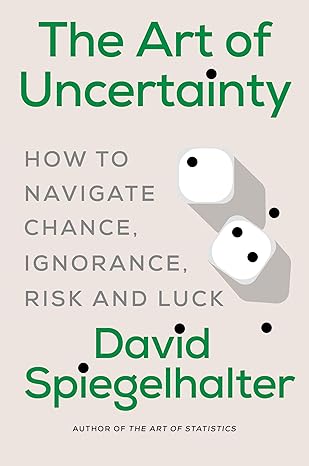
Reframing the World Through Numbers in an Age of Uncertainty- A way of thinking that navigates chance, risk, ignorance, and luck
A world overflowing with “confident” claims
Today’s world is strangely full of certainty. In forecasts about the economy and real estate, election outcomes, and the future of artificial intelligence, people who appear on screens often declare without hesitation, “This is how it will be.” Yet looking back at the past few years, our lives have been shaken again and again by events that no one predicted accurately: pandemics, wars, climate disasters, and financial instability. People increasingly want “definite answers,” but the world shows little intention of becoming that simple to satisfy this desire.
When we look more closely at reality, the world we live in resembles a vast field where chance, risk, ignorance, and luck are intertwined. There are things we cannot control at all, things whose rough range we can only estimate, and areas where we do not even know what we do not know. The problem of uncertainty ultimately leads to a question about how we can live slightly less deceived, slightly less fearful, and slightly less arrogant in such a world.
A life story woven from chains of chance
Before turning to statistical formulas, we can first think about the chain of events that runs through a single human life.
On 29 January 1918, a thirty-five-year-old man serving as a gas officer in the 104th Brigade in the Ypres sector of the Western Front went out, as usual, to inspect trenches and strongpoints. The path he had to take was already thoroughly targeted by German artillery. In his diary, entries like “barely escaped with my life on the way back” and “luckily got away just in time” are repeated. And on that very day, a shell finally landed nearby, and he wrote that he had been “caught up in the explosion.”
Fortunately, he survived, was classified as wounded, and was evacuated far from the front. The unit he had belonged to later moved to the Somme front, which had been regarded as “relatively quiet,” and then passed straight through the middle of the German offensive in the spring of 1918. If he had remained at the front, what would his later life have looked like? If the shell had fallen just slightly in a different direction, his descendants might not have existed at all.
We can then turn to the experiences of the parents’ generation. There is flight by sea, crises caused by plane crashes and illness during wartime, and a series of dangers that were narrowly avoided. The story eventually reaches one winter night in the 1950s, in a stone house so poorly heated that it barely kept out the cold, where the parents, going to bed early, “just like that” came to have a child. Tracing one family history in this way makes it clear that each person’s existence is the result of “countless small chances linked together.”
Such a chain of events can be called a “sequence of microscopic chances,” a series of “micro-chances.” Each event may appear trivial, but had it been slightly different, the present self and the present world might never have existed. When we try to understand this chain of chance, a question naturally follows: “What force, if any, lies beneath all of this?” Some people think of a directed force such as fate, providence, or karma, while others see it as the flow of disordered randomness. Interpretations differ, but it is difficult to deny that our lives as a whole rest fundamentally on uncertainty.
Uncertainty is not an exception but the default
An old line of text encapsulates this intuition: “The race is not to the swift, nor the battle to the strong… everything is subject to time and chance.”
This sentence is not merely rhetorical decoration; it comes close to describing the human condition. If we recall the lives of family members who were soldiers, migrants, or patients, the era when the average life expectancy before industrialization was little more than twenty years, and the constantly growing risks of climate change, war, and pandemics, stability and certainty may in fact have been short “interludes” rather than the norm.
Every generation has tended to call its own time “a particularly dangerous and uncertain age.” The 1950s, overshadowed by the fear of nuclear war; the 1930s, when the Great Depression and totalitarianism rose together; and today’s world, familiar with climate disasters, political polarization, and an economy of “hyper-uncertainty.” In any period we examine, people have always said, “This time, it really is different.” Even so, life has continued, and each generation has found its own ways to endure and domesticate uncertainty.
Translating uncertainty into numbers
Alongside these philosophical and historical reflections, there is the “world of numbers,” which also deserves attention. One important way to understand uncertainty is to translate it into numerical form.
In doing so, it first becomes apparent that “uncertainty is personal.” Faced with the same risk, different people feel it to different degrees, and the same probability is perceived very differently depending on one’s situation. From there, the discussion moves on to ways of expressing uncertainty numerically and to methods of “taming” chance with probability. It proceeds further into topics such as surprising coincidences, the role of luck, Bayesian inference, science and uncertainty, climate and disaster, and medicine and prediction.
Consider a representative example. News reports often state that “a certain drug reduces the risk of heart attack by 50 percent.” Taken at face value, this sounds as if the risk has been cut in half. Yet what it may actually mean is that “an event that used to occur in 4 out of 1,000 people now occurs in 2 out of 1,000.” Both descriptions refer to the same data, but the impression and emotion they evoke in listeners are completely different.
This kind of example shows how easily fear can be exaggerated when risk is described only as a relative proportion. Through simple arithmetic, tables, and expressions like “how many out of 1,000 people,” one can carefully examine how numbers collide with people’s emotions. Statistics, in this sense, is less an abstract mathematical theory than a “technique for reducing distortions that arise when describing an uncertain world in words.”
Risk as analysis, risk as feeling
An important distinction when understanding risk is between “risk as analysis” and “risk as feeling.” The former is the world expressed through concepts such as probability, expected value, and confidence intervals; the latter is the world governed by emotions like anxiety, fear, anger, and relief.
Take air travel as an example. Statistically, airplanes are a very safe means of transportation. Nevertheless, whenever a major accident is reported, people come to fear flying in an excessive way. Conversely, everyday driving or falls at home pose much greater risks, yet they are often dismissed as “just the way things are.” People’s fear responds more sensitively to “what the experience would be like if an event actually happened” than to “the probability that it will occur.”
For this reason, numbers alone are insufficient to deal with risk. It is necessary to understand how people feel about risk, which expressions generate exaggerated fear, and which visualizations enable more honest communication. Topics such as scoring rules, Bayesian inference, climate models, and pandemic predictions are ultimately linked to the question, “How should these numbers be explained to people?”
An attitude needed in the age of prediction
In politics, economics, and technology, prediction has already become a commodity. Reports are full of phrases like “highly likely” and “almost certain.” Yet it is not uncommon for different institutions to attach different probability ranges to the same verbal expression. For some, “likely” may mean 60?75 percent, while for others it may mean 66?90 percent.
What is needed here is not some grand solution. It is to use words more sparingly and to clarify the relationship between numbers and language. When expressions such as “very likely” are used, there should be a prior agreement about roughly what probability range they refer to. And when predictions go wrong, it is important to honestly record which assumptions were overestimated or underestimated.
This attitude is not demanded only of central banks, climate panels, or public health authorities. It is equally necessary for individuals making investment decisions, young people choosing career paths, and anyone who has to interpret the results of a health checkup. For a modern citizen, the most basic stance may be precisely that middle position which neither throws up their hands saying, “We know nothing,” nor exaggerates, “I know for sure.”
Scenes that overlap with Korean society
This way of looking at uncertainty naturally overlaps with many aspects of Korean society. Consider the ambiguous wording on health checkup reports, the sensational terms layered over real estate, stock, and cryptocurrency charts, the political battles over how to interpret poll numbers, and the conflicting claims about the risks of climate change, nuclear power, and various disasters.
In all of these scenes, what is ultimately needed is similar:
- A sense for seeing both how numbers are produced and what those numbers fail to say
- An eye for distinguishing striking “single cases” from overall “patterns”
- A civic attitude that demands explanations of uncertainty that do not try to hide it
Literacy about uncertainty is not merely a matter of mathematics grades; it is directly connected to these habits of thought. Before we seek “smarter predictions,” what is needed first is “more honest expression of uncertainty.” Only when we can clearly state how much is known and how much is unknown can a discussion about responsible choice truly begin.
Learning to breathe with uncertainty
Engaging deeply with uncertainty breaks the frame that treats statistics simply as one branch of mathematics. Statistics is a discipline connected to the way we face the future. Looking together at family histories and war, sports leagues, lotteries, climate models, medical data, and major disasters, we see that human beings live by simultaneously accepting both small coincidences and large risks.
The art of dealing with uncertainty is not a process of learning how never to be wrong. It is closer to confronting head-on the human task of making decisions without indefinitely postponing them, even while accepting that one can be wrong at any time.
In a world where chance and skill, effort and luck are all entangled, the important thing is not to find a “secret method” that erases uncertainty. It is to cultivate a sensitivity that allows us to be a little less deceived, a little less frightened, and a little less arrogant, by handling numbers and stories together.
In the end, the issue of uncertainty is less about “finding the right answer” and more about “what kind of questions we live with.” In an age where uncertainty has become everyday reality, the attitude of asking how to breathe together with uncertainty itself may be the most realistic survival strategy.
.jpg)
.jpg)
.jpg)