From a money-making machine to an institution that builds trust
A corporation’s purpose always begins as a declaration, but in reality it reveals itself in the way choices are made. The more an era seems to suggest that short-term numbers explain everything, the more invisible assets such as trust and responsibility determine a corporation’s survival. If you follow the conflicts surrounding the twenty-first-century corporation, one question ultimately remains. What does it exist for.
Why the corporation’s purpose must be asked again
If you say it belongs to shareholders, it sounds simple, and if you say it belongs to society, it sounds plausible. But the way corporations actually operate in the real world cannot be neatly settled by either of those sentences. A corporation looks like someone’s property, yet at the same time it moves like an institution entangled with countless interests.
The twenty-first-century corporation cannot be explained by factories and machines alone. Data and networks, brands and regulation, fandom and distrust, global supply chains and geopolitics are all tangled together in a single mass. That is why asking about corporate purpose is not an abstract debate in business theory, but connects directly to jobs, prices, service quality, and social trust.
What matters here is not rushing to an answer, but choosing the right question. If you start by arguing over whose property the corporation is, the debate hardens into the language of rights, and the explanation of what the corporation actually survives on gets pushed aside. The moment you ask about purpose, your gaze shifts from the sentence of ownership to the reality of operation.
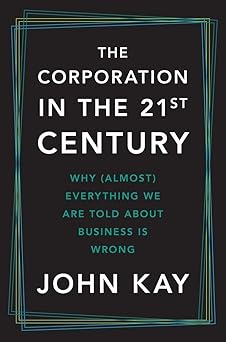
"It is neither necessary nor sufficient to determine whether shareholders are owners of the corporation(It is neither necessary nor sufficient to determine whether shareholders are owners of the corporation.)."
What this sentence implies is simple. Rather than clinging to how the word ownership should be defined, it proposes starting by looking at whose expectations and rules the corporation actually moves within. A corporation exists by passing through law and regulation, and grows by feeding on the trust of consumers, workers, and partners. Within that web of relationships, performance is created, and around that performance the language of responsibility emerges.
Now the question changes like this. What is the engine that drives a corporation, and how does the corporation shake when that engine breaks. In the next scene, the lure of short-term numbers appears naturally.
The losses created by the simplicity of shareholder value
If you set a single goal, performance can also be organized into a single number. If the number is clear, accountability also looks clear. Managing an organization by short-term performance makes it faster, makes comparisons easier, and matches the language of external investors. The reason this lure is so strong is not simply greed, but that a simple goal lets you forget the complexity of reality for a moment.
The problem is that this simplicity often misses the corporation’s real competitiveness. A corporation’s strengths do not suddenly rise from a single line on the income statement. Skilled people, long-accumulated trading practices, habits of protecting quality, a culture that corrects mistakes quickly, these are built through slow accumulation. They are things that appear late in the numbers, and things that appear late also tend to collapse late.
The moment goals are fixed on short-term numbers, a choice that looks like growth can turn into a choice that eats away at assets. If you cut research and development, profits improve immediately. If you reduce headcount too aggressively or squeeze people too hard, short-term productivity goes up. But what remains the following year may be fatigue, turnover, and technical debt. What the organization loses is not a cost item, but the speed of accumulation that is hard to rebuild.
That is why purpose is not a simple ethical sentence. There are organizations that become faster the more they are pushed by numbers, but fast organizations are not always durable ones. The more management by short-term numbers is repeated, the more easily a corporation forgets what it endures on. The place where that forgetting shows up first is reputation and trust.
How trust and reputation collapse
When reputation shakes, it does not mean that the corporation’s technology or capital suddenly disappears. It is closer to meaning that the lens through which society views the corporation has changed. The ability to earn profit alone no longer brings respect, and the attitude shown when wrongdoing occurs, and the language and actions shown in crisis, directly affect the corporation’s survival.
"Business reputation has suffered many blows in the last two decades(Business reputation has suffered many blows in the last two decades.)."
Changes in reputation often begin with a single incident, but in reality they grow through the accumulation of repeated experiences. When customers feel promises are not kept, when workers feel they are not respected, when partners feel things are not fair, small cracks are shared quickly. Online, those cracks spread faster and remain longer.
Here, reputation becomes not an issue of emotion but an issue of cost structure. When trust disappears, transaction costs rise, and surveillance, rules, and contracts thicken. Internal control costs also increase. In the end, the corporation has to spend more effort to do the same work, and that effort cannot be used for innovation.
If you see trust as a device, a corporation is less a bundle of contracts than a system that produces trust. The trading relationship that holds on by considering each other’s situation when delivery schedules go wrong, the attitude that responds at the level of promise rather than the minimum legal responsibility when a quality problem occurs, the culture in which correction comes before concealment when something explodes internally, these save a corporation. Trust is always the result of choices, and choices always carry the shadow of purpose.
Then the next question arises. In an era where trust is shaken, what has the way corporations make money changed into. Here, the word profit stops being simple.
From profit to rent, looking again at the rules of competition
The statement that corporations make money always seems the same, but the way money is made has changed a lot. There were eras when corporations with lots of factory equipment were strong, and eras when organizational coordination, brands, and networks were central. The closer you get to the twenty-first century, the more the source of value has moved toward what is less visible to the eye.
"what we call ‘profit’ is no longer primarily a return on capital but is ‘economic rent’(what we call ‘profit’ is no longer primarily a return on capital but is ‘economic rent’)."
The concept of economic rent is often consumed only with a negative image, but it does not always mean exploitation. If you create a combination that others cannot easily imitate, and with that combination you provide what customers want better, profit arises from that difference. If a brand builds trust and escapes price competition, or if you build a structure where service improves as the network grows, that structure creates rent.
The problem is when it is not distinguished where the rent came from. Rent that comes from innovation and quality, and rent that comes from regulatory gaps, lobbying, and monopoly position can appear with the same face. Consumers find it difficult to distinguish, and politics also finds it difficult to decide quickly. So the debate over corporate purpose soon moves to the question of how the rules of competition should be designed.
"Economic rent is not an anomaly but a central and valuable feature of a vibrant economy(Economic rent is not an anomaly but a central and valuable feature of a vibrant economy.)."
The reason this matters is that it shifts the debate about corporate purpose from a moral debate to a structural debate. It naturally leads to a direction of encouraging rent that comes from innovation, while reducing rent that comes from political privilege. Purpose is translated not into slogans but into institutional design. And that translation ultimately leads to what kinds of choices will be demanded of corporations.
Purpose is not a declaration but the cost of choices
Many organizations speak of mission and vision. But for purpose to have real force, it must be a criterion for choices rather than a poster. A criterion for deciding what to give up and what to protect when difficult decisions must be made, a criterion for choosing a direction between sacrificing people for profit and slowing profit to protect people is needed.
Purpose is usually similar in words, but shows itself differently in the way costs are borne. There is the cost of giving up short-term profit, the cost of keeping inconvenient regulations, the cost of slowing down for transparency. Having a purpose is close to a discipline of not automatically choosing the easiest path. And that discipline builds organizational culture, and culture in turn builds long-term competitiveness.
At this point, purpose is often distorted. The language of purpose can look like care to customers, but inside it is sometimes translated only into numerical targets. When sincerity in service is broken down into target management, the field quickly learns distrust. People try to read motives in professions and services, and the moment they feel motives have changed, trust quickly declines.
"You can see the ‘visible hand’ cuddling the pet, in the meantime, the ‘invisible hand’ is rifling the pockets of the pet owner(You can see the ‘visible hand’ cuddling the pet, in the meantime, the ‘invisible hand’ is rifling the pockets of the pet owner.)."
Where this metaphor stings is clear. When a friendly face and the actual incentives are misaligned, purpose collapses into a marketing sentence. When a sales target and a treatment target are placed in the same sentence, customers feel the motive has changed. At that point, purpose becomes not simply an ethical issue but an issue of an operating method that can sustain trust. That operating method ultimately leads to institutions and regulation.
Corporations and institutions, and the landscape of Korea
Corporations compete in markets, but at the same time they live within institutions. Labor, environment, personal information, fair trade, and international trade norms are not outside corporate activity but internal conditions. The larger the scale, the more corporations begin to look like public infrastructure. When platforms stop, daily life stops, and when financial institutions wobble, society wobbles. Corporate purpose can no longer remain only an internal slogan of the corporation.
"institutions might be the product of human action, but not of human design(institutions might be the product of human action, but not of human design.)."
This sentence explains why the institutions surrounding corporations often produce results different from intentions, and why they are not easily fixed. Regulation does not exist only as a device to suppress markets. Some regulation creates trust and lowers transaction costs. Some regulation instead blocks innovation and solidifies privilege. So when speaking about corporate purpose, you also come to see the design of institutions that enable or distort that purpose together.
In Korea, corporate purpose provokes particularly sensitive reactions. That is because scenes repeat in which large corporations are the core driving force of the economy while at the same time being consumed as symbols of inequality and privilege. The statement that corporations create jobs and the statement that corporations monopolize opportunities collide on the same screen. So the purpose debate shifts from a moral issue to a design issue. Questions such as whether governance creates trust, whether internal control reduces risk, and how short-term performance pressure distorts the field become central.
Finally, what remains is again the first question, but the weight of the question changes. The question of what a corporation exists for becomes not a sentence demanding goodwill, but a demand to build a structure that can sustain trust. A corporation cannot exist alone. The trust of society, the permission of institutions, people’s cooperation, the stability of supply chains, and the patience of consumers must all be there for a corporation to remain a corporation.
Purpose is not a grand slogan, but the act of rebuilding daily choices in order not to forget that obvious fact. When those choices accumulate, a corporation becomes not merely a money-making machine, but a part of the way society sustains itself.

.jpg)
.jpg)
.jpg)