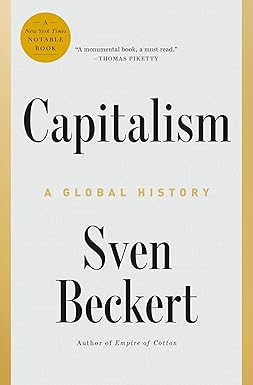
When Capital Binds the World, Violence Becomes an Institution- Capitalism is not a market but an engine of accumulation, and that engine has run globally from the beginning
Capitalism is so familiar that it looks like nature
Capitalism is so familiar that it looks like nature. Buying cheap and selling dear, the habit of reinvesting profits to generate even greater profits, and the sensibility of treating growth as an unquestioned goal can feel like part of human nature itself. But if the impression of “naturalness” is itself a historically produced outcome, the story changes.
The reason today’s routines feel self-evident is not because they are old, but because they have seeped in so deeply. Once a system starts rolling, it does not stop at moving the economy; it rearranges society’s rules, morals, and common sense. That is why asking what capitalism is ultimately overlaps with asking what governs our lives.
The more important shift is in people’s sensibilities. What counts as valuable, what counts as success, and what counts as safety may be spoken with the same words, yet rebuilt into different meanings. In this sense, capitalism is not merely a system of production and consumption; it is a device that reshapes the very way people imagine the future.
Accumulation, in one sentence, pushes everything forward
If you view capitalism only through the lens of exchange or consumption, your explanation for why the world has become so harsh will be incomplete. The core is accumulation. What matters more is not earning money, but fixing a structure in which money produces money.
As accumulation intensifies, society places future expansion above present satisfaction. In this process, individual choices may appear free, yet in reality they are pushed in the direction demanded by accumulation. Labor is broken down into costs, time is converted into productivity, and failure is easily sorted as personal incompetence.
When the language of accumulation begins to replace the language of morality, society worships achievement while breeding anxiety. The more prosperity grows, the stronger the pressure to possess more becomes, and that pressure seeps into everyday life through institutions and practices. In the end, accumulation operates not as one part of the economy but as a sentence that moves the whole of society.
A global system expanded through coercion as much as through connection
If you describe capitalism only as a glamorous story of international trade, crucial scenes disappear. It is true that the world became connected, but that connection was not always the result of fair exchange. When sea lanes and markets opened, armies, colonial administrations, and forced labor often moved with them.
Some regions were fixed as production sites, some people were classified as labor power, and some lives were treated as costs. In this process, violence became not a temporary incident but a method of sustaining order. Guns and law were not exceptions that disrupted markets; they also became conditions under which markets expanded.
Global accumulation created channels that converted distant suffering into nearby profit. And once such channels are built, they do not disappear easily even as generations change. The reason today’s inequality is not unrelated to past tragedies is that the shapes left by these channels have hardened into institutions and customs.
The state is not a backdrop but an engine, and law is not morality but a device
It sounds plausible to say that markets become healthier the more the state withdraws, but this often misreads the history of accumulation. For accumulation to continue stably, power is needed to guarantee ownership, enforce contracts, and resolve disputes. In many cases, that power operated in the form of the state.
Managing borders, protecting sea routes, making currency trustworthy, collecting taxes, and issuing debt all increased the speed of accumulation. Law can be a language for realizing justice, but it is also a technique for fixing ownership and allocating labor. The moments when certain property becomes sacred and certain livelihoods become precarious were often determined by the design of laws and institutions.
So to understand capitalism, you must look not only at firms and markets but also at what the state protected and what it neglected. When the state’s choices change, the pathways of accumulation change, and those pathway shifts shake the shape of people’s lives and cities. Capitalism is not an economy separated from politics; it is a sum of structures in which politics pushes the economy in particular directions.
Everywhere there was accumulation, and everywhere resistance accompanied it
If you think the machine of accumulation moved in only one direction, you miss the complexity of reality. Wherever the system expanded, backlash and adjustment unfolded at the same time. Workers fought over wages and hours, farmers endured struggles over land and taxes, and cities attempted balance through regulation and welfare.
Resistance was not merely moral outrage; it was a social force that moderated the speed of accumulation. In some countries, unions and welfare restrained overheating and created stability; in others, repression accumulated anxiety. Capitalism survived not by eliminating resistance entirely, but by partially absorbing it and rearranging itself, changing shape in the process.
That is why the history of capitalism is not only a history of a triumphant system, but also a history of collision and negotiation. This perspective makes you look again at today’s choices. If today’s rules are not nature but negotiated outcomes, then room for renegotiation still remains.
Today’s capitalism runs on platforms, but its core remains the same
Today’s accumulation moves faster not only through factory smokestacks but through data and networks. Platforms build machines that gather people’s time, gather attention, and gather relationships, converting them into profit. Finance looks like numbers, but in reality it operates as power that decides the direction of wealth.
Intellectual property can narrow the door of competition in the name of protecting innovation, and it can also become a weapon in technological conflict between states. Even if the surface changes, the core remains the same. It is not the way value is created and shared, but the way accumulation keeps expanding that sits at the center of society.
As a result, phenomena such as inequality, precarious work, and housing crises repeatedly surface. If you call these merely side effects, the root of the problem is obscured. If accumulation is a structure that pushes certain costs outward, those costs will eventually return to society as a whole.
The question now shifts from what it is to for whom, and how, it should be made to run
If you accept capitalism as nature, people find it easy to resign themselves or to worship it. But in the history of accumulation, there were always rules, and those rules were someone’s choices. Questions such as who can own, what can be privatized, what kinds of labor are legitimate, and what risks society should bear together have changed the direction of accumulation.
So what matters is not slogans like “let’s return to the market,” but how to redesign the devices of accumulation. Predictable laws and fair competitive conditions are often not enough. When inequality grows, trust collapses; when trust collapses, innovation, investment, and long-term experimentation decline.
That is why, alongside the language of growth, the language of distribution, safety nets, and public infrastructure becomes important again. To sustain the prosperity capitalism has produced, we must manage the fear and distrust that accumulation generates, and that management ultimately returns to politics and institutions. Rather than praising or cursing the system, the next chapter of economic history begins with asking which rules we will choose.

.jpg)
.jpg)
.jpg)