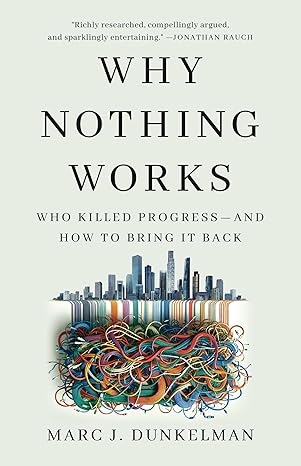
A Country That Can’t Build Anything, an Age When the Veto Becomes Power- What blocks execution is not incompetence but a design in which “stopping” is the default
A Memory of Being Able to Build
America is remembered as a country that once did big things. Dams and highways, public housing and schools, airports and ports?these were treated as if they were things that “get made once a decision is made.” Technology was ahead, and money was plentiful, but even more important was the rhythm of execution. There was a time when the public sector set the direction, the private sector followed, and rules functioned as devices that helped produce results.
But today’s landscape feels unfamiliar. Faced with tasks everyone agrees are necessary?like the housing shortage, the climate crisis, and aging infrastructure?society often comes to a halt. There are endless words about what must be done, yet too few tangible results. Policy debates therefore increasingly shift from “what should we do” to a blame game over “why didn’t it happen.” At that point, incompetence becomes not a matter of character but a matter of structure.
The Proliferation of Veto Power
Today’s core issue is “the way veto power becomes power.” There are too many gates one must pass through before a decision can be carried out, and at each gate stands an actor who can say, “No.” Approval procedures pile up in layers; exceptions and interpretive wiggle room expand; lawsuits and lobbying slip into the spaces between. In the end, pushing forward is always provisional, while opposition becomes almost definitive.
On the surface, this structure looks safe and democratic. After all, brakes have been strengthened to avoid infringing on someone’s rights, to prevent environmental damage, and to keep public power from running amok. The problem arises when the brakes also bind the accelerator. If devices meant to reduce risk end up making experimentation impossible, society hardens into a state of “doing nothing in exchange for making no mistakes.” When execution disappears, trust collapses?not toward policy but toward process.
From the Politics of Intent to the Politics of Structure
The crucial change is not that “there are more bad people,” but that “it has become hard for results to emerge.” No matter who governs or what slogans are raised, if the channel that turns decisions into execution is clogged, outcomes will look similar. Society then tries to audit willpower and morality, and the emotion of mutual suspicion comes to dominate politics. As failures repeat, the other camp is suspected not of “incompetence” but of “malice.”
In such a moment, the “quality of politics” reveals itself not in the beauty of its message but in the solidity of its structure. When responsibility is dispersed, no one takes responsibility. When authority is fragmented, no one can decide. The more the right to oppose expands, the blurrier the responsibility for design becomes. Inside this contradiction, citizens demand even more procedure, but as procedures multiply, results arrive even later. Delayed results then breed more distrust, and distrust in turn produces more control mechanisms. A vicious cycle becomes an institution.
A Compressed Picture of the Housing Crisis
Housing shows this problem in the most intuitive way. Even if people agree that supply must increase, local opposition, stacked permitting requirements, and the risk of lawsuits make decisions “nearly impossible.” Homes do not get built, prices rise, and younger generations are pushed out of cities where jobs are. As a result, the promise that “if you work hard, life improves” begins to crack.
Here the key is not morality but the rules of the game. The “current residents” of a neighborhood can profit from stopping things, while “future residents” are treated as stakeholders who do not yet exist. Opposition gets organized; support remains scattered. Time sides with opponents, and costs fall on those trying to build. The housing crisis appears not merely as a market problem but as the product of political design?of “who has what rights, and when.”
Bottlenecks in the Energy Transition
Responding to the climate crisis is “work that must be built” on an even larger scale. Expanding renewable energy requires connecting power grids and transmission lines, and designing storage, distribution, and stability at the same time. Yet what is needed is not just good technology, but the capacity of the public sector to decide quickly and push forward consistently. When bottlenecks arise, the transition is delayed; delays raise costs; costs then provoke more opposition.
This is also why climate policy often slips into a politics of words. Declarations are easy, but laying tracks, burying cables, and installing facilities inevitably spark conflict. Infrastructure needed for the environment gets stuck in the swamp of environmental review, and projects for the public good turn into battlefields of private interest. Meanwhile citizens ask, “Why does this take so long?” and the answer comes back: “Because we’re following procedure.” The moment procedure becomes the goal, the energy transition becomes not a plan but a list of delays.
When Procedural Justice Becomes a Tactic
Procedure is, in the first place, a device to protect the vulnerable and constrain power. But when there are too many procedures, procedure itself turns into a tactic. People use procedure to stop what their opponents want to do, and instead of rational debate, the “techniques of delay” become competitive advantages. Society then enters a strange ethical reversal. The person who stops something bears no responsibility, while the person who tries to build bears responsibility for every consequence.
If this structure hardens, the public’s options shrink to two. One is to do nothing. The other is to long for “a strong hand that can ignore procedure.” A system without execution can end up dreaming of a rougher fixer. When slow, frustrating democracy exhausts people, they are tempted less to strengthen democracy than to choose a way that “ends it in one blow.” The absence of execution becomes the fuel of populism.
A Design for Restoring State Capacity
The way back is not simple deregulation. Safety, environmental protection, and the protection of rights are necessary. But rules must be designed so that protective devices do not turn into infinite stop buttons: the authority to approve must be organized, overlaps reduced, and the subject of responsibility made clear. If a decision has been made, it must be executable under defined conditions; if there is opposition, the grounds and costs of that opposition must also be made transparent.
The key is to rebalance power. This is not an argument for concentrating dispersed authority in one place, but for clarifying “who decides what, and who is responsible for what.” When responsibility becomes clear, debate also becomes clear. Trust comes not from “a government that speaks well,” but from “a government that keeps its promises.” When concrete results accumulate?homes are built, grids are connected, transportation improves?citizens begin to trust the public sector again.
Rebuilding Trust, the Language of Results
Trust in government is not restored by speeches. Results are needed. And results require structure. The question “Why does nothing work?” easily turns into the emotion of “Who killed it?” but a more productive question is to shift toward “What structure made stopping the default?”
Politics now is closer to a problem of operations than of declarations. Without a design that makes execution possible, any ideal ends as a slogan. But if the channels of execution are restored, society remembers again that it can “make things happen.” And the moment that memory returns, the age when distrust becomes an institution begins to end as well.

.jpg)
.jpg)
.jpg)