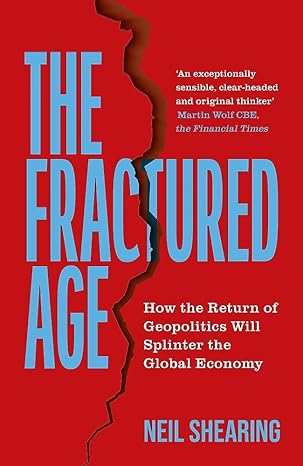
The Fractured Age and the Fractured Global Economy- Uncertainty Now Comes Not from Interest Rates, but from the Map
Once, the default setting of the global economy was connection. There was a strong belief that the cheaper you made things and the farther you sold them, the more everyone benefited, and supply chains stretched long in pursuit of efficiency. Geopolitics lay low like background music, and even if companies occasionally turned up the volume, they ultimately made decisions by calculating cost and speed. In the era when the common sense that connection equals growth was in effect, even when risks erupted, the world generally had an elasticity that pulled it back toward its original flow.
But the default setting today is not connection, but division. Efficiency becomes risk, optimization becomes vulnerability, and trade is translated into the language of security. In the past, when conflicts emerged, a reduction in trade followed as a result, but now the act of reducing trade itself becomes a means of conflict. When volatility hardens not into an event but into a structure, the central question of the economy changes as well. It becomes not how cheaply things can be made, but how long one can endure.
The Mechanism of Division
Division begins not in emotion but in institutions. Tariffs are not merely measures that raise prices; they become signals that reclassify trading counterparts. Export controls block the flow of certain technologies while functioning as instruments that force a choice about which side’s ecosystem one will belong to. Sanctions look like punishment, but in practice they are closer to a task of reconfiguring entire networks by adjusting the gateways of connection?finance, insurance, and transport.
The real change here is that the language of policy shifts. When the language of growth and prices moves to the language of security and resilience, the criteria for profit-and-loss calculation shift with it. The justification for sourcing from places that can be trusted even if unit costs are a bit higher grows stronger, and designs that build in slack rather than pure optimization spread. In this way, globalization does not end, but becomes a market divided into multiple regions rather than a single unified market. The direction of connections changes, and the conditions of connection become more demanding.
The reality companies face is sharper. Moving production sites does not end the problem. Costs related to labor and quality, certifications and regulatory compliance, labor and taxes, data transfer and security all follow at once. If you change suppliers, you incur the time needed to test a new supply chain and the costs of failure, and in the meantime delivery delays shake revenue. In the end, the cost larger than the cost recorded on the books is uncertainty itself. The possibility that rules could change one day delays investment decisions, and delayed investment slows the pace of technology and productivity.
Not a Fight of Friends and Enemies, but a Fight of Rules and Exceptions
If division is read only as bloc confrontation, it is easy to miss the core. The more fundamental battlefield is the battlefield of rules and exceptions. Technologies permitted in one country are prohibited in another, and even the same item faces different levels of control depending on its use. Some firms obtain exceptions while others are blocked, and private transactions halt when they run into government permits and reviews. The higher the regulatory threshold rises, the main stage of competition moves from price to approval.
This structure eats away at market transparency. Firms pour more capacity into regulatory 대응 than into production innovation, and legal, compliance, and lobbying rise to the center of strategy. When the rules of competition change, the face of the winner changes as well. Firms that read rules well gain an advantage over firms that manufacture well, and firms that design well to avoid sanctions gain an advantage over firms that are ahead in technology. And in that process, the speed of the market slows. Slower speed is cost, and cost again triggers political backlash. Division is not only an economic problem; it is intertwined with political cycles as well.
Another division appears in the technology ecosystem. Core technologies such as semiconductors and AI become not mere industrial inputs but compressed representations of national capability. When controls intensify here, firms must decide to split their technology stacks by region. The era when a single product ran identically across the world ends, and regulation-tailored variant products increase. As economies of scale weaken, unit costs rise, and as unit costs rise, inflationary pressure grows again. Geopolitics ultimately translates into everyday prices.
Division also proceeds in finance. Areas such as payments and dollar liquidity, sanctions risk, and supply-chain insurance and the reinsurance of transport do not show clearly on the surface, but once a crack appears, they can stop an entire transaction. So firms design not only the issue of moving factories, but also payment routes and currency risk, and their counterparties’ sanctions exposure. From this point on, the global economy is not a single ship sailing one sea, but a flotilla that must calculate multiple routes at once. As routes increase, safety may increase, but speed falls.
New Opportunities Born of Division
Then does this trend leave only tragedy. Not necessarily. Division is a cost, but it is also a reconfiguration. The moment production that was overly concentrated in one country disperses, space opens for intermediate hubs to enter. Regions that only assembled can climb into components and materials, and countries treated as peripheries can establish themselves as core suppliers for particular regions. Change is painful, but it shakes the positions that the existing order had fixed in place.
However, opportunity does not arrive automatically. Without industrial policy, opportunity passes by like a financial product, briefly flashing and then gone. Without manpower and infrastructure, production does not move in, and only parts of the process remain. What the age of division demands is not cheap labor, but stable institutions and fast permitting, skilled technical workers, and the trust that contracts will be upheld even as conflicts grow. When this trust accumulates, supply chains do not merely move; they take root. Rooted supply chains bring investment and jobs again.
So the pleasure of reading this trend is closer to a map than a prophecy. It places on one screen where connections will be cut and where they will be joined, which technologies will be blocked and which will create detours, which countries will speak of manufacturing’s return only as rhetoric and which will actually do it, and how the results of those choices will register in long-run growth rates. The value of this map does not increase the more it predicts correctly; it increases the more it enables preparation. Preparation ultimately means diversifying supply chains, defining core items, quantifying risk, and establishing in advance the routes to return to in a crisis.
Lasting Impressions and Reservations
The greatest strength is that it binds into a single lens the volatility that traditional business-cycle explanations cannot capture. It provides a sense of what is structurally moving behind the swings of inflation, interest rates, and growth, and it makes one see not a mere list of individual events but the very board on which the game is shifting. As a result, real-world news does not accumulate only as fragments, but connects into a flow moving in one direction.
But if division is drawn too deterministically, there is a risk that every policy failure will be reduced to geopolitics. In reality, endogenous variables such as domestic politics within countries, regulatory inefficiency, and the slowdown of education and research also operate together. It becomes important to emphasize the structure of division while keeping balance so that the structure does not become a master key that opens everything.
Even so, one remaining sentence becomes clear. Uncertainty no longer comes only from interest rates. It comes from the map. And in an age when the map is shaking, the most expensive cost is not the biggest mistake, but the longest delay.

.jpg)
.jpg)
.jpg)