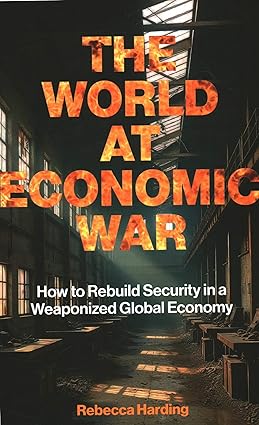
The Economy Has Already Become an Arsenal
There was a time when the economy seemed to be categorized as trade, and war as the military. But in today’s world, that boundary is collapsing quickly. Tariffs become not a bargaining chip but a device of pressure, and sanctions become not exceptional events but recurring policy. Export controls and investment restrictions stop the flow of technology and capital, and payment networks, insurance, and shipping become the stage of conflict. The economy is no longer outside war; it becomes the front line where war begins first. Companies can no longer move by looking only at prices and demand, and states can no longer guarantee safety with military power alone. The moment economic instruments become tools of war, victory is decided not by gunfire but by rules and routes.
The institutionalization of quiet war
The reason economic war is frightening is not because it is quiet, but because it becomes institutionalized. Rules created once remain for a long time, exceptions open only through political deals, and companies rewrite their supply chains and investment plans on the premise of those rules. Even if a war ends, a sanctions regime can remain, and a regime that remains becomes the default setting for the next conflict. When the default changes, common sense in the economy changes as well. Transactions become not exchanges that benefit both sides, but pressure that reduces the other side’s choices. The movement of technology and capital becomes not the result of efficiency, but the result of permission. The market seems to move freely, but in reality invisible walls increase. As walls increase, companies create more detours, and as detours increase, costs become not an exception but the default.
Institutionalization is stronger than an outburst of emotion. Emotions can subside, but rules remain. Companies cannot wait for a dispute to end; they change their structures on the assumption that the rules will persist. The structures changed in this way create interests again, and interests make the rules live longer. That is why economic war hardens in a self-reinforcing way. In a world of sanctions and controls, what matters is not “When will this conflict end,” but “How likely is it that this rule will still remain next year.” Companies and states come to make decisions not against events, but against a constitution.
The changing character of uncertainty
Market uncertainty leaves room to be managed with statistics and hedging. Interest rates and exchange rates fluctuate, but there is a range of predictability and many tools for risk management. Rule uncertainty is different. Tomorrow, a certain component can suddenly become a controlled item, a counterparty can be placed on a sanctions list, and a payment route can be blocked. This possibility itself delays investment. Delayed investment slows the pace of productivity, and the slowdown in productivity increases economic dissatisfaction again. As dissatisfaction grows, politics demands stronger control, and as control strengthens, rule uncertainty grows larger. A crisis damages the economy not through a single explosion, but through the accumulation of delays.
One more thing is added to this. Rule uncertainty operates unequally. Large companies can build detours by equipping legal and compliance functions, but small and medium-sized enterprises lack the capacity to respond to rule changes. As a result, markets become more concentrated, and concentrated markets become more politicized. Politicized markets produce rule changes more frequently again. Economic war does not merely block transactions; it changes the form of competition and restructures industrial structure as well. At this point, competitiveness is not determined by technology alone. The ability to interpret rules, the speed at which an organization responds to rule changes, and the accounting method that turns risk into cost become the conditions for a company’s survival.
The militarization of supply chains
Supply chains are no longer circuits for minimizing costs. Key items become strategic assets, and dependence on certain countries is classified as a national security risk. So companies calculate not only the issue of moving production sites, but also certification and regulatory compliance, data and security, and sanctions exposure. Supply-chain restructuring becomes not the act of moving an assembly line, but the act of moving the entire structure, including contracts, legal work, and finance. Even when making the same product, “where to make it” shifts from a matter of cost to a matter of exposure. Exposure includes not only tariff rates, but complex risks such as the possibility of being designated a controlled item, linkage to sanctions lists, financial payment blockages, and exclusion from shipping insurance.
Here, the slower the speed of restructuring, the larger the costs grow. The cost larger than building a new factory is the period during which supply instability continues. Companies increase inventories, arrange redundant supply lines, and build emergency procurement networks. The cost paid for resilience hardens into the default cost of peacetime. The militarization of supply chains also changes technology choices. If a certain component becomes subject to controls, finding an alternative technology becomes innovation, but that innovation may aim not at optimal performance but at control avoidance. If standards split, the same product must be made in multiple versions, and that duplication raises costs. If costs rise, consumer prices wobble, and when prices wobble, politics wobbles. Supply chains are no longer an internal corporate issue; they are directly linked to national stability.
The power of financial networks and payments
At the core of economic war lies an invisible infrastructure. Areas such as payment networks and dollar liquidity, credit ratings and insurance, reinsurance and shipping contracts are not easily seen in ordinary times, but once fractures occur, they bring all transactions to a halt. Financial infrastructure seems neutral, but once it becomes a weapon, it is difficult to maintain neutrality. So states and companies make the stability of payment and procurement routes part of strategy, not only the securing of technology and resources. If you depend on a single route, you can go cheaply, but in a crisis you stop. If you create multiple routes, safety increases, but you lose speed and pay more cost. The era of economic war makes this balance recalculated every day.
Financial networks also reveal the problem of trust. Sanctions are ultimately a declaration of who can trust whom and who can transact with whom. The moment trust collapses, payments are delayed, delays increase the cost of financing, and rising costs press the real economy again. So economic war tries to seize not only goods and technology but also the time of money. When the speed at which money flows slows down, the market loses “possibility” before it loses price. The condition for a transaction to be established becomes not the meeting of supply and demand, but the existence of a route through which payment is possible.
A new grammar of corporate operations
Price competition alone is no longer enough. The ability to read rules becomes strategy. Capabilities are needed to sense signals of sanctions and export controls, check a counterparty’s exposure, and design alternative routes. It does not end with dispersing the supply chain. You must operate it, including the cost of maintaining a dispersed supply chain in peacetime and the procedures for switching during a crisis. The organizational chart changes as well. Legal and compliance become core departments that determine business direction, not mere support departments. Trade teams must manage sanctions risk, not only tariffs, and finance teams must manage not only exchange rates but also the possibility of payment. HR teams must understand the rules when collaborating with personnel from certain countries, and R&D teams must design on the premise that technology choices are connected to regulation.
Economic war draws companies into the arena of policy and remakes the forms of organizations that survive within it. In the end, victory is not determined only by “where you place your factory.” The companies that survive are those that read the speed at which rules change and turn uncertainty, whose costs have become default, into procedures that can be operated. At the same time, the state must redefine what safety means for this new front. Not only military deterrence, but comprehensive resilience including supply chains and financial networks, technology controls, and industrial capacity becomes the center of national security. In an era when the economy is an arsenal, control intended to reduce risk can increase costs, and efficiency intended to reduce costs can increase risk. Between the two, companies and states must recalculate the balance every day.

.jpg)
.jpg)
.jpg)