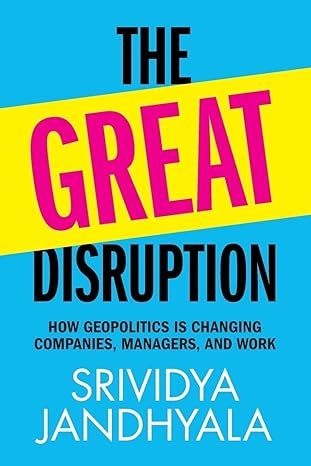
The Great Disruption, the Geopolitical Time That Entered Companies and the Rewiring of Work
For a long time, the corporate world moved with an assumption like this: “politics is the background, the market is the foreground.” Rules felt relatively stable, and competition could be organized as a matter of price and quality, technology and scale. Then, at some point, the background walked out onto the stage. War and sanctions, export controls and investment screening, supply-chain rewiring and alliance choices began to shake the most practical decisions?revenue and hiring, R&D and plant location?directly. This is not the banal statement that “geopolitics affects business,” but the opening of a phase in which geopolitics changes the operating language of companies itself.
The Security Logic That Fell Over the Market Logic
Many conflicts in today’s global economy ask “security” before they ask “efficiency.” The priority is no longer what can be made the cheapest, but what can be made without being cut off. Risk is no longer confined to exchange-rate swings or raw-material volatility. Laws and regulations, diplomatic relations, and military tensions become conditions of trade, and certain technologies and components can suddenly become “things you must not buy,” or “things you must not sell.” As a result, companies are pushed from a game of cost minimization into a game of finding the best survival route within the options that are permitted.
The biggest change here is that the standard of “competition” shifts. In the past, if a rival produced more cheaply, you looked for reasons in process efficiency, labor costs, or automation. Now the reason can lie in “permitted access.” One firm can enter a given market, while another cannot; even if the product is made, sales can be blocked because export licenses are denied. At that moment, it is no longer that a company wins simply by executing better?it wins only within the range that international politics allows. The market stops being a neutral referee and becomes a playing field that changes the rules frequently.
Speed is also a problem. Geopolitical events do not end as single shocks; they produce chain reactions. One round of sanctions shakes payment networks and logistics, and the shock is translated into insurance premiums, lead times, and contract terms. Inside the company, what you see is extremely concrete. “Can we deliver this quarter.” “Does an alternative supplier actually exist.” “What is the boundary that legal and compliance will allow.” A macro-level upheaval ultimately settles, on the ground, into sentences on a checklist.
What becomes even more difficult is that once the security logic enters, what matters is not “optimization” but “alignment.” If you cannot align the interests of supply chains, technology, customers, and investors in a single direction, the organization begins to split from within. Whatever you choose, it easily becomes a betrayal to some stakeholders, so management turns into not a problem of persuasion but a technology of managing conflict.
The Supply Chain Became a “Map,” Not a “Road”
If the old supply chain was a road, today’s supply chain is a map. Roads extend in the direction of efficiency; maps show restricted zones, borders, and conditions of passage. Even with the same factory, “possible supply chains” and “impossible supply chains” diverge depending on what nationality the equipment is, where data flows, and whether a partner is caught in a given country’s regulatory net.
This does not end with a simple prescription like “just diversify production.” Diversification costs money, that cost gets passed into prices, and prices can reduce demand. In other words, resilience is not an ethical slogan but a financial choice. The safer route tends to be slower and more expensive. The most efficient route tends to deepen dependence on a specific country or a specific technology. Companies therefore shift from calculating “lowest cost” to calculating “vulnerability we can afford.”
A map-type supply chain has one defining feature: you need detours. In normal times, the fastest path is the right answer, but in crisis, the side that has detours survives. The problem is that detours look like inefficiency in normal times. Extra inventory, redundant components, and a supplier structure spread across multiple countries are easily treated as cost centers. But when a disruption hits, that cost center suddenly becomes a survival device. So companies must design a structure that is criticized in normal times and praised in crisis.
This is where “visibility” changes most sharply in practice. A map is meaningless if you cannot see it. “Rewiring the supply chain” does not merely mean moving factories; it means tracing the flows of parts, data, and payments?including second- and third-tier suppliers?and identifying in advance “where it can break.” Competitiveness therefore expands beyond production capacity into tracking capability and simulation capability.
The New Managerial Capability: Operating “Management Mixed With Politics”
When geopolitics comes to the front of the company, what managers are required to do also changes. Strategy can no longer be completed with market analysis alone, because regulations, public sentiment, alliances, sanctions, and national-security logics are laid on top all at once. The important capability is therefore not a loud message but a standard of judgment?a standard for deciding which markets to exit, how far to endure, which risks can be shifted to insurance, and which risks the organization must carry itself.
In this environment, managers live in “two clocks” at the same time. The market clock runs by quarterly earnings and product cycles, but the political clock runs by elections, diplomatic events, and unexpected conflicts. The market clock is predictable; the political clock often mocks prediction. So even with numbers and plans in hand, managers must decide in advance what they will protect first when the plan collapses. Without such a standard, the organization flails in each crisis, and that wobble returns as an even larger cost.
There is another common misunderstanding: the division-of-labor notion that “political risk is solved by government relations.” Specialized functions are necessary, but in today’s environment the impact of political variables is so broad that it cannot be isolated as the task of a single department. R&D connects to technology regulations, HR intersects with visa and immigration policy, and finance is directly tied to sanctions and payment networks. Geopolitics is not a variable that enters through a side door; it is a variable that knocks on every door of the company at once.
Accordingly, the core of leadership shifts from “the power to proclaim the right answer” to “the power to organize collisions.” For example, you may need to invest in one country for growth, but that investment can be read as a dangerous signal in another. If you choose your words carefully to avoid losing customers, it can look like cowardice to internal employees; if you use strong language to build internal cohesion, it can be read as instability by external partners. Leadership that endures this dilemma is not the ability to simplify principles, but the ability to translate principles into rules that can actually be operated.
The Rewiring of Work: Careers Become a Matter of “Location,” Not Only “Capability”
Geopolitical shocks leave marks not only on companies but on “work” itself. Some industries suddenly grow through subsidies and regulatory change; other industries see markets close overnight through a single export control. The movement of talent also changes. Global talent flows are not always open, and borders again affect labor markets. As a result, an individual’s career becomes more sensitive to the variable of “where you belong, where you are located,” as much as “what you can do.”
This changes the intuition of workers. Before, “skilling up” felt like the most reliable strategy for the future. Now, even with skills, the value can shake the moment the technical domain becomes a regulatory target, or the connection to a specific country is treated as a risk. Conversely, roles that used to be peripheral?compliance, supply-chain risk, regulatory response, data governance?move to the center. In other words, the world of work moves beyond competition among “competent people” into a reallocation of abilities demanded by the environment.
Organizations demand more from employees. Rather than people who simply do tasks well, they need people who can endure uncertainty and re-prioritize, and who can read the regulatory, cultural, and political implications and design communication accordingly. The “technology of work” no longer ends at expertise; it comes to include the ability to interpret the environment.
And this shift affects the emotional texture of labor as well. As predictable career ladders shorten, people want safety; as safety is not guaranteed, loyalty to organizations declines. Meanwhile, the more uncertainty grows, the more organizations demand stronger cohesion. When this gap widens, what matters is not only benefits or pay, but “where this organization can take me”?trust in a path.
Implications for Korea: Survival Design in the “Post-Globalization” Phase
Korean companies are on the front line of this change. The export share is high, and there are many industries with high geopolitical temperature?semiconductors, batteries, shipbuilding, defense, displays, automobiles. The important question here is not a simple choice like “which side to stand on.” The more practical questions are these.
First, are regulations and sanctions being treated not as “after-the-fact 대응” but as design variables. You cannot keep up with speed by matching paperwork after regulations appear. You need a structure that reduces the chance of regulatory collision from the stages of product design, data architecture, and supplier contracts. Second, is supply-chain diversification being calculated not as cost but as insurance. Insurance feels wasteful in normal times, but in accidents its reason for existence is proven. Third, does the organization have alternatives when data, technology, and talent mobility are blocked. If a moment comes when technology developed in one country cannot be commercialized in another, a company without an “alternative route” loses not time but its existence.
Korean policy, too, becomes insufficient if it stops at “industrial promotion.” What becomes important is information, diplomacy, and institutional infrastructure that can buffer geopolitical risks that companies cannot bear alone?sanctions clashes, sudden rule changes, the ripple effects of export controls. Policy communication that increases predictability, systems that provide early signals of regulatory change, and diplomatic safety devices that help companies explore new markets are needed together. Companies must diversify risks on their side, and the state must widen the “possible range” so that corporate options do not suddenly collapse.
Another implication is “mid-sized and small firms.” Large firms can afford to invest in diversification and redundancy, but small firms can collapse from a single disruption. So for Korea to become truly strong, it must increase not only a few champion firms but the resilience of the entire connected ecosystem. Even micro issues like contract pricing in supply relationships become components of national competitiveness in the face of geopolitical shocks. In the era of the great disruption, competitiveness comes not only from innovation but from the stamina to endure breaks.
How to Read After Disruption: “Structure,” Not “News”
Geopolitics often looks like an event, but what remains in companies is not the event; it is the structure. What matters is less what shock arrived than through which channels?procurement, production, sales, talent, technology?it seeps into the organization. And the power to read that structure becomes the most practical capability in an age of anxiety.
Reading by structure means grasping “paths” rather than consuming events in terms of “for or against.” For example, when sanctions are announced, the first questions should not be “who is right,” but: “Which routes does our payment use.” “What are the origins and substitutability of our critical components.” “How far do the force-majeure clauses in customer contracts go.” In other words, the way to reduce uncertainty is not emotional certainty but drawing a map of chain reactions.
The great disruption is not merely the claim that the world has become more dangerous. It means that as the world has become riskier, the standards of corporate judgment and the methods of work have changed. The important question now is not “will we return to normal,” but “what standards will we use to operate in a world where normal has changed.” Once that standard is set, organizations can turn disruption from fear into a manageable variable, and individuals can pull careers a little more upward from luck into design.

.jpg)
.jpg)
.jpg)