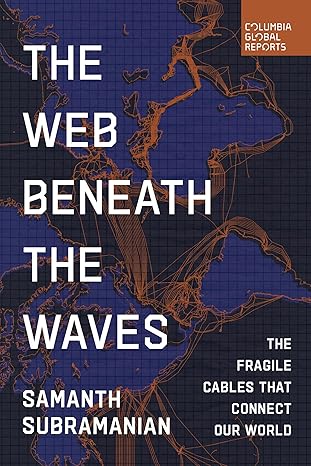
The World Beneath the Sea- Why Has the Age of Connection Become More Unstable?
The digital world appears to be a light, fast, and borderless space. But what actually supports that world are the physical routes laid beneath the sea and the massive facilities on land. An era is beginning in which the more connections increase, the more not freedom expands, but the costs and tensions required to protect those connections grow along with it.
Invisible Infrastructure Has Become the Real Body of the World
The internet is often understood as something abstract. It is regarded as an intangible space that cannot be seen or touched, and that can reach anywhere the moment one connects. That is why, when people think of the digital world, they usually picture the results they encounter on screens first: services and platforms, search bars and videos, artificial intelligence and the cloud. But the real world operates in exactly the opposite way. The internet is not floating in the air; it is suspended on top of extraordinarily heavy, long, and complex physical infrastructure. Cables stretching across the seafloor, landing facilities installed along coastlines, inland networks extending from them, data centers requiring electricity and cooling, the ships and engineers that maintain them, the governments that grant permits, and the companies that operate them all make up a single system. The digital appears immaterial, but in reality it is profoundly material.
This fact matters because for the past several decades we have consumed globalization through an image that was too light. There was a belief that information flowed freely, capital moved across borders, and connection itself meant progress. There was also a strong optimism that the more connected the world became, the more open and prosperous it would be. But in reality, connection is not a dazzling abstraction. It depends on very concrete routes, equipment, and gateways. Which sea it crosses, which point it reaches, through whose jurisdiction it passes, and which company’s facility it connects to all matter. The more the world becomes connected, the less digital life becomes free-floating; instead, it becomes more tightly dependent on an increasingly precise physical order and on more rules.
At this point, people’s intuition begins to waver. We have learned to think of the internet as a symbol of freedom, but in reality that freedom rests on a small number of routes, specific landing points, and a limited number of operators. The fact that a network that feels infinitely open is actually maintained through a handful of bottlenecks and gateways forces us to look again at the optimism of the digital age. If one line on the seafloor is severed, the flow of data between continents is shaken, and if a landing facility in a certain region stops working, countless services can slow down or be interrupted. People feel lightness in the world on the screen, but the world that supports it underneath is heavy, slow, and not easily replaced.
More fundamentally, it may be more accurate to say that our world today is not an age of software, but an age in which software is bound more deeply to physical infrastructure. The more advanced technology becomes, the less the importance of its physical foundation diminishes; in fact, it only grows. The more data moves and the more computation is carried out in real time, the more important the channels that can carry that flow safely become. It may look like the era of abstract technology has arrived, but in reality it is the era in which those who possess the physical foundations hold greater power.
Connection Creates Not Convenience, but Structures of Dependence
The expansion of connection was long understood as progress. The fact that one could connect from anywhere, that physical distance seemed to lose much of its meaning, and that information moved rapidly organized modern life in ways entirely different from before. Remote meetings made it possible to work together without being in the same place, international finance became connected in real time, and online services came to dominate everyday life across borders. But this convenience does not remain mere convenience. It creates dependence. At a certain point, society is reorganized into a structure that finds it difficult to function without connection. Connection becomes not a choice, but the default.
The problem is what happens when this default connection is broken. A brief power outage and a brief internet slowdown can now lead beyond personal inconvenience to paralysis across society as a whole. That is because corporate transaction systems, government administrative processing, international settlements, logistics management, cloud servers, hospital data management, and even the operation of school classes all depend on connectivity. If internet disruption was once an inconvenient event, now it can become a structural event directly tied to economic loss, administrative confusion, and declining trust. The stronger the connection becomes, the stronger the shock of disconnection becomes as well. And that shock cannot be patched over as a simple technical issue.
Connection makes society more efficient, but at the same time it makes society more sensitive. Tasks that were once handled locally now operate across international networks. A company’s servers may be located on another continent, financial data may pass through overseas cloud systems, and customer service and content delivery may also move through the infrastructure of multiple countries. Efficiency rises, but the chain of dependence grows longer along with it. The larger the system becomes, the more a single component failure can shake the entire structure, just as in a machine. A connected society, too, can become unstable in a chain reaction when problems arise in a specific route or node. A vast network appears solid, but in reality it is also an ecosystem highly sensitive to small disruptions.
In such an environment, connection is no longer a romantic word. It becomes the language of design and defense, maintenance and cost. People still want faster internet, more convenient services, and more powerful artificial intelligence, but they often forget how fragile the routes that make all of this possible actually are. The abundance of the digital age is not given automatically; it is placed on top of an order that must be continually maintained and protected. To possess many connections means not only to have much freedom, but also to have many vulnerabilities that must be defended. Networks create abundance while multiplying fragility at the same time.
The Lines Beneath the Sea Have Now Become the Nervous System of the Economy
Submarine cables are not merely telecommunications infrastructure. They are closer to the nervous system through which today’s global economy senses and responds. International financial settlement signals, the flow of data on global platforms, corporate cloud computing, administrative information exchanged between states, and the training and operation of artificial intelligence all travel along these paths. People take one click, one transfer, and one search completely for granted. But that sense of inevitability is in fact the result of enormous physical effort, international cooperation, and technical maintenance. It is because the routes beneath the sea remain calm that life on the screen continues uninterrupted.
This point has become even more important in an era like today’s, when finance, technology, and platform economies are tightly intertwined. In the past, facilities such as logistics and energy, ports and factories, were recognized as the core foundations of the economy. They still matter, of course, but now another foundation has clearly been added: the flow of data. This flow of data is far less visible than the railways or highways of an earlier industrial society. But it moves more things at once. Corporate decision-making, automated systems, financial transactions, the operation of global services, and the information processing of government agencies all hang on this flow. That is why it is more accurate to see submarine cables not simply as internet lines, but as the basic circuitry through which modern civilization operates.
What matters is that this circuitry is physical. It looks like an abstract network, but in reality it passes through specific seas, reaches specific coasts, and connects to specific facilities. And precisely because of that, it spills over into the realm of politics and security. The moment tensions rise in a certain region, the safety of a particular sea is shaken, or a particular state begins to view technology and infrastructure as strategic assets, the pathways of data also change from being mere industrial infrastructure into geopolitical assets. The nervous system of the global economy has now reached a point where it can no longer be managed only by the efficiency of private firms. It has become a domain in which national strategy and corporate investment, international norms and military calculation all become entangled at the same time.
Moreover, the nature of submarine cables is not “lay them once and you are done.” Construction is difficult, but maintenance and repair are also difficult, and when accidents happen, recovery requires time and money. This slow physicality stands in sharp contrast to the speed of the digital age. People exchange data in real time, but the infrastructure that supports that data is installed slowly, repaired slowly, and not easily replaced. That is why the age of connection is also an age of delay and fragility. On the screen everything feels immediate, but beneath the sea everything is slow and complicated. This gap is one of the greatest paradoxes contained within today’s digital world.
Even the Cloud and Artificial Intelligence Are Ultimately Bound to Land and Sea
Today’s technology discourse often erases materiality. When people hear the word cloud, they imagine lightness and flexibility, and when they hear artificial intelligence, they imagine abstract intelligence and automation. But all of this, in reality, rests on very specific places and routes, energy and facilities. The cloud is not floating somewhere in the sky; it exists inside buildings called data centers. Artificial intelligence is not immaterial intelligence, but a vast industrial system requiring enormous electricity, cooling, semiconductors, and network capacity. That system can operate only when land-based facilities and submarine cables work together.
This fact also changes the way we view technological supremacy. We often speak of better models, more data, and more powerful semiconductors as the core of competitiveness. And of course they are important. But going forward, they will not be enough on their own. How data moves, which country’s regulations it must pass through, which seas and landing points it depends on, and how much resilience it possesses all become part of competitiveness. Even if one has the most advanced technology, long-term advantage can be shaken if the network that carries that technology is fragile.
For that reason, competition in the age of artificial intelligence is increasingly likely to be decided in places that are not easily visible. Behind the glamorous competition of services and algorithms, what may actually determine the outcome are such factors as power supply, the location of data centers, international circuits, cable investment, maintenance systems, and the scope of legal permissions. Things that appear to belong to the future of industry in fact lead back to very old questions: Where should the roads be laid? How should those roads be protected? If a certain route is cut, what stops? The more advanced the technological age becomes, the less infrastructure becomes a backward concern; instead, it becomes more central.
The position of technology companies also changes. They are no longer entities that merely create applications and services. They are becoming actors that invest in cables, data centers, and international networks, and that in fact design the physical foundations of the digital world. At that point, technology firms become less like ordinary market actors and more like quasi-public infrastructure operators. Yet the question of where exactly they stand between the logic of private enterprise and the logic of national security becomes increasingly complicated. In the digital age, power comes not only from gathering many users, but also from owning and controlling the routes that support the flow.
The New Geopolitics Unfolds Not Around Territory, but Around Routes
When people hear the word geopolitics, they usually imagine territory on a map, border lines, straits, and military bases. Of course those elements are still important. But in today’s world, another layer has been added. Increasingly, routes matter more than territory itself. Who gets to pass through where, who controls which points of connection, and on what kinds of networks economies and information move are becoming important standards of power. Modern power comes not only from the ability to occupy land, but from the ability to manage flows.
Especially in the age of data, routes are power. To hold the roads along which information moves does not simply mean possessing technical infrastructure. It means being able to influence corporate activity, financial transactions, administrative processing, and military decision-making. Those who control routes are not merely managing traffic; they can influence time, trust, and the stability of transactions as well. That is why the geopolitics of the future may be less about “which state is larger” and more about “which states and companies possess the most indispensable routes.”
This shift also rewrites the relationship between states and companies. In the past, a relatively simple division of labor was possible, in which governments handled security and companies handled efficiency. But in the world of submarine cables and international data infrastructure, that distinction no longer works well. A single investment decision by a corporation can change the strategic importance of a particular region, and a national security judgment by a state can directly influence the design of private networks. That is because private efficiency and national security meet at the same point. Digital infrastructure is therefore neither a purely market sphere nor a purely state sphere. It is closer to a gray zone in which different logics overlap and operate together.
At such a time, the most important capability is not simple expansion, but visibility. Having many connections does not mean one is safe. What matters in reality is knowing which section is a bottleneck, which region is vulnerable, and which detour routes are possible. The less visible the infrastructure is, the more it must be seen and traced. Competitiveness in the digital age is shifting from speed alone to the ability to read structure. In times of crisis, what survives is not simply the side with the fastest route, but the side that possesses an alternative structure capable of sustaining the whole system even when disruption comes.
The Deeper the Connection, the More Management Matters More Than Freedom
Early internet culture promised openness and freedom. It imagined a world in which central control diminished, anyone could participate, and information flowed across borders. That imagination did become reality to some extent. But now that networks have become the core infrastructure of society, the issue is no longer simply how freely to connect. The more important question is how to operate those connections, by what standards to defend them, and under whose responsibility they will be restored when danger arrives. Freedom still matters, but the question of management can no longer be bypassed.
The word management often sounds old-fashioned and bureaucratic. But in the digital reality of today, management is survival. The more data flows across borders, the more important it becomes to know who understands the pathways of that flow, who possesses the capacity to restore them, and who bears the cost. Connection is no longer sustained as a neglected state of freedom. It is built on constant monitoring, maintenance, international coordination, regulatory adjustment, technological investment, and trained personnel. People consume only the outcome, but states and corporations must operate the background. If the background collapses, the outcome disappears with it.
In this respect, the digital age is paradoxical. It appears to have become freer, but in reality it requires more control; it appears more open, but in reality it requires more protective devices. The lighter and more flexible the internet appears, the heavier and more complicated the reality required to protect it becomes. Free flows do not exist automatically. They endure only when there is well-designed infrastructure, well-coordinated rules, and the capacity to respond to crises. The age of connection is therefore not an age of laissez-faire, but an age of meticulous management.
Questions Left for Korea, We Are Used to Consuming Connection, but Do We Have Enough Sensibility to Design It?
Korea has long taken pride in being a digital powerhouse. Fast internet speeds, high smartphone penetration, active use of online services, and competitiveness in semiconductors and electronics are all clear strengths. But the question now needed is not simply, “Are we good at using digital technology?” The more important question is, “How strategically do we view the structure of digital connection?” The ability to consume connection and the ability to design and defend connection are entirely different matters.
In an economy like Korea’s, which is highly dependent on exports and deeply embedded in global supply chains and data networks, the stability of submarine cables and international data flows cannot remain merely a telecommunications issue. It is a matter intertwined with financial stability, industrial operations, global customer response, cloud usage, platform economics, and even security and diplomacy. If invisible routes are shaken, visible industries are shaken as well. Not only highly visible infrastructure such as semiconductor plants, ports, and power grids form the foundation of industry. Routes beneath the sea, international circuits, and data center connection structures must now also be seen as strategic assets.
The first sensibility Korea needs at this point is the task of drawing a map of dependence. On which routes do we rely? How might tensions in a certain region affect our industrial and financial flows? How deeply are we tied to the infrastructure of a particular company or a particular country? These questions must become strategic questions at the national level, not just matters for technical departments. If dependence is unknown, fragility is unknown as well. And if fragility is unknown, response becomes impossible.
The second thing needed is resilience. The assumption that every route will always remain stable is no longer valid. Even if some connections are shaken, detour routes must be prepared so that the overall system can endure, and distributed structures must be considered so that the whole system does not become completely paralyzed when a specific node encounters trouble. This process naturally requires cost. But that cost is closer to insurance than to luxury. In ordinary times it may look inefficient, but when crisis comes it becomes the force that protects the entire system. Competitiveness in the digital age comes not only from the ability to provide the fastest services, but from the capacity to maintain operations even amid disruption.
Finally, what is needed is a shift in thinking. For a long time, we viewed digital technology merely as a domain of new industry. But now digital has become the foundation supporting industry and society as a whole. Once it becomes a foundation, it is at once a question of growth and a question of security, a question of convenience and a question of order. Without this shift in perspective, a state can end up chasing only visible technological trends while overlooking the importance of the routes and infrastructure that actually support those technologies. It is not enough simply to use connection well. We must be able to read it, protect it, and when necessary reconfigure it.
The Age of Connection Has Not Ended, But Now We Must Think About the Cost of Connection as Well
The world will continue to become more connected. The amount of data will keep increasing, artificial intelligence will demand ever greater computation, and finance, industry, administration, and culture will become more networked at ever greater speed. The problem is not connection itself, but the fact that the issues of cost and fragility, control and defense surrounding connection are coming much more fully to the forefront. If connection once appeared as opportunity, it is now also a burden. More connection means more possibility, but it also means more routes that must be defended.
This change alters our very intuition about globalization. In the past, globalization was understood as a process that weakened borders and reduced distance. Now the opposite scene also becomes visible. The more connections increase, the more important connection points become, the more sensitive bottlenecks become, and the greater grows the power of the states and corporations that protect those routes. Connection does not flatten the world; rather, it makes certain points more important and certain nodes more strategic. That is why the new geopolitics is likely to become less a matter of broad territory than of narrow and quiet routes.
In the end, to look at the world beneath the sea is not to look at the background of the internet. It is to see what today’s economy and power, technology and security, actually depend on. The digital world on the screen is dazzling, but the real body of that world lies in invisible places. And it is precisely in those invisible places that more of the competition and conflict, cooperation and instability of the future are likely to be decided. The age of connection has not ended. It is simply that we can no longer speak of connection only in the language of optimism. What will matter more going forward is not how much we are connected, but how deeply we understand those connections and how long we can protect them.

.jpg)
.jpg)
.jpg)