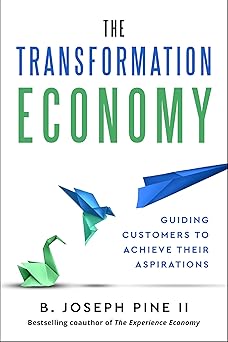
Customers Aren’t Buying Things. They’re Buying Transformation
[Key Message]
* Competition in the market is now moving beyond products, services, and experiences toward customers’ actual transformation.
* People are not simply buying things; they are buying the possibility of becoming healthier, growing further, and moving toward a better life.
* The strongest companies of the future will not stop at providing functions, but will design the path and accompany customers toward the state they want to reach.
* The standard of success is also likely to shift away from sales volume and toward how much customers have actually changed.
* In the end, future brand competitiveness will depend less on what is being sold and more on how, and in what direction, people are truly transformed.
For a long time, the market has competed over better products, faster services, and more impressive experiences. But now the focus of competition is moving one step higher. People are beginning to care less about what they buy and more about what kind of person they want to become through that choice. The companies that grow stronger from here are likely to be not the ones that sell satisfaction, but the ones that design the direction of change.
Why Does “Transformation” Come After the Age of Experience?
In the past, making good products was enough to create competitiveness. If quality was better, price was more reasonable, and durability was stronger, a company had an advantage in the market. Then service became important. As it grew harder to differentiate by selling products alone, standards such as how kind, how convenient, and how quickly responsive a company was became the criteria that separated one company from another. And from a certain point on, experience became the core of premium value. Even when buying a single product, people also began purchasing space, atmosphere, emotion, story, and a sense of belonging. A cup of coffee was no longer judged by taste alone, and a hotel was no longer remembered only for its room. Consumption gradually became more sensory and more narrative.
But experience, too, began to level out quickly before long. What had once felt special soon became an industry-wide standard, and what had been special turned familiar again. Apps all started to look alike, membership programs all started to look alike, and even the emotional language of brands began to resemble one another. As the elements created for differentiation were repeatedly copied, companies once again found themselves facing a fundamental question. What truly creates difference? Why do customers remember and return to a particular brand and a particular company among so many choices?
The answer to that question is becoming increasingly clear. People do not want the product itself alone; they want to move into a better state through that product or service. They want to become healthier, learn more, live more efficiently, build more stable lives, and spend their days with greater meaning. On the surface, it may look as though they are buying things, but in many cases they are actually purchasing the possibility of change. People do not buy running shoes simply because they need shoes. They buy them because they want to move closer to a better body and better habits. People do not pay for educational programs merely to watch lectures. They do so because they expect a more developed version of themselves. The reason people seek financial services is not limited to increasing numbers. It is also because they want to escape anxiety and regain a sense of control over their lives.
At this point, the center of gravity in the market shifts from “ownership” to “change.” What matters more is no longer what one possesses, but what has actually changed. Products become tools of change, services become the process of change, and experiences become the entrance into change. In the end, the highest level of value depends on whether the customer’s life has actually moved. Giving someone a pleasant experience once and changing that person’s way of living, way of judging, and expectations for the future are two completely different things. The former may remain in memory. The latter remains in life.
Customers Are Not Consumers but “People Who Want to Become Different”
Traditional marketing has focused on identifying customer needs and solving inconvenience. It has done so by asking what is lacking, what should be more convenient, and what additional functions are needed. Of course, those questions still matter. But they are no longer enough on their own. Now another question must be added. What kind of person do you want to become? What do you want to change from your current state? What must be different before you finally feel satisfied?
This question matters because people’s choices are increasingly driven by aspiration. On the surface it may look like consumption, but underneath it, the desire for self-transformation is at work. The success or failure of health-management services depends less on explaining functions than on the possibility of changing daily habits. The competitiveness of education platforms depends less on the number of pieces of content than on the learner’s achievement and persistence. Even the beauty industry is selling not just product effectiveness, but changes in self-confidence and self-image. Travel is no exception. What matters more is not simple movement from place to place, but psychological outcomes such as recharging, transition, recovery, and discovery. In the end, most industries may look different on the outside, but they are all facing the same question: in what direction are they moving people?
Within this flow, the role of the brand also changes. In the past, it was closer to a provider that solved problems. Now it is closer to a guide that accompanies people to a destination. Delivering a product and ending the transaction is no longer enough. It must continue to stay involved until the customer reaches the desired state, design the path, keep the customer from dropping out along the way, and help progress become visible. That is why the important brands of the future will increasingly be explained not by what they sell, but by what they make possible.
This shift is already appearing across industries. The fitness industry is moving from being a place that provides facilities to being a system that changes lifestyles. The education industry is being pushed away from a structure that supplies lectures and toward one that takes responsibility for actual achievement and even changes in career direction. The financial industry is expanding beyond selling products into helping with life stability, retirement design, and future planning. In healthcare, too, treatment alone is no longer enough. Prevention, recovery, ongoing management, and improvement in quality of life must all be included for real competitiveness to emerge. Even luxury and lifestyle brands are working not only through the consumption of image, but also through the question of what kind of identity customers want to live.
Companies That Create Real Change Will Become Stronger Than Companies That Simply Sell More
What changes most in this process is the standard by which companies judge success. Selling a lot is no longer enough. It still matters how often customers return, how long they stay, and how often they recommend the brand, but an even deeper standard is what customers have actually achieved. Have they become healthier than before? More capable? More confident? Have they been able to design a more stable life? Have they developed a stronger sense of purpose? These questions are not mere marketing rhetoric. They are likely to become connected to how corporate performance is measured in the future.
The concept of price may change accordingly as well. Traditionally, prices were attached to the quantity of products, the amount of service time, or the range of functions. But in a market centered on change, outcomes become the standard that justifies price. What matters more is not how many hours were provided, but how much improvement actually occurred. In education, that means achievement matters more than hours of instruction. In coaching, behavior change matters more than the number of sessions. In health management, real improvement matters more than the number of program visits. This idea places a heavy burden on companies. Outcomes are also affected by the customer’s will and environment. But that is precisely why more serious design becomes necessary. To charge for change, a structure capable of creating change must be built.
For that reason, the companies with the advantage are unlikely to be only the ones that make functions well. The stronger companies will be the ones that can diagnose, personalize, track, give feedback, and motivate. Rather than a structure that ends after one sale, what matters is a structure that stays involved throughout the customer’s entire journey. Here, data and artificial intelligence can become powerful tools. They can grasp individual conditions, break goals into smaller parts, intervene at the right moment, and make even small progress visible. But no matter how sophisticated technology becomes, the core does not change. What matters is not how complex the system is, but how much a person’s life has actually moved.
The coming battle among brands is also unlikely to end as a contest of emotion alone. Beautiful imagery, refined language, stylish spaces, and viral content will still matter. But those alone have limits when it comes to lasting power. In the end, people remember what remains in their lives. A brand becomes strong only when experiences accumulate in which people feel that using it changed them, participating in it improved them, and building a relationship with it clarified the direction of their lives. A good brand does not stop at earning affection. It creates evidence of transformation. And that evidence leads to reviews, recommendations, repeat purchases, and loyalty within communities. The moment people feel transformation in their lives, consumption becomes narrative.
In the Age of Transformation, What Matters Is Not What You Sell but Whom You Move and How
This trend also demands a different kind of talent within companies. It may no longer be enough to divide roles into salesperson, consultant, marketer, and operator. The important capabilities will be the ability to read a person’s condition, interpret goals, help sustain motivation, and design transformation. More people will be needed who have the qualities of coaches, guides, and curators. Customer touchpoints will no longer be simple sites of response; they will become sites of transformation design. That is why the standard of service in the future may be determined not simply by kindness, but by how accurately a company can read another person’s aspiration and how long it can stay alongside that person.
Seen more broadly, this change is also a sign that the direction of capitalism itself is being adjusted little by little. If past markets revolved around mass production and mass sales, today’s markets are digging more deeply into personalization, meaning, and the desire for growth. The fact that human beings are not merely creatures who consume things, but beings who constantly want to remake themselves, is moving more openly into the center of the market. The companies that understand this desire most precisely are likely to capture higher added value. In the end, future competition may shift away from who supplied more and toward who produced clearer results of transformation.
What matters is that this flow is not limited to any one industry. Healthcare, education, finance, wellness, beauty, travel, community, SaaS, and B2B services are all connected to it. Everywhere, people want a better version of themselves, and companies will be evaluated according to how well they can structure that aspiration. The market, having passed through the age of function and crossed the age of experience, is now entering the age of transformation. And in this age of transformation, what matters more is not what you are selling, but whom you are moving and in what direction.
In the end, the companies that last the longest are likely to be not only those that make good products, but those that understand the desire for human growth with the greatest precision. Customers are becoming clearer. Even when they buy a single product, they want to become better than they are now. Even when they use a service, they want the direction of their lives to improve, if only a little. Even when they consume an experience, they want it not to end as a memory alone, but to lead to transformation. This is exactly where the next contest in the market will be decided. There are many companies that provide satisfaction. But there are still not many that actually change people. The opportunities ahead will emerge in that gap.

.jpg)
.jpg)
.jpg)