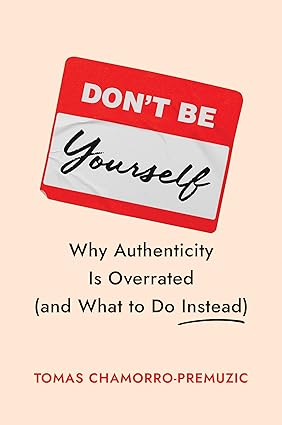
Beyond the Age of Authenticity, Toward the Age of Self-Design
[Key Message]
* Authenticity is often treated as a virtue in itself, but in the world of work and organizations, unfiltered self-expression can sometimes harm relationships and performance.
* What helps people grow is not endlessly confirming their “true self,” but building and calibrating a better version of themselves for the situation.
* The core of leadership, too, does not lie in revealing one’s inner feelings as they are, but in responsibly choosing the attitude and language that a community needs.
* Self-management is likewise not about accepting one’s current tendencies as a fixed essence, but about training oneself toward becoming more capable and more trusted.
* Ultimately, future competitiveness will depend less on who a person “really is” and more on how effectively they can design themselves and function within relationships and organizations.
***
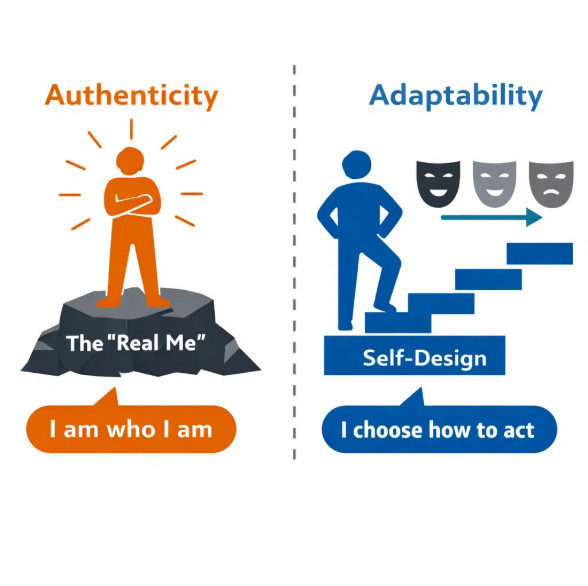
For a long time, people have been taught that living true to oneself is the healthiest and most desirable attitude. But in the world of work and organizations, the ability to regulate oneself according to the situation often carries more power than expressing oneself exactly as one is. What matters may not be insisting on the “real me,” but cultivating the capacity to build oneself in a better direction.
Being exactly as I am is not always the best option
Today, authenticity is accepted as a value that is almost impossible to challenge. Honest people, unpretentious people, and people who do not hide themselves are generally regarded as healthier and more trustworthy. When someone says, “This is just the way I am,” it sounds like the attitude of a person with a clear understanding of themselves. By contrast, a person who changes their tone depending on the situation, adjusts their expression and attitude, and chooses a more appropriate response over their immediate feelings may easily seem calculating or insincere. But social life does not move in such a simple way. Especially in the world of work and organizations, what makes the greater difference is not what one feels, but how one handles it.
Suppose there is someone who does not hide their discomfort in a meeting and reveals it immediately. That person may regard themselves as honest. But from the perspective of colleagues working with them, that honesty can shrink the space for discussion, stiffen the flow of conversation, and drag the exchange into the territory of emotion. The same is true of a manager who says, “I’m naturally a blunt person, so I don’t sugarcoat things,” and then delivers harsh feedback. Such an attitude may appear faithful to one’s own disposition, but in reality it can narrow the other person’s room for growth and damage psychological safety in the organization. The problem is not honesty itself. The problem lies in treating honesty as something that is always good.
Human beings do not live with only one face. The way one speaks with family, the expression one wears with friends, the attitude one takes toward customers, and the way one leads a team in a crisis cannot possibly be the same. That difference cannot simply be dismissed as hypocrisy. Rather, it is closer to a sense of role, social intelligence, and the ability to read a situation. Within one person exist multiple possibilities, and the power to choose which version of oneself to place at the front in a given scene becomes part of maturity. Even so, many people regard reacting exactly as they feel in the moment as the most truthful attitude. But spontaneity is not always proof of truthfulness. At times, it is merely an untrained response, a state in which one has not yet fully shaped a self that could become better.
In the world of work, what is evaluated is not the purity of one’s inner self but the effect of one’s actions. More important than whether the intention was good or the feeling was real is what kind of experience that action left for others and what kind of result it produced. That is why mature social life does not stop at the question, “Am I acting like myself right now?” The more important questions are, “What attitude is more useful in this situation?” and “What impact is the version of myself I am showing now having on relationships and on the results of work?” A person is a being who reveals themselves as they are, but also a being who can regulate, discipline, and design themselves.
Leadership is not the exposure of one’s inner feelings, but the completeness of one’s role
When speaking of leadership, authenticity has long been treated as an ideal virtue. It is often said that a human leader, a leader who does not hide emotions, and a leader who candidly acknowledges weaknesses earns greater trust. Of course, there is truth in that claim. An excessively masked attitude, a coldness devoid of emotional connection, and messages that differ inside and out all leave people with fatigue and distrust. But that does not mean a leader should always reveal their emotions and thoughts exactly as they are. What organizations require from leaders is less the freedom of self-expression than the ability to present direction and stabilize people even in uncertain circumstances.
This difference becomes even clearer when one imagines a situation in which business is faltering and performance is declining. Team members are already anxious. If, at such a moment, a leader pours out their own anxiety and irritation without restraint, that may be honesty, but it does not function as leadership. On the contrary, it is likely to heighten the team’s tension and leave members with even deeper unease. By contrast, even if the leader is inwardly worried, if they calmly sort through the problem, present priorities, and clearly guide the team on what can be done now, the team becomes far more stable. In such a case, the attitude is not the result of laying bare inner emotion, but of choosing a response intentionally for the sake of the community. That kind of choice is closer to responsibility than to pretense.
Many people understand leadership as an extension of personality. They think that charismatic people should push hard, warm people should always be kind, and blunt people should speak without restraint in order to be true to themselves. But in actual organizations, consistency and reliability matter more than individuality. A leader whose tone fluctuates with emotion, whose way of giving direction changes according to mood, and who applies entirely different standards depending on the situation may be humanly honest, but as a leader they are unstable. People want predictability from such a leader more than sincerity. The one who maintains at least a minimum standard in every situation and chooses what the organization needs over what they happen to feel in the moment will earn deeper trust.
In the end, leadership is not about revealing “what kind of person I am,” but about knowing “what kind of presence I must embody in this position.” At times, one must keep a calm face even without full confidence; at times, one must speak in the form of questions even when angry; and at times, one must put the long-term interests of the organization before personal preference. A leader is not an interpreter of instinct, but closer to a designer who precisely adjusts their attitude and language so that the group can move forward. Seen this way, leadership becomes not a matter of inborn personality, but a trainable skill and a role-sense that can be refined.
Self-management is not about preserving the present self, but about building a better self
The phrase self-management is often understood only in technical terms such as time management, emotional control, stress relief, and productivity improvement. Of course, these elements matter too. But self-management at a deeper level begins with not treating oneself as a fixed identity. Many people value self-understanding. Yet self-understanding often turns into self-fixation. Statements such as “I’m just bad at presentations,” “I’m not leadership material,” “I’m not the type who comforts people,” or “I’m naturally very shy” seem, on the surface, like signs of knowing oneself well. In reality, however, they may be ways of mistaking one’s current condition for one’s essence.
People are born with their own dispositions, but social functioning is not determined by disposition alone. A person who appears calm can, through training, learn to become more decisive. A blunt person can, through practice, learn how to speak more gently and effectively. A person who gets nervous easily can develop presentation skills through repeated experience and feedback. A person who feels more comfortable working alone can still acquire sufficient collaborative ability within the necessary range. The problem is that many people stop at the stage of understanding themselves and never move on to the stage of reconstructing themselves. Self-management does not end with acknowledging the present self. That is only the starting point. What must follow is the process of asking which habits and reactions should be maintained and which should be changed in order to produce better outcomes.
Take, for example, someone who always freezes up in meetings. That person may define themselves as “naturally introverted.” But even if that statement is true, it does not mean they must always remain silent in meetings. Introversion and the ability to speak up are not the same issue. They can prepare key points in advance, set a goal of speaking once in the middle rather than at the beginning of the meeting, or repeatedly practice expressing a point in a single sentence. Viewed this way, change is not about abandoning one’s personality. It is about training oneself for better functioning. In the end, self-management is not a defensive effort to preserve one’s original self, but a constructive effort to bring a broader range of possibilities into reality.
This perspective is especially important for working people. The world of work does not operate according only to individual comfort. A style that feels natural to me may come across as unfriendly to someone else, and the communication style I prefer may be inefficient for the team’s goals. That is why growth is not completed through self-acceptance alone. One must acknowledge oneself, but also be able, when necessary, to train in uncomfortable directions. One must ask questions when questions need to be asked, confront conflict appropriately when it cannot be avoided, restrain emotion when restraint is needed, and bear the responsibilities of a role even when one feels underprepared. In the end, self-management is not a technique for protecting my feelings, but a technique for handling myself in order to function at a higher level.
The success or failure of communication is determined less by sincerity than by design
Conflict within organizations does not arise only because of lies. More often, it arises because unprocessed sincerity is delivered too quickly. Someone may think, “I was just being honest,” but the listener may receive those words as aggression, disregard, or emotional pressure. In social life, speech is not judged only by the release it gives to the speaker. More important is how it reached the other person, what kind of behavioral change it produced, and what kind of mark it left on the relationship. That is why effective communication is closer not to the ability to express genuine emotions, but to the ability to design and deliver them according to context.
Even when the content is the same, the result changes completely depending on how it is delivered. The statement “Why couldn’t you even do this properly?” and the statement “Shall we take a look together at where this got stuck?” both point to a problem. But the first expression triggers the other person’s defensiveness, while the second is more likely to move the conversation toward resolution. Truth can be contained in both sentences. But the effects are entirely different. In the end, what matters in organizations is not how factually one spoke, but whether those words worked in a way that fit the purpose.
Many people understand communication only as a matter of self-expression. They believe that good communication means accurately conveying what I think, not hiding my feelings, and making my position clear. Of course, expression matters. But organizational communication does not stop at self-expression. It involves considering the other person’s understanding, conveying necessary messages without unnecessarily damaging the relationship, and at times restructuring uncomfortable content into a form that can be accepted. This process requires skill and training. It demands the ability to arrange the order of words, choose the tone, balance question and assertion, and recast feedback not as a personal attack but as the language of a shared task.
Especially in the world of work, the attitude of first considering “How will the other person receive these words?” matters more than the desire to say “I want to say exactly what I feel.” This is neither cowardice nor self-censorship. It is a responsible way of speaking in a space where there is a shared purpose. People who are excessively honest often think of themselves as transparent, but in reality they may simply be expecting others to absorb their impulsiveness. By contrast, those with strong powers of adjustment carefully calibrate the intensity and form of their words while still not losing the substance that must be conveyed. That is why they earn greater trust, draw out more cooperation, and build greater influence. In the end, the essence of communication lies not in the intensity of sincerity, but in the ability to organize sincerity according to purpose.
From the era of finding the true self to the era of creating a better self
Today’s culture constantly tells us to live true to ourselves. It urges us not to be swayed by others’ expectations, but to face our desires and emotions honestly. This message has played an important liberating role in the wake of eras shaped by strong norms and repression. A life spent responding only to others’ demands, without knowing one’s own emotions, easily exhausts a person. But the language of liberation alone is not enough. In the world of work and social roles, another question is needed. The important question is not whether I am being honest about my feelings right now, but whether I am growing myself in a better direction.
The idea of the “true self” is appealing, but at times excessively romantic. A person is not a being born with one finished essence that must be preserved for life. Rather, a person is closer to a being continually reconstructed through environment, experience, learning, and choice. There is no guarantee that what feels comfortable today will still be best tomorrow, nor that the response that feels natural now will produce the best long-term result. That is why the core of growth lies not only in self-discovery. The ability to produce oneself, construct oneself, and update oneself is becoming increasingly important. It matters to understand oneself as one is, but what matters even more is the power to move oneself in a direction that is more capable, more trusted, and more mature than before.
This shift is especially evident in the world of leadership and careers. Organizations do not run on individual sincerity alone. A trustworthy attitude, the ability to read context, emotional steadiness, a way of communicating suited to the other person, and a sense of responsibility toward one’s role must all work together. That is why the capacity that will carry greater value in the future may be not self-exposure but self-regulation. More important than the ability to reveal everything inside oneself may be the ability to choose which version of oneself to place at the front when the moment demands it. People often criticize this as wearing a mask, but the responsible fulfillment of a role is by no means the same as falsehood.
In the end, what matters is not remaining trapped in the belief that “I must preserve myself exactly as I am.” At times, going beyond the present self may be the more sincere and more courageous choice. Learning a more effective tone than the one that feels comfortable, choosing an expression that preserves the relationship over a moment of anger, putting forward the attitude a team needs rather than the one that feels most familiar?these are not acts of self-denial, but of self-expansion. A person is not a being confined only within their disposition, but one who can create better functioning through training and choice.
Now the important question of the age is also changing. The question “Who am I?” is no longer enough. Alongside it, we must ask, “How am I functioning as a person?”, “What kind of experience am I leaving within relationships and organizations?”, and “Am I designing myself into a better version than before?” If the age of authenticity awakened the need for self-expression, the next stage is likely to demand even more strongly the need for self-construction. And within that flow, competitiveness is likely to be determined not by inborn personality, but by the ability to manage and update oneself.
That is why the key to understanding future leadership, self-management, and organizational communication is also changing. What matters is not endlessly confirming the true self, but making a better self actually work in the real world. More important than inner purity are attitudes that produce results; more important than instinctive reaction are trained choices; more important than impulsive self-expression is self-design that takes context into account. In the end, the force that allows a person to grow in social life comes not from the declaration “This is just who I am,” but from the premise “I can change in a better direction.” The moment one accepts that premise, the world of work and relationships begins to appear far broader and more refined.

.jpg)
.jpg)
.jpg)