Why Do Old Questions Keep Returning?
The classics are not decorative remnants of a bygone age, but old devices that compel us to ask again about power, culture, and identity in the present. The past is not time that has ended, but a reservoir of interpretation that the present constantly summons in order to explain itself. To read the ancient world again is not to lean on nostalgia, but to see how unstable the order and sensibility of today really are.
[Key Message]
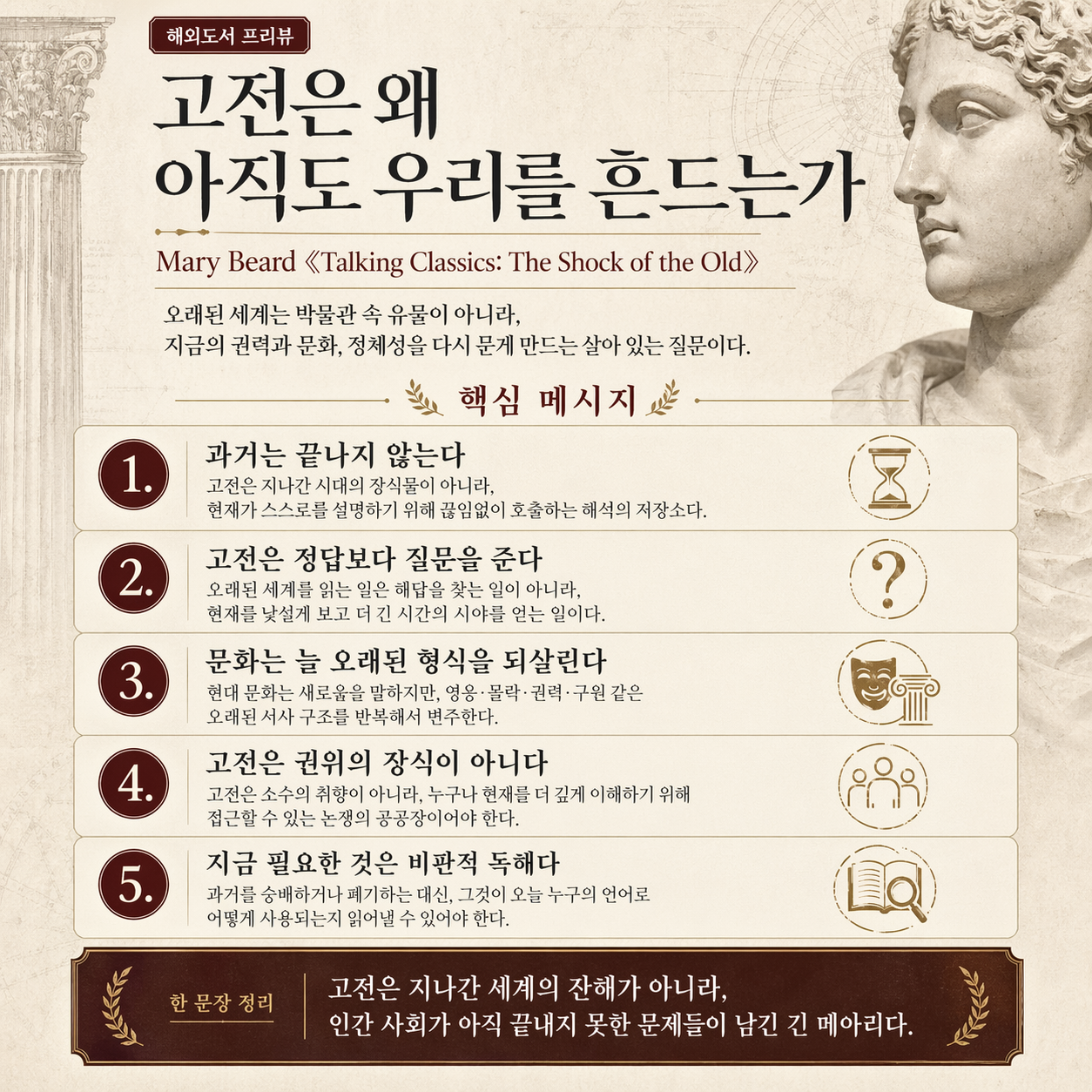
* The classics are not relics of a bygone age, but a reservoir of interpretation that the present constantly summons in order to explain itself. How we read the past shapes how we understand power, culture, and identity today.
* Reading the ancient world is not about finding ready-made answers, but about making the present unfamiliar and securing a longer historical perspective. It reminds us that today’s institutions and common sense were also produced under specific historical conditions.
* Modern culture constantly speaks in the language of novelty, yet in reality it keeps repeating old narrative structures and emotional patterns in new forms. To understand the classics is to gain insight into how modern societies persuade, move, and organize people through stories.
* The classics should not remain ornaments of authority, but become a public arena where anyone can enter, question, and challenge competing interpretations. Struggles over how to interpret the past are ultimately tied to struggles over what direction the present should take.
* What we need now is not reverence for the past, but the ability to handle it critically. The task is to value what is old without worshipping it blindly, and to question it without discarding it in ignorance.
***
The Past Never Ends; It Only Returns in Different Forms
People often think of the past as time that has already gone by. It is treated as history arranged inside textbooks, as relics preserved in museums, or as an old civilization with little to do with the present. But in reality, the past does not disappear so neatly. It keeps returning in different forms within the present. When we speak of democracy, citizenship, empire and order, heroes and betrayal, authority and satire, we are, knowingly or not, borrowing the language of old worlds. The past is not something left behind. It is time that is repeatedly summoned whenever the present tries to understand itself.
In this sense, the classics are not merely a list of cultural accomplishments. They are closer to a deep reservoir that modern people keep reopening in order to interpret themselves. The problem is that this reservoir is never neutral. The same past can mean entirely different things depending on who invokes it, for what purpose, and in what language. One person sees the origin of liberty there, while another sees the prototype of the strong state. One discovers a deeper understanding of humanity, while another sees the long habits of authority and exclusion. The past may be one, but the present translates it in endlessly different directions. To read the classics, then, is not only to know old texts. It is also to read what our own age desires and what it fears.
This is precisely why the classics must be spoken of again today. The important question is not whether the past should be worshipped or discarded. What matters more is how it is being used now, why certain old stories return with such force in particular eras, and how that return empowers some while silencing others. In that sense, the classics are not symbols of stale authority, but living sites where authority itself is made and unmade.
The Ancient World Is the Strangest Mirror of Today’s Power
Those who live in the present tend to accept it too easily as something natural. Our institutions, our common sense, our language, and our sensibilities often appear self-evident and rational. Yet when we look into the past, it becomes clear that what we take for granted was also produced under specific historical conditions. Power has always returned in similar forms, but the language that justified it changed from age to age. Some societies organized exclusion in the name of citizenship. Some regimes packaged violence in the name of civilization. Some powers strengthened private domination while invoking the common good. Strikingly, these scenes are not entirely unfamiliar today.
This is where the true force of the classics lies. Their value does not rest in delivering simple lessons. Rather, it lies in making the present strange again. We live too close to our own world to see its structure clearly. But when we pass through a distant age and then turn back to the present, our desires, hypocrisies, ideals, and forms of violence become far more distinct. The past is an indirect route to the present. Things too familiar to be seen gain shape the moment they are refracted through ancient narratives.
To read the classics, then, is not to search for ready-made answers, but to secure distance. It is to step back so that the immediate world does not become absolute. It is to draw on a longer span of time so that today’s debates are not mistaken for eternal truths. The depth of that time does not come merely from being old. It comes from the accumulated record of what human beings have repeatedly desired, feared, built, and destroyed. Without that depth, the present is interpreted only through shallow and improvised language. With it, today’s conflicts are placed within a much longer and heavier historical chain. The present becomes more complex, but also more accurate.
Culture Always Speaks of Novelty, Yet Repeats Ancient Forms
Modern society adores the new. Whenever new technologies, new media, new sensibilities, and new generations emerge, the previous world is often declared finished. But if one looks at culture over a longer span, novelty often turns out to be the rearrangement of older forms. The structure of heroic rise, tragic fall, communal ideal, corrupt power, revenge, redemption, honor, and shame returns again and again under different names.
This does not mean culture fails to evolve. Rather, culture moves by translating old narratives into the language and sensibility of the present. Myth does not disappear; it becomes genre. Tragedy does not vanish; it becomes political drama. The imagination of empire does not die; it reappears in blockbusters and in the language of international order. People may no longer read ancient texts directly, yet they are trained emotionally and morally inside stories that still carry the same structural patterns. To know the classics, therefore, is not simply to have read a few old books. It is also to understand where modern culture draws its emotional architecture from.
At this point, the humanities escape the old accusation of uselessness. They are not merely a hobby of admiring beautiful sentences. They are a technique for dissecting the stories through which society binds itself together. People are not moved by logic alone. They are persuaded by narrative, seduced by story, and taught to understand their world as a kind of drama. States offer narratives to citizens. Markets sell narratives to consumers. Politicians tell voters stories of crisis and recovery. In the end, power often depends on who succeeds in controlling the story. To understand the genealogy of old narratives is therefore not a luxury of cultivation, but a way of reclaiming interpretive power.
The Classics Must Become a Public Arena of Argument, Not an Ornament of Authority
The problem is that the classics have long been used as a language of authority. There was a culture in which the person who quoted old texts most fluently seemed deeper, more refined, and more legitimate. Educational systems reinforced that feeling, while cultural hierarchies wrapped it in the language of taste. As a result, the classics came to feel for many people not like an open space of inquiry, but like a closed world that was difficult to enter. At that point, the classics cease to be a living language and become a frozen symbol.
If the classics are to remain alive, they must return not as ornaments of prestige but as public arenas of dispute. Ancient texts, objects, myths, and institutions breathe again only when connected to the questions of the present. Why were women so long treated as beings without the right to speak? Who was included within citizenship, and who was cast out? Why has the common good so often been built upon the sacrifice of minorities? When did civilization become a language of exchange, and when did it become an alibi for domination? These are all questions that the ancient world helps us revisit.
In that form, the classics belong to no single group. They become open resources that anyone can approach in order to think more deeply and more historically about the present. For the classics to become democratic, everyone does not need to agree on a single interpretation. On the contrary, interpretations must be allowed to collide. One reader sees the origin of liberty there, another the history of exclusion. One learns civic virtue, another reads imperial arrogance. What matters is not avoiding such conflict, but sustaining it. Disagreements about the past are ultimately disagreements about what direction the present should take.
That is why the classics do not simply end. In times of instability, they are summoned even more often. When order trembles, people search for origins. When legitimacy is shaken, they reach for ancient foundations. When culture overheats, they look to older forms to reorganize themselves. This repetition is itself the source of the classics’ vitality. Old things survive not simply because they are old, but because they contain questions that can be fought over anew each time.
What We Need Now Is Not Worship of the Past, but the Ability to Handle It
The contemporary world worships speed too much. New information pours in, new technologies unsettle old orders, and new crises arise almost daily. In such an age, what is fast appears more valuable than what is old. Yet speed cannot substitute for direction. On the contrary, the faster change becomes, the more easily people lose their bearings. It becomes difficult to distinguish what is truly new from what is merely the repetition of an old pattern, what is innovation and what is only an old desire wrapped in new packaging. At such moments, what is needed is not a quicker reaction, but a longer view.
To read the classics again is to secure that longer view. It is not an escape into the past. It is a way of cooling the overheated present and bringing the depth of time into our understanding of what is happening now. Studying the ancient world does not automatically make our judgments wiser. But it does allow us to see how many of the problems we imagine to be unprecedented are in fact repetitions of older patterns, and to distinguish what within that repetition has changed from what has not.
The societies of the future will likely fight even more often over the past. In the conflicts surrounding education, culture, politics, and identity, the question of who gets to remember which past and inherit which tradition will become increasingly central. That is why what we need is not reverence for the past, but the ability to handle it critically. We must be able to love what is old without worshipping it blindly, and to question what is old without discarding it out of ignorance. The past can always become a weapon in the present. The more important task, then, is not to deny that weapon’s existence, but to keep asking in whose hands it lies and how it is being used.
In the end, old questions keep returning because human societies have not yet become wholly new beings. Power repeats itself even when it changes names. Culture revives ancient emotions even when it changes form. Communities build new institutions while failing to abandon old habits of exclusion. That is why the classics do not end. They are not relics of a vanished age, but long echoes left behind by problems humanity has still not resolved. And listening to those echoes remains a useful way of knowing, more precisely, where we stand now.

.jpg)
.jpg)
.jpg)