The Revolutionary Center, Reinventing Liberalism
The center has come to look like a place for people who cannot decide anything. Yet when one traces the history of liberalism, the center was not a technique of compromise but a language of reform that dismantled old orders. The question now is simple. Can liberalism once again become a force that changes people’s lives?
[Key Message]
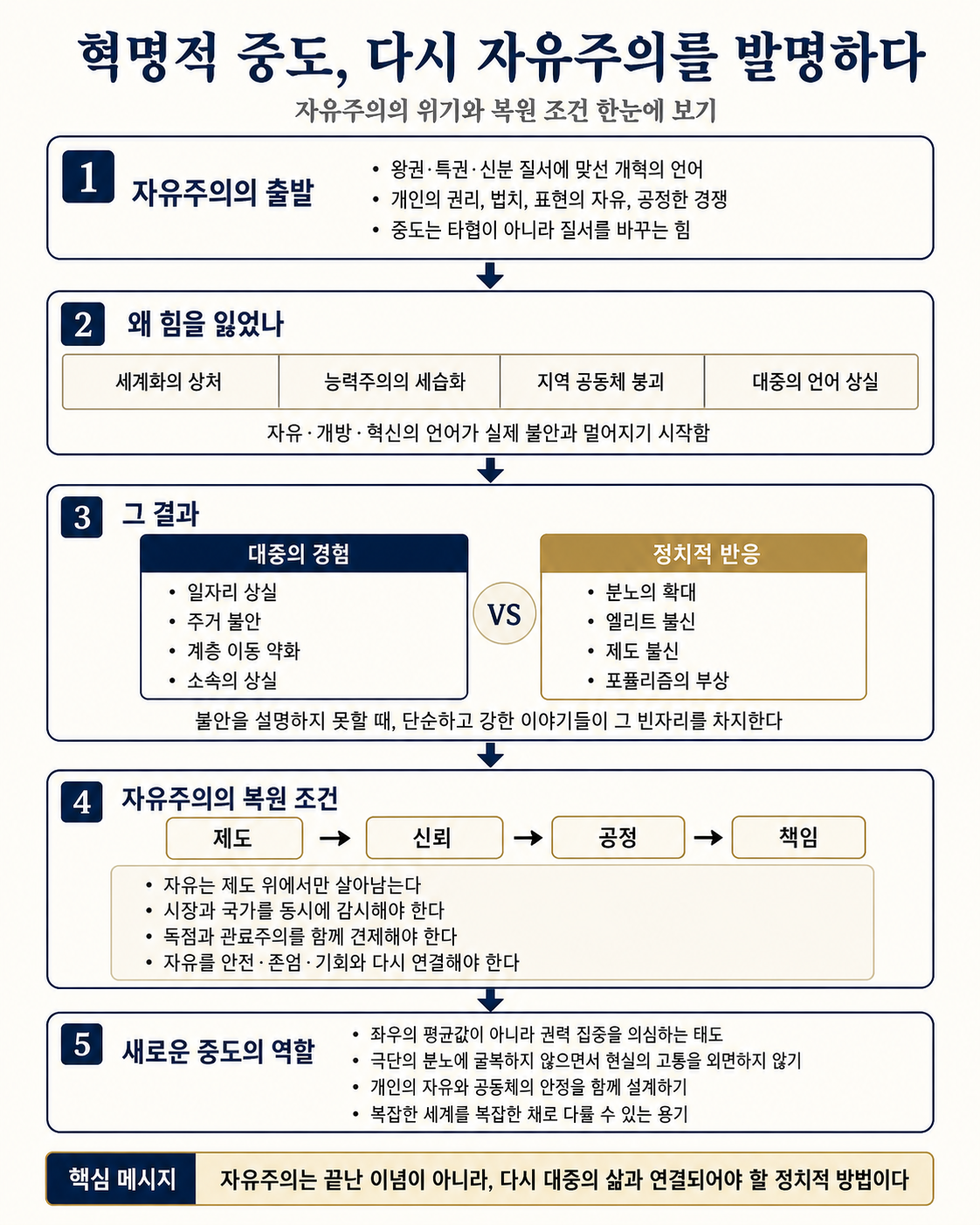
* The center is not a powerless compromise, but a place of reform. The liberal center is not the average of left and right. It is a political attitude that questions and dismantles the places where power and privilege harden. The essence of the center lies in the courage to keep dealing with complex realities between old orders and the simplistic slogans of the extremes.
* Liberalism weakened as it lost the language of the people. As words such as freedom, openness, competition, globalization, and innovation grew distant from the real insecurities many people experience, liberalism lost its persuasive power. When it fails to explain job loss, housing insecurity, the collapse of local communities, and the breakdown of social mobility, populism occupies the empty space.
* Freedom works only on institutions and trust. Freedom does not automatically arise when the state withdraws. Individual freedom becomes real only when there is fair law, good education, markets free from monopoly, trusted public institutions, and a social foundation that allows people to stand up again after failure.
* A new liberalism must monitor both the market and the state. Neither market fundamentalism nor state fundamentalism can solve today’s crisis. Liberalism must check corporate monopoly and bureaucracy, platform power and state power alike, while designing fair competition and a social safety net together.
* The recovery of liberalism begins with self-criticism. Liberalism cannot regain strength by speaking only of its past achievements. It must honestly acknowledge the wounds of globalization, the inheritance of privilege within meritocracy, the arrogance of technological elites, and the collapse of community, while reconnecting freedom with security, fairness, belonging, and dignity.
***
The Boldest Political Language
The word “center” has little force today. The more politics splits toward the extremes, the more the center appears to be a vague gray zone. It is treated as a temporary shelter for people without strong convictions, clear anger, or decisive will. One side calls for the defense of markets and tradition, while the other foregrounds the state and equality. Those who stand between them are often misunderstood as people who simply watch both sides and avoid commitment. Yet when we look back to the era in which liberalism first emerged, this image is almost the opposite of the truth. The liberal center was not a quiet compromise. It was the boldest political language against monarchy, privilege, inherited status, and closed social orders.
The world in which liberalism was born was a closed world. The status into which one was born determined the boundaries of life. Religion and thought required the permission of power. Economic activity was bound by privileged groups, guilds, and local barriers. The individual was not someone who could design life freely, but someone who had to live within the place assigned by the state, the church, and custom. In such a world, the statement “the individual is a bearer of rights” was by no means moderate. The claim that “all people must be equal before the law” was also dangerous. The demand that “freedom of expression and publication must be protected” was likewise a threat to established power. From the beginning, liberalism was an idea that shook the basic arrangement of the world.
The strength of liberalism did not lie only in abstract praise of freedom. More important was its ability to identify, one by one, the barriers that blocked human possibility and to dismantle them through institutions. The rule of law, parliament, freedom of the press, religious toleration, private property, freedom of contract, fair competition, freedom to choose one’s occupation, and social mobility through education were all devices that released human beings from fixed positions. Liberalism was not a doctrine of “do whatever you want.” It was an institutional imagination designed to prevent power and privilege from monopolizing the human future.
In that sense, the lost power of liberalism is its reforming spirit. Liberalism was once a language that opened a closed world. Yet at some point, it began to look like a language for managing the existing order. It narrowed into the language of financial markets, globalization, highly educated elites, international organizations, professional bureaucrats, and the metropolitan middle class. The problem begins when liberalism no longer sounds like a promise to open opportunities to more people, but like a logic by which those who already have opportunities defend their own order. Liberalism appears outdated not because it is inherently old, but because it has forgotten its own reforming origins.
Liberalism That Lost the Language of the People
Modern liberalism has achieved a great deal. Individual rights have expanded, markets have lifted countless people out of poverty, and education and technology have widened the range of choices in life. Awareness of the rights of women, minorities, and religious and cultural differences has grown beyond comparison with the past. Democratic institutions have made power replaceable, and the rule of law has restrained the arbitrary rule of those in power. Without the liberal order, today’s open society, civil rights, knowledge economy, and global exchange could hardly exist in their current forms.
Yet great achievements do not erase failures. Globalization provided consumers with cheaper goods, but left some regions with factory closures and job losses. Technological innovation increased convenience and productivity, but weakened the foundation of middle-skill labor. Meritocracy appeared fairer than a status society, but over time it hardened into a system in which classes with education and assets passed advantageous starting lines to their children. The language of diversity and openness expanded the rights of many people, but to some members of the public it also created the feeling that their sense of life and culture was being ignored.
The problem is that liberalism did not explain these fractures honestly enough. Speaking of the long-term benefits of globalization to people who have lost their jobs has little persuasive power. Emphasizing only individual choice and responsibility to young people who find it difficult to plan for the future because of housing prices and education costs can also sound cruel. In a society where local communities have collapsed, stable jobs have disappeared, and the ladder of class mobility has broken, openness and innovation no longer sound like words of hope. They sound like words that beautify insecurity.
Political language has power when it can explain reality. When words such as freedom, competition, diversity, globalization, and innovation begin to diverge from people’s lived experience, other languages take their place. “You are struggling not because you failed to adapt, but because someone took what was yours.” “The country has been ruined because elites betrayed the people.” “Complex institutions and debate are unnecessary. A strong leader can fix it.” Populism grows precisely in this gap. When liberalism fails to explain insecurity, anger looks for a simpler and harsher story.
The Space Populism Occupied
Populism is not a sudden phenomenon that appeared outside liberalism. It is the result of questions liberalism failed to answer. Populism gains strength when more people feel that parliaments only talk, bureaucrats are slow, and experts do not understand reality. When laws and institutions are seen as shields for the strong and barriers for the weak, the core devices of liberalism become objects of distrust. The rule of law appears to be a protective device for the privileged. Freedom of the press appears to be a monopoly of elite discourse. Independent institutions appear to be bureaucratic powers that block the will of the people.
Populism turns complex problems into simple stories. Society is divided into the good people and the corrupt elite, and the causes of suffering are assigned to traitors and outsiders. Such stories are dangerous, but powerful. It is difficult and exhausting to examine complex causes such as economic structures, technological change, international trade, educational gaps, and regional inequality. By contrast, the statement “they ruined your life” is easy, fast, and emotionally clear. In a tired society, simple anger spreads much faster than complex explanation.
The emotion populism touches is not anger alone. Beneath it lies a deeper loss of belonging. Liberalism is strong in protecting individual rights, but it has had a relatively weak language for where people belong, what they must protect together, and why they must take responsibility for one another. It matters to say that the individual is free. But when that individual becomes isolated and insecure, freedom becomes hollow. There are more choices, but fewer stable lives. Mobility has increased, but local communities have weakened. Freedom of expression has expanded, but the shared language through which people understand one another has become thin. At that moment, people seek belonging before freedom.
Therefore, it is not enough to treat populism simply as the result of ignorance and agitation. Populism mixes in falsehoods, but it uses real insecurity. If liberalism dismisses that insecurity merely as irrational anger, it will lose the public again. For liberalism to recover, it must criticize the falsehoods of populism while also explaining, in its own language, the real pain that populism has captured. It must say why people’s lives are being shaken, what is unfair, which institutions have broken down, and how opportunities can be created again. Liberalism will not return through denunciation alone. It needs better explanation and more substantial reform.
Freedom Survives Only on Institutions
The core of liberalism is the dignity of the individual. A person is not an appendage of the state or the group, but has the right to design life for oneself. Yet freedom cannot stand alone. For freedom to work in actual life, it needs institutions that support it. Law must be fair, education must become a path for class mobility, and markets must not harden into monopoly and privilege. The press must monitor power, public institutions must not lose trust, and citizens must be trained not to see those with different opinions only as enemies.
Freedom does not arise simply because the state withdraws. It lasts only on good institutions and social trust. A free market does not mean that everyone is free. For those who already possess capital, information, and education, competition can become opportunity. But for those with weak foundations, the same competition becomes another name for insecurity and exclusion. Conversely, the promise of state protection does not automatically expand freedom. The state can reduce risk, but it cannot design every life on behalf of the individual. What matters is not whether government is big or small. The key question is what kind of institutions give people the real ability to choose.
For liberalism to regain strength, it must make the meaning of freedom thicker. What is needed is not freedom as simple noninterference, but freedom as the capacity to make real choices; not the freedom of isolated individuals, but freedom within trustworthy institutions; not mobility for the privileged, but broader social mobility. If freedom is not connected to the conditions of life, liberalism becomes empty speech. Freedom becomes persuasive when people have a foundation on which they can stand up again even after failure, a belief that effort can gradually improve life, and a confidence that rules do not operate only in favor of the strong.
The language of responsibility must also be revived. Freedom matures when it is joined with responsibility. Freedom of expression must come with an attitude that does not silence others. Economic freedom must come with responsibility for maintaining fair rules. Individual choice must come with a sense of how that choice affects the lives of others. One reason liberalism has weakened today is that the language of rights remains strong, while the language of responsibility has become thin. Rights are emphasized, but duties are spoken of weakly. Choice is discussed, but the social consequences created by that choice are not sufficiently questioned. When this balance collapses, liberalism is easily misunderstood as selfishness.
Beyond Big Government and Small Government
Today’s political debates remain trapped in the old framework of big government versus small government. One side says the state must intervene more to correct inequality and market failure. The other argues that the state must step back so that the creativity of individuals and companies can flourish. Yet the reality of the twenty-first century has long since moved beyond this simple structure. Platform monopolies, artificial intelligence, the climate crisis, supply chain reorganization, aging populations, housing insecurity, regional decline, and educational inequality cannot be solved by the state simply withdrawing. Nor can they be solved by the state directly managing everything.
What is needed is not a debate over size, but a debate over capacity. A liberal state is not a weak state. What liberalism opposes is incompetent intervention and arbitrary power, not the capacity of the state itself to solve public problems. For the rule of law, markets, and individual freedom to function properly, the state must in fact be capable enough. It must monitor monopolies, guarantee fair competition, provide education and infrastructure, reduce social risks, and design long-term investment. The problem is not whether the state grows or shrinks. The problem is whether the state can escape capture by privileged groups and function as a fair referee and a designer of the future.
The market must also be reinterpreted. The reason liberalism has defended the market is not only that markets help people make more money. The market was originally a device of openness against privilege and monopoly. It was emancipatory in the sense that anyone could enter, compete with ability and ideas, and start a new business without the permission of those in power. But when the market combines with giant corporate monopolies, algorithmic domination, excessive financial capital, and the inheritance of wealth, it no longer functions as a device of freedom. It becomes a new device of privilege. To defend the market, one must defend not market fundamentalism, but antitrust, fair competition, transparent rules, and social mobility.
At precisely this point, the center can become revolutionary again. The center is not the average of left and right. It is an attitude that suspects the concentration of power. Whether it is state power, corporate power, bureaucratic power, platform power, or the power of knowledge elites, any power that hardens without checks corrodes freedom. Therefore, a new liberalism must monitor both the market and the state. It must criticize both the inefficiency of bureaucracy and the greed of corporate monopoly. It needs an institutional design that does not turn individual rights and communal stability, economic dynamism and the social safety net, into enemies of one another.
The Test of Liberalism Facing Korean Society
The crisis of liberalism is not only a problem of Western politics. Korean society stands before the same question. Korea has passed through industrialization, democratization, globalization, and digital transformation in a short period of time. In the process, individual rights and choices expanded greatly. Education and markets provided a path upward for many people, and democracy built an institutional foundation for the transfer of power. Yet because the pace of change was so fast, the fractures are also deep. Competition created opportunities, but at the same time exhausted life. Meritocracy looked fairer than a status society, but at a certain point it became a language that justified gaps at the starting line.
The point at which liberalism becomes most vulnerable in Korean society is the sense of fairness. Liberalism respects individual effort and choice, but it can function only when there is trust that the structure evaluating that effort is fair. When fairness is questioned in entrance examinations, hiring, real estate, military service, taxation, and law enforcement, the language of liberalism quickly loses power. People feel anger before freedom, and demand punishment before procedure. When the rule of law fails to gain trust, the language of harsh punishment becomes popular. When parliament fails to show the capacity to solve problems, the desire for a strong leader grows. This is not a problem of one political camp. It is a crisis of trust in liberal institutions as a whole.
The tension between freedom of expression and social respect is also growing. Korean society has diversified rapidly, but it has not accumulated enough training in the coexistence of different values. Debates over gender, generation, region, ideology, historical memory, labor, and education easily turn into moral wars. The attitude of seeing the other side as a danger to be eliminated rather than as someone to be persuaded becomes stronger. At such moments, tolerance and debate, the core of liberalism, weaken. Tolerance does not mean treating all opinions as equally right. It is a political technique that makes it possible to deal with opinions one dislikes without violence or suppression.
The insecurity of the younger generation is also an important point that will decide the future of liberalism. Liberalism says, “Choose for yourself.” But in a society where the cost of choice has become excessive, this can easily become a burden. When buying a home is difficult, when stable employment is hard to obtain, when marriage and childbirth become economic gambles, and when old age is increasingly pushed onto individual responsibility, freedom becomes not liberation but risk. A new liberalism must ask how to restore the foundation on which people can choose before demanding more choices from individuals. If housing, education, labor, care, and regional opportunities collapse, individual freedom remains only nominal.
Liberalism That Fights Again
For liberalism to live again, it must break away from a defensive posture. It cannot persuade the public through passive excuses such as “at least the current system is not the worst.” People feel that their lives are insecure now, and speaking only of past achievements is not enough. Liberalism must acknowledge not only the achievements of the world it created, but also its failures. It must honestly address the regional wounds left by globalization, the new inheritance created by meritocracy, the monopolization of markets, the power of technological elites, the fatigue surrounding political correctness, and the dissolution of community. Liberalism without self-criticism appears as moral superiority, and moral superiority easily provokes resentment in today’s politics.
Yet it must not remain only in self-criticism. Liberalism still has a powerful asset. It has the ability to recognize error and correct itself. Authoritarianism hides failure, populism shifts responsibility to external enemies, and extremism treats doubt as betrayal. By contrast, liberalism can revise itself through public debate, transfers of power, judicial checks, monitoring by the press, and criticism from civil society. The strength of liberalism lies not in perfection but in corrigibility. Its core is that it is not an ideology that sets one answer and forces the world to fit it, but a political method that recognizes human imperfection and continues to make corrections.
The liberalism needed today must be clearer. It must protect freedom of expression while preventing falsehood and agitation from destroying the public sphere. It must preserve the dynamism of markets while preventing monopoly and inheritance from killing competition. It must protect individual rights while not evading communal responsibility. It must recognize the role of the state while remaining alert to bureaucracy and the abuse of power. It must respect diversity while not tearing society apart into endless identity wars. This balance is not easy. But liberalism never promised an easy path. Liberalism is an advanced civilizational technique for managing difference without violence, based on the premise that human beings are different from one another.
In the end, the future of liberalism depends on whether the center can recover courage. Here, the center is not the average of the two sides. It is an attitude that refuses to surrender to the anger of extremes while also refusing to ignore real suffering. It is a political imagination that trusts markets but acknowledges market failure, uses the state but remains wary of state arrogance, and defends individual freedom without isolating the individual. The center is not a vague gray zone, but the courage to deal with a complex world as complex. In an age overflowing with simple slogans, this courage is rarer and more important.
Revolution does not always begin at the extremes. Sometimes the deepest change begins with the refusal to confine human beings to a single identity, a single class, a single camp, or a single anger. To redesign institutions in which different interests and desires can coexist, without splitting a complex society into the language of simple hostility, is itself a bold reform. For liberalism to become the language of the people again, it must reconnect freedom with security, fairness, belonging, and dignity. Freedom must not be merely a right written in legal provisions, but a social foundation on which people can rise again even after failure. Openness must not be merely a slogan about opening borders, but an institution that allows more people to access opportunity. Fairness must not be an order to accept the results of competition, but a process of constantly examining the starting line and the rules of that competition.
Liberalism is not a dead ideology. It has simply been too accustomed for too long to the world it once won. Now it must fight again. It must fight privilege and monopoly, incompetent institutions and arrogant elites, populism that exploits anger, and authoritarianism that feeds on fear. Above all, it must fight the laziness within itself. Liberalism will live again when those who speak of freedom can actually change the lives of people who feel insecure. At that moment, the center will no longer be a powerless compromise. It will become the name of the most difficult reform: rebuilding a common world that has fallen apart.

.jpg)
.jpg)
.jpg)