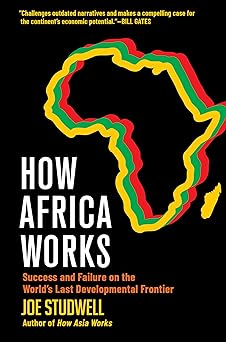
Why Africa Is Still the World’s Last Growth Frontier
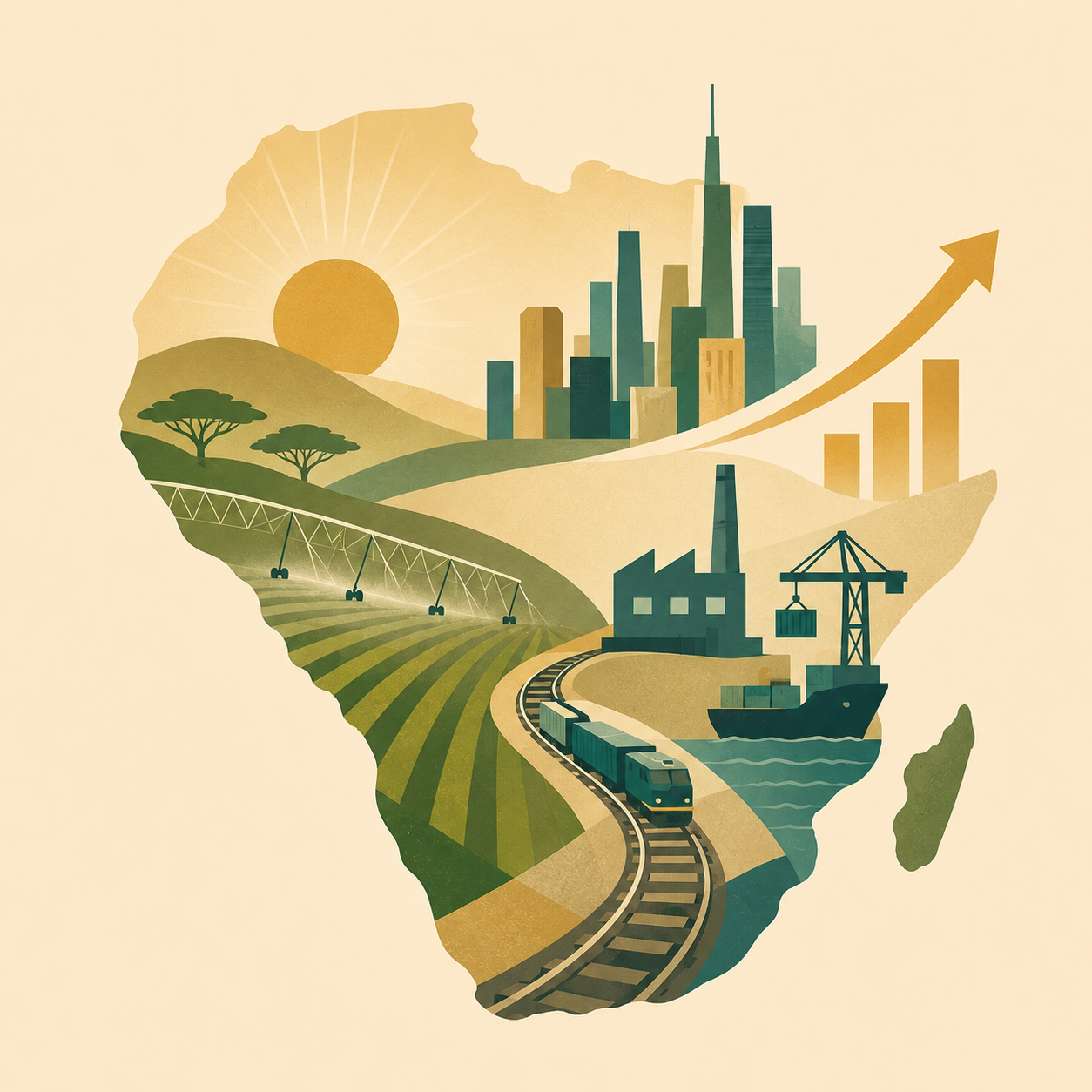
The era of explaining Africa only through the language of aid and poverty is coming to an end. The important question now is not “how much help should be given,” but “under what conditions does a country actually develop?” When we return to the old grammar of growth?agriculture, manufacturing, and state capacity?Africa begins to appear not as the periphery of the world economy, but as a central stage of the next global order.
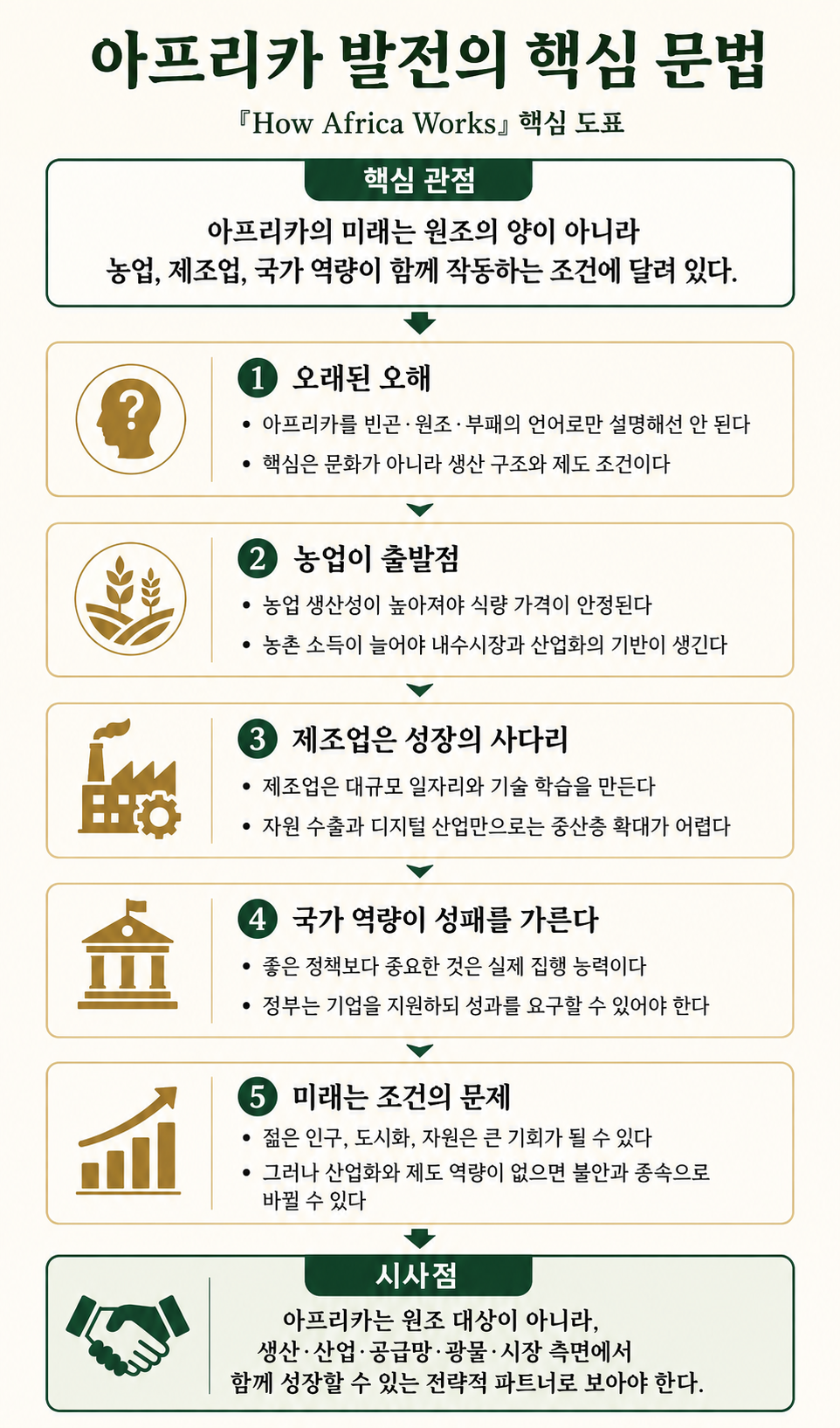
[Key Message]
* Africa’s problem is not simply a lack of aid, but the weakness of its production structure. Sustainable growth cannot be created by external support alone; it becomes possible only when agriculture, industry, and institutions move together.
* Agriculture is the starting point of development. Only when rural productivity rises can food prices stabilize, domestic markets emerge, and the accumulation needed for manufacturing become possible.
* Manufacturing is the key ladder that allows poor countries to become middle-class societies. The digital economy and resource exports alone cannot sufficiently create large-scale jobs, technological learning, or productivity growth.
* State capacity matters more than good policy. Development is determined not by the ability to design plans, but by the ability to implement and revise them on the ground while disciplining companies and markets.
* Africa’s future is not a matter of optimism or pessimism, but of conditions. A young population, resources, and urbanization can become opportunities, but without industrialization and institutional capacity, they can turn into new forms of instability and dependency.
***
The Oldest Misunderstanding Surrounding Africa
There is a set of words that is repeated whenever Africa is discussed: poverty, aid, civil war, corruption, famine, refugees, and resource plunder. Of course, these words are not fiction. Many African countries have indeed faced the legacy of colonial rule, fragile administrative systems, weak industrial foundations, unstable political orders, the climate crisis, and debt burdens all at once. The problem, however, is that these words have stood in for the whole of Africa for too long. An entire continent has been consumed almost as a synonym for failure, while the distinct histories, institutions, and industrial conditions of individual countries have been flattened and erased.
For a long time, explanations of the African economy have largely followed two paths. One is an aid-centered view that assumes problems can be solved if more external assistance is provided. The other is a resigned view that development is ultimately difficult because of corrupt politics and weak institutions. The two perspectives may seem different, but they share something in common. They do not ask enough questions about what kinds of production structures are actually being formed within Africa, how farmers live, under what conditions companies grow, and how states coordinate markets.
The process by which a poor country becomes a wealthy one is not an abstract moral tale. Economic development does not happen through goodwill alone. Reports from international organizations, development aid, democratic institutions, and slogans about attracting investment are not enough either. Development is a complex process of accumulation that begins on the land, moves into factories, and then expands into cities and institutions. Agricultural productivity must rise for food prices to stabilize. Rural incomes must increase for a domestic market to emerge. Labor that moves into cities must be absorbed by manufacturing so that wages and skills can grow together. And there must be state capacity capable of pushing all these processes in a coherent direction. In the end, reading Africa anew means not merely looking at the symptoms of poverty, but examining why the conditions for development have failed to work and where they may begin to work again.
At this point, Africa carries the full weight of the phrase “the world’s last developmental frontier.” The word “last” does not only mean lagging behind. It also means not yet decided. In a world economy where advanced countries have already entered aging and low growth, China’s pace of growth has slowed, and global supply chains are being shaken by restructuring, Africa is still a continent with a young population, expanding cities, vast land, abundant minerals, and a growing consumer market all at once. But possibility itself is not achievement. A young population becomes social unrest if there are no jobs. Abundant resources become channels of plunder if institutions are weak. Urbanization, if it proceeds without industry, produces vast zones of informal poverty. Africa’s future cannot be easily summarized as either optimism or pessimism. The core issue is conditions. Under what conditions can Africa become a continent of growth?
Industry Cannot Be Born Unless Agriculture Changes First
When people talk about development, they often first think of factories, ports, highways, digital platforms, and high-tech industrial complexes. But the growth of a poor country usually begins in fields and farms. If agriculture remains backward, manufacturing cannot endure for long either. When food prices are high and unstable, the cost of living for urban workers rises, and wage competitiveness weakens. When rural incomes are low, the domestic consumer market cannot grow. When farmers cannot generate a surplus, savings and investment are difficult to create, and the state has only a narrow base from which to collect taxes. Agriculture, in other words, is not simply a primary industry. It is the social foundation that supports the base of industrialization.
The growth experience of East Asia has repeatedly shown this point. Japan, South Korea, Taiwan, and China all had, to varying degrees, agricultural reform and improvements in rural productivity during their early growth periods. When farmers can use land securely, when they have incentives to increase production, and when the government organizes agriculture through irrigation, fertilizer, seeds, credit, and price policies, the countryside changes from a space of poverty into a space of accumulation. Cheap food stabilizes the livelihoods of urban workers, and increased rural income creates demand for manufactured goods. Agriculture becomes the platform for manufacturing.
Africa’s difficulty lies in the fact that this connection has been broken in many places. Many countries have large areas of land, but the productivity of small farmers remains low. In many cases, land ownership and usage rights are unstable, and because irrigation facilities, rural roads, storage facilities, and cold-chain distribution networks are insufficient, post-harvest losses are also large. Farmers lack the money to buy fertilizer and seeds, while financial institutions view agriculture as a risky sector. Since routes to market are unreliable, the incentive to produce more is also weak. On top of this, the climate crisis has brought more frequent droughts, floods, and pest outbreaks. Agriculture remains the livelihood base for a large share of the population, but in many cases it has not been sufficiently transformed into an engine of national growth.
This problem is difficult to solve through aid alone. Distributing fertilizer, providing food support, and carrying out pilot projects in specific regions can be helpful in the short term. But for agriculture to truly change, land systems, credit, agricultural prices, distribution infrastructure, rural education, local administration, cooperatives, and private processing industries must move together. A farmer producing more in a single year and the agricultural structure changing are entirely different matters. The latter requires sustained state intervention and implementation capacity. More important than a good plan is the power to revise and push that plan forward year after year.
There is another reason agriculture matters in discussions of Africa’s development. Agriculture is necessary for manufacturing, but it is also decisive for political stability. In countries where the rural population is overwhelming, if farmers’ lives do not improve, cities become unstable and politics tends to depend on short-term subsidies and patronage during every election cycle. If rural areas remain poor, young people rush into cities, but those cities lack the industries needed to absorb them. As a result, informal labor, temporary jobs, low wages, and housing insecurity accumulate. Industrialization that neglects agriculture ultimately weakens the foundation of the entire society.
That is why, in order to understand Africa’s future, one must look at rural productivity before skyscrapers or fintech apps. Who uses the land? What can farmers plant? Where can they sell their harvests? Are there roads and warehouses? How does the government respond to price crashes and climate disasters? Does the surplus generated in agriculture lead to food processing, logistics, packaging, fertilizer, machinery, and light industry? These questions are the most realistic starting point for development.
Manufacturing Is the Ladder That Allows Poor Countries to Become Middle-Class Societies
In today’s world economy, people often say that the age of manufacturing is over. As services grow, the digital economy expands, and artificial intelligence moves to the center of industry, some argue that poor countries no longer need to pass through manufacturing. In Africa in particular, as mobile payments, fintech, platform labor, digital education, and remote services rise rapidly, expectations have grown around “development that skips the factory.” But there is a dangerous illusion in this expectation. Digital industries are important, but they still find it difficult to fully replace manufacturing when it comes to steadily absorbing large numbers of low-skilled workers, raising productivity, and earning foreign currency through exports.
The power of manufacturing does not lie simply in making things. Manufacturing creates discipline. In the process of arriving at work at fixed times, meeting quality standards, keeping delivery deadlines, operating machinery, improving processes, and reducing defect rates, workers and companies learn new habits of production. Even in lower-level industries such as garments, shoes, food processing, plastics, furniture, and construction materials, once circuits of production and export are created, technological learning begins. A country’s firms do not produce semiconductors or electric vehicles from the beginning. They start with low-value-added manufacturing and gradually move toward more complex products. Climbing this ladder is industrialization.
Africa has not had enough of this ladder. Resource exports can earn foreign currency, but their job-creation effects are limited. Resources such as oil, copper, cobalt, gold, and diamonds can have a large impact on national finances, but they do not create employment on a large scale. Moreover, resource prices fluctuate according to international markets, and profits can combine with political power to fuel corruption. Manufacturing, by contrast, draws more people into the labor market, changes urban consumption, education, housing, and transportation, and becomes the foundation for the formation of a middle class. Resources alone are not enough to turn development into sustainable social change.
Of course, the manufacturing environment today is much more difficult than it was when East Asia was growing. China has already built an enormous manufacturing ecosystem, and countries such as Vietnam, Bangladesh, India, and Mexico have also secured places in global supply chains. Automation reduces the advantages of low-wage labor, and protectionism in advanced countries narrows the path for export-led growth. Power shortages, port delays, high logistics costs, unstable customs procedures, low skill levels, and a lack of policy consistency also hold back African manufacturing. More difficult than building a factory is making sure that the factory can operate predictably every day.
Even so, the possibility of manufacturing has not disappeared. Rather, as global supply chains are being reorganized, new openings are emerging for Africa. Rising wages in China, U.S.-China conflict, companies’ efforts to diversify supply chains, geographical proximity to Europe, a young labor force, and growing domestic markets can all become opportunities. Fields such as clothing and footwear, food processing, pharmaceutical packaging, construction materials, agricultural machinery repair, solar-related components, and primary processing of battery minerals can serve as realistic starting points. What matters is not grand slogans about advanced industries, but a structure in which even lower-level manufacturing can learn steadily and expand in scale.
To develop manufacturing, it is not enough simply to attract foreign companies. Creating industrial parks and offering tax benefits may be necessary, but they alone do not create a sustainable industrial ecosystem. Electricity, logistics, vocational training, finance, customs, land, labor laws, technical support, and quality certification must work together. The government must neither protect companies unconditionally nor abandon them entirely to the market. It must provide support for a certain period, demand performance, and adjust benefits based on exports, employment, and productivity improvements. The core of a developmental state is not helping companies for its own sake, but making them actually learn and compete.
More Difficult Than Good Policy Is the State That Executes It
The most frequently underestimated factor in discussions of economic development is state capacity. Good policies are easy to write on paper. Few people would oppose statements such as: agricultural productivity must be raised, manufacturing must be fostered, education must be strengthened, corruption must be reduced, and infrastructure must be expanded. The problem is execution. Who will implement the policy? Which ministry will take responsibility? Can local governments move? Does the budget actually reach the field? Under what rules do companies and bureaucrats interact with each other? Can failed projects be stopped and redirected? Faced with these questions, many development plans lose their force.
State capacity does not simply mean that the government is large. Large government spending does not necessarily mean that the state is strong, and a large number of officials does not mean that the administration functions well. Real state capacity is the ability to set goals, gather information, understand conditions on the ground, coordinate interests, enforce rules, and evaluate performance. More important than building a road is designing it so that it actually connects production areas and markets. More important than building schools is ensuring that students can actually read and calculate. More important than creating an industrial park is making sure that companies inside it can reliably secure electricity, logistics, and workers.
Many African states were designed during the colonial period not as states intended to raise the productivity of citizens, but as states intended to extract resources and control order. Even after independence, administrative systems remained weak, and political power often operated around specific regions, ethnic groups, or patronage networks. Even when elections were introduced, short-term distributive politics often took precedence over long-term development plans. External aid provided necessary funding, but at times it also weakened the relationship in which governments collect taxes from their own citizens and become accountable to them. If the tension between taxpaying citizens and a government that must deliver results is weak, the state struggles to become an organizer of development.
Building state capacity is not a matter that conflicts with democracy. On the contrary, for accountable democracy to function, administration must be strong. Elections can change leaders, but it is administration that moves schools, hospitals, roads, taxes, security, and industrial policy every day. Democracy creates the legitimacy of policy, while administration creates its continuity. One without the other is insufficient. The distinction between Africa’s success stories and failure stories also emerges here. Even if a leader has vision, achievements scatter if the bureaucracy does not move. Even if institutions exist, reform remains a slogan if companies and farmers cannot feel its effects.
State capacity is also connected to the attitude toward markets. States that fail at development easily fall into one of two extremes: suppressing the market or neglecting it. If companies are treated as objects of political privilege, competition disappears. If the market is left completely to laissez-faire, early industries do not gain the time they need to grow. Countries that have succeeded in development have usually walked the difficult middle path. They supported companies but demanded results, fostered specific industries but did not keep incompetent firms alive indefinitely, and encouraged exports while also building the foundations of domestic consumption and employment. This delicate coordination is the core of state capacity.
This is why Africa’s future does not depend simply on more investment or more aid. Money is necessary, but the capacity to absorb and transform money is more important. Even if there is a road budget, infrastructure will not lead to growth if the money disappears through corruption and poor construction. Even if education budgets increase, youth unemployment will not fall if teachers do not come to school or if education and the labor market are not connected. Even if industrial policy exists, manufacturing will not grow if companies and bureaucrats move according to relationships rather than performance. In the end, development is determined not by the names of institutions, but by the density of execution.
After China, Is Africa’s Time Coming?
The world economy is now passing through a major transition. China is no longer a factory that can provide endlessly cheap labor. The conflict between the United States and China is turning supply chains into matters of security, and Europe is redesigning its energy, raw material, and battery supply chains. The climate crisis is shaking food, water, electricity, and urban infrastructure, while artificial intelligence and automation are reshaping the future of labor. Amid these changes, Africa is receiving renewed attention. Its young population, urbanization, mineral resources, vast consumer markets, and geographical proximity to Europe and the Middle East are all becoming more prominent at the same time.
Africa’s demographic structure is one of the most powerful variables in the world. While many advanced countries and East Asian economies have entered aging, Africa is a region where the young population will continue to grow for a considerable period. This young population is a vast possibility. The labor force is abundant, the consumer market is expanding, and if education and technology are combined, it can become the foundation for new industrial growth. But population does not automatically become a blessing. Young people without jobs can become a source of political dissatisfaction and social unrest. If the number of educated young people increases but industry fails to absorb them, the gap between expectations and reality becomes even wider.
Urbanization is the same. A city is a space that can raise productivity. When people gather, markets expand, companies can find workers more easily, and information and technology spread quickly. But urbanization without industry only increases the density of poverty. Slums expand, informal jobs grow, and problems involving transportation, housing, sanitation, and security explode. For cities to become engines of growth, manufacturing, services, infrastructure, housing policy, and local administration must move together. African cities are likely to grow faster than almost any others in the world, but it has not yet been decided whether they will become spaces of production or remain spaces of survival.
Resources are also double-edged. A significant share of the strategic minerals needed for electric vehicle batteries, renewable energy, semiconductors, defense industries, and digital infrastructure is connected to Africa. Minerals such as cobalt, lithium, manganese, copper, and graphite are becoming core materials of the global industrial order. But if the structure of extracting minerals and exporting them as raw ore is simply repeated, Africa faces a great risk of remaining once again a supplier of raw materials to the world economy. The real challenge is how much of the value chain after extraction can remain inside the continent. Only when refining, processing, component production, logistics, technical training, environmental regulation, and the distribution of benefits to local communities are combined can resources become a platform for growth.
The climate crisis makes Africa’s development even more difficult, while also providing a rationale for new investment. Africa is not a region that has historically emitted large amounts of greenhouse gases, but it is highly vulnerable to the damage caused by the climate crisis. Agriculture is shaken by droughts and floods, and urban infrastructure is exposed to heat waves and flooding. At the same time, fields such as solar power, wind power, green hydrogen, power grids, climate-adaptive agriculture, and water resource management can become new industrial opportunities. Here too, however, what matters is not merely that external capital comes in and establishes projects, but that the projects lead to local technology, jobs, and administrative capacity.
Therefore, the statement “Africa’s time is coming” is only half right. The arrival of a moment does not mean that opportunity opens automatically. The world is interested in Africa’s minerals, labor force, markets, and geopolitical position, but for that interest to lead to Africa’s development, bargaining power, institutions, and industrial strategy are necessary. Otherwise, Africa may once again become a space used according to the needs of external powers. For Africa to become an actor in the new world order, it must go beyond selling resources at higher prices and create structures of production and processing, technology and employment, taxation and reinvestment.
Is South Korea Ready to See Africa Not as an Object of Aid, but as an Industrial Partner?
In South Korean society, Africa still feels distant. In the news, civil wars, famine, coups, and infectious diseases come to mind first. For companies, risks appear larger than markets. In government cooperation, the language of aid and development projects is familiar. But in the future, the view that sees Africa simply as an object of support is likely to become increasingly outdated. Africa is a region that will inevitably be connected to South Korea in every respect: food, energy, minerals, population, consumer markets, supply chains, and diplomacy. The important question is how that connection will be formed.
South Korea is a country with development experience. It has a history of moving from an agricultural society to an industrial society, and from an aid recipient to a manufacturing powerhouse. But this experience cannot simply be applied to Africa as it is. South Korea’s development took place within the Cold War order, access to the U.S. market, industrial linkages with Japan, a strong bureaucracy, intense educational aspirations, compressed urbanization, and particular political-economic conditions. The era is different, and the region is different. Therefore, simplistic advice such as “do it like South Korea” is dangerous. What can be extracted from South Korea’s experience is not a success story, but a way of asking questions. How was agriculture made into a foundation of productivity? How was manufacturing used as a field of learning? How did the state support and discipline companies? How were education and industry connected? These questions matter more.
Cooperation between South Korea and Africa must become more concrete. Rather than abstract development discourse, practical connections should be built in areas such as agricultural productivity, vocational education, industrial park operation, small and medium-sized manufacturing, food processing, health infrastructure, digital administration, power grids, ports and logistics, battery mineral processing, and climate adaptation technology. Agricultural cooperation, for example, should not simply mean sending agricultural machinery. It should connect seeds, fertilizer, storage facilities, processing, distribution, finance, and education. Manufacturing cooperation should not end with building factories, but should include training local workers, building parts supply chains, and establishing quality standards together. Mineral cooperation should not stop at securing raw materials, but should include processing, environmental standards, and benefits for local communities.
For South Korean companies as well, Africa is a risky but difficult-to-ignore market. Infrastructure may be lacking, institutions may be unstable, and political risks may be high. But many global companies and countries already see Africa as part of their long-term strategy. China has entered deeply through infrastructure and finance. Europe is reconnecting with Africa through energy, migration, and security issues. Middle Eastern countries are expanding investments in food, ports, and logistics. If South Korea moves late, Africa may remain a distant market forever. On the other hand, if it rushes in but approaches shallowly, the possibility of failure is also high. What is needed is not short-term project acquisition, but long-term industrial partnership.
South Korea’s view of Africa must also change. Aid may be necessary, but the relationship must not be defined by aid alone. Africa’s younger generation is no longer an object of pity. They use smartphones, look for jobs in cities, dream of starting businesses, and demand better education and political rights. What they need is not charity, but opportunity and institutions, and realistic pathways connected to industry. The way South Korea builds relationships with Africa must also adapt to this change. It must not be a structure of a country that teaches and a country that learns, but a relationship between partners with different experiences.
The True Meaning of the Last Growth Frontier
When discussing Africa’s development, the things we must be most careful of are exaggerated optimism and old pessimism. Optimism says Africa’s future is bright because of its young population and abundant resources. Pessimism concludes that Africa’s growth is difficult because of corruption, civil wars, and weak institutions. But reality lies between the two. The possibility of growth clearly exists, but it will not be realized automatically. The causes of failure should not be sought in destiny or culture, but in production structures, institutions, and policy execution. And precisely for that reason, the possibility of change also exists.
Africa is not one story. It is a continent of more than fifty countries, countless languages and ethnic groups, different colonial experiences, and diverse political systems and industrial conditions. Some countries depend on minerals, some have great agricultural potential, and some dream of becoming hubs of services, logistics, and finance. Some countries bear deep scars from civil war, while others have relatively stable administrative systems. The moment Africa is grouped into a single failure or a single hope, it becomes impossible to see actual change. What matters is to look concretely at what conditions are functioning in each country.
The phrase “the world’s last developmental frontier” is therefore not merely rhetoric. It means that enormous questions still remain. Can agriculture become a foundation of productivity? Can manufacturing absorb a large young population? Can the state support companies while also disciplining them? Can resources become a platform for industrialization rather than a channel of plunder? Can cities become centers of production rather than concentrations of poverty? Can connection with the outside world become a partnership with bargaining power rather than another form of dependence? The answers to these questions will determine Africa’s future.
Understanding Africa is not a matter of observing the problems of a distant continent. It is a matter of reading where the twenty-first-century world economy is moving. Aging advanced countries, China facing slowing growth, companies redesigning supply chains, states trying to secure strategic minerals, and humanity worrying about food and energy amid the climate crisis will all be connected to Africa in one way or another. Africa’s success and failure are no longer Africa’s alone. The global order of production, consumption, resources, population, climate, and security is intersecting there once again.
In the end, the core point is simple. We must move beyond the questions of whether Africa is a continent to be helped, a market to invest in, or a space from which resources should be secured. The more fundamental question is this: in what ways can African countries build economies that produce, learn, accumulate, and negotiate on their own? And how can the outside world connect with that process in a fairer and more sustainable way without obstructing it? If we cannot answer this question, Africa will once again be consumed in the name of possibility. If, however, we begin to answer it seriously, Africa can become not the periphery of the world economy, but the center of the next theory of development.

.jpg)
.jpg)
.jpg)