The Age When Private Power Erodes Democracy- The Second Gilded Age Created by Technological Monopoly and Concentrated Wealth
The force that threatens democracy does not always arrive in the form of military boots, censorship, or a coup. Sometimes it comes as a more convenient platform, a faster algorithm, a smoother service, or a more powerful corporate ecosystem. When private power born inside the market begins to shake labor and livelihoods, information and public opinion, and even political choice, democracy weakens first not in institutions but in citizens’ everyday lives.
[Key Message]
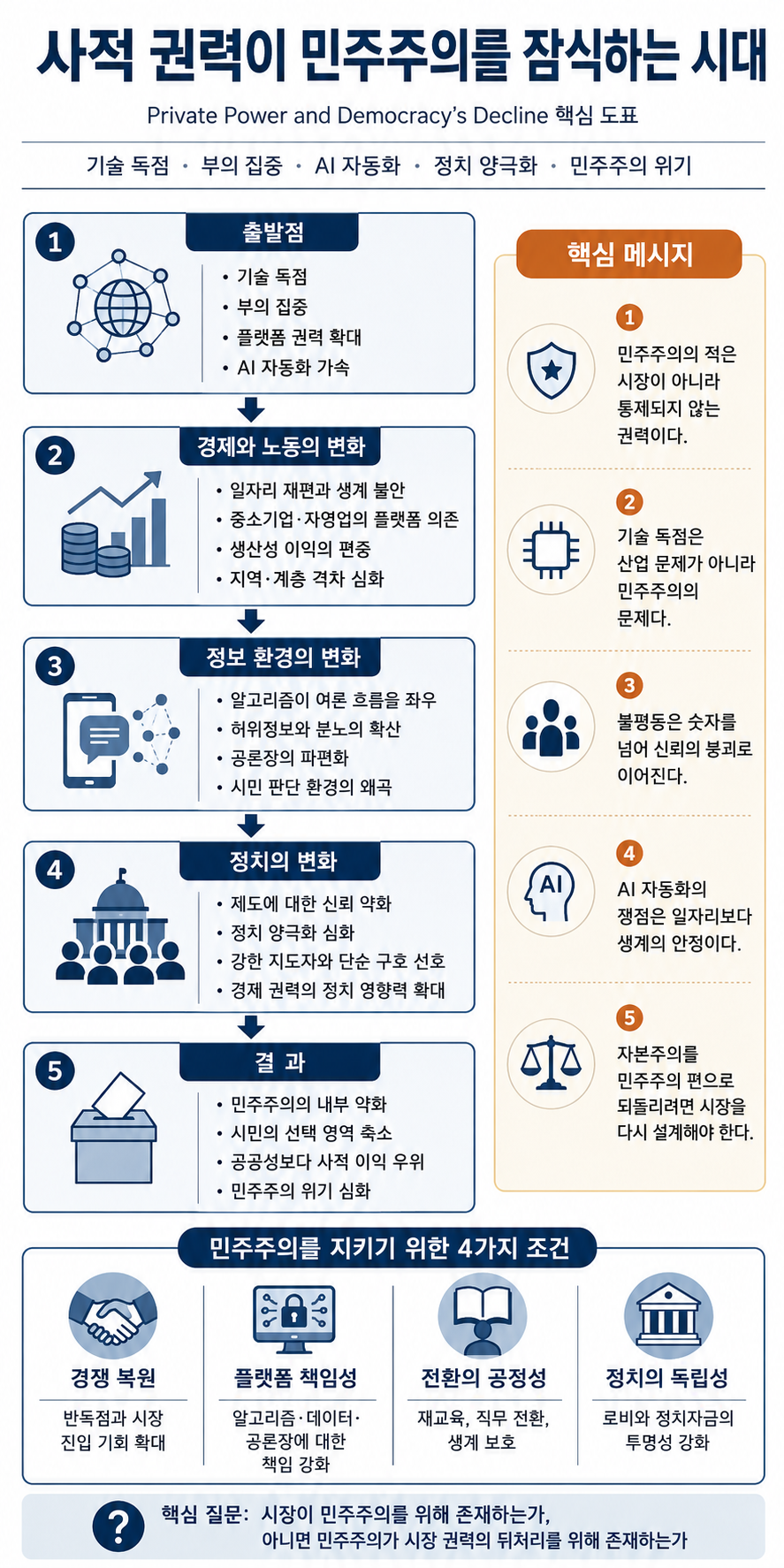
* The real threat to democracy is not the market itself, but uncontrolled private power. When large corporations and platforms begin to shape information, labor, public opinion, and political agendas, democracy weakens first in citizens’ everyday lives before it collapses in institutions.
* Technological monopoly is not merely an industrial issue; it is a democratic issue. Companies that control search, social media, cloud infrastructure, and artificial intelligence become not just businesses, but operators of social infrastructure.
* Concentrated wealth is not only a matter of numbers; it leads to the collapse of trust. When people feel that diligent work no longer improves their lives, they begin to lose faith in institutions, politics, and democratic procedures.
* The central issue of AI automation is not only job loss, but the stability of livelihoods. When the gains from technological progress are concentrated among a few while the costs of transition are passed on to workers, AI becomes a source of inequality and political anger rather than shared progress.
* To return capitalism to the side of democracy, the market must be redesigned. Innovation should be rewarded, but monopoly must be checked; corporate freedom should be recognized, but it must not be allowed to undermine civic freedom and citizens’ choices.
***
When the Winner of the Market Becomes the Designer of Society
Capitalism and democracy have long been regarded as systems that need each other. The market was believed to expand individual choice, competition was believed to disperse power, and economic prosperity was believed to grow the middle class. It was also possible to explain the relationship by saying that democracy gave citizens political rights, while capitalism gave them economic opportunity. At least until the late twentieth century, optimism was strong that these two systems moved together.
But the landscape of the twenty-first century is more complicated. The market still creates innovation, but the results of that innovation are not distributed evenly to everyone. Competition gives birth to new companies, but it also creates structures in which the winner takes control of the entire market. Technology seems to give people more freedom, but the moment the companies that control that technology begin to design people’s behavior and judgment, freedom changes into another form of dependence.
The core issue is not the market itself. It is the character of power formed inside the market. In the past, corporate power mainly influenced products and prices, employment and wages. Today’s platform power is far broader. Search engines become the gateway to knowledge, social media becomes the public square of opinion, cloud infrastructure becomes the foundation of industry, and artificial intelligence changes the way people work and judge. When companies are no longer merely business operators but become operators of social infrastructure, their influence moves beyond the boundaries of the economy.
Democracy is based on the premise of citizens’ political equality. Each person is given one vote, the public sphere must be open to all, and public decisions must be made through the deliberation of the community. But when private power with overwhelming wealth, data, networks, and lobbying capacity grows, political equality can easily remain only as a formality. Elections continue to be held and parliaments continue to exist, but the actual agenda tilts toward the interests of large corporations and the super-rich. The way democracy collapses is sometimes very quiet. The institutions remain in place, but the areas where citizens can actually decide gradually shrink.
The Return of the Second Gilded Age
Today’s technological monopoly recalls the Gilded Age of late nineteenth-century America. At that time, railroads, oil, steel, and financial capital grew explosively. Industrialization created new wealth, and the United States emerged as a massive economic power. But that wealth was concentrated in the hands of a few. Large corporations controlled prices, controlled workers, and exercised enormous influence over politics. The surface shone like gold, but inside, deep inequality and social fractures were accumulating.
The Gilded Age of the present unfolds not on railroads and oil, but on data and algorithms, platforms and artificial intelligence. If the monopolies of the past controlled physical infrastructure, the monopolies of today control digital infrastructure and the pathways of perception. People read news, buy goods, find work, communicate, and form political opinions through platforms. Convenience has increased, but the small number of companies that provide that convenience now stand in a position where they can coordinate the flow of society as a whole.
This change is dangerous because monopoly is difficult to see clearly. Railroad monopoly could be identified through tracks and fares. Oil monopoly appeared through production facilities and distribution networks. But digital monopoly seeps into users’ everyday lives. A platform that appears to be a free service collects users’ data and attention. Recommendation algorithms decide what people see, advertising systems predict what will be sold, and accumulated data makes it difficult for competitors to enter. Users feel that they are choosing, but the environment of choice has already been designed.
A structure in which the winner becomes an even stronger winner is also a problem. A platform with many users obtains more data, creates better services, and attracts even more users again. Latecomers struggle to overcome network effects and data gaps even if they possess technological capability. Startups often treat being acquired by a large company as the route to success rather than becoming independent competitors. The more vibrant the innovation ecosystem appears, the more actual power gathers around the larger platforms. Even if the language of competition remains, the structure of the market becomes increasingly closed.
Technological Monopoly Is Not an Industrial Problem but a Democratic Problem
Technological monopoly does not simply mean excessive concentration in a particular industry. It is connected to the entire way citizens encounter information, form opinions, sustain livelihoods, and make political judgments. When platforms become the center of the public sphere, algorithms become part of the political environment. What is shown more often, what disappears, and which emotions are amplified are directly linked to the quality of democracy.
Social media has expanded citizens’ ability to speak, while also creating a structure in which anger and false information spread rapidly. Provocative content receives more reactions, and more reactions lead to more exposure. Algorithms are not designed for mature civic debate but for increasing user time on the platform and advertising revenue. As a result, the public sphere easily becomes a battlefield of emotions rather than a space for deliberation.
Democracy requires a minimum agreement about facts. People may have different opinions, but there must be a basic shared understanding of what has actually happened. But when the information environment fragments, when each person sees a different reality, and when anger and conspiracy theories combine with a profit model, democracy’s capacity for deliberation weakens. Citizens encounter more information, but that does not mean they become better at judgment. A paradox emerges: the amount of information increases, while the common reality decreases.
In the realm of labor as well, platform power is connected to democracy. Platform workers appear to work freely, but in reality they depend on dispatching, ratings, commissions, and visibility rankings determined by algorithms. Small business owners meet customers through platforms, but at the same time they become dependent on advertising fees, commissions, search rankings, and review systems. Content creators can meet more readers, but a single change in platform policy can shake their entire revenue structure. When economic choices narrow, citizens’ political independence also weakens. Democracy does not operate only at the polling place. It is tested every day in workplaces and markets, in information environments and livelihood structures.
Inequality Is Not a Number but a Collapse of Trust
Concentrated wealth is often explained through statistics. The share of assets held by the top 1 percent, stagnant median wages, the gap between productivity and wages, rising housing costs, and the burden of education expenses are all brought into the discussion. But from the perspective of democracy, inequality is not merely a number. It is a question of how people feel about society. When some people use the rules to become endlessly richer while others feel that their lives do not improve no matter how diligently they work, trust in institutions collapses.
The danger of economic inequality is not only that it increases relative deprivation. The deeper problem is that citizens begin to doubt whether the rules of society operate fairly for them as well. When there are jobs but no future, wages but no way to bear housing, medical, and education costs, and elections but no sense that life conditions change no matter who comes to power, political anger accumulates.
This anger sometimes becomes energy for reform. But when left unattended for too long, it turns into cynicism toward democracy itself. Citizens come to want immediate punishment rather than waiting for procedures, and they are drawn to politics that identifies a clear enemy rather than politics that offers complex solutions. The rise of strong leaders, simple slogans, and the language of exclusion is not driven only by cultural conflict. Beneath it lie anxiety over livelihoods, the collapse of mobility, and a lost sense of fairness.
Democracy demands patience from citizens. They must wait for elections, endure debate, and recognize the rights of opponents. But when citizens feel that the economy gives them no reward, that patience weakens. Citizens who feel that democracy does not protect them become tempted to rely on power that appears faster and stronger than democracy. This is why political polarization deepens in a society where private power grows and public institutions weaken.
The Question of Livelihood Raised by AI Automation
Artificial intelligence makes this flow even more urgent. Automation in the past was generally believed to replace repetitive and physical labor. Factory automation, logistics automation, and office automation reduced certain jobs, but they also created new ones. But generative artificial intelligence and advanced algorithms have entered the realm of knowledge work. Fields once thought to depend on human judgment and expertise, including document writing, legal review, medical diagnostic assistance, software development, design, education, counseling, and research support, are being reorganized.
Technological development itself cannot be stopped. The question is who bears the cost of transition. Companies can quickly gain the benefits of higher productivity. They can reduce labor costs, increase work speed, and produce more results with fewer people. Workers, by contrast, are likely to shoulder the anxiety of transition, income loss, and the burden of retraining. A structure can repeat itself in which the fruits of technological change are concentrated among capital and platform owners, while the costs are borne by workers and local communities.
The core issue of the AI era is not only whether jobs disappear. The more important issue is the stability of livelihoods. Some jobs will disappear, some jobs will change, and some jobs will be newly created. But if citizens lose the ability to predict their own future in this process, the foundation of trust in democracy will be shaken. The faster technological change becomes, the stronger the social safety net and transition system society needs. Retraining, wage support, local economic recovery, job transition assistance, and the expansion of public services must move together.
Whether AI becomes a tool that helps workers or a pressure that pushes them out depends less on the technology itself than on institutional design. If corporate incentives are focused only on cost reduction and workforce cuts, AI is likely to increase inequality. By contrast, if AI is combined with worker capability building, productivity sharing, job redesign, and investment in public education, it can become a technology that raises the capacity of society as a whole. Democracy should not fear technology itself. It should fear a society that fails to ask who takes the gains from technology and who bears the cost of transition.
Political Polarization Is the Shadow of the Economy
Today’s political polarization is often explained as a culture war. Conflicts over immigration, gender, race, generation, region, and education level have moved to the front of politics. These conflicts certainly exist. But beneath them lie economic insecurity and distrust in institutions. People whose lives are stable have more room to tolerate difference, while people whose livelihoods are shaken experience conflict more sharply. In a society where the future feels closed, even small differences are interpreted as threats.
Economic anxiety changes political emotions. Citizens who feel that they have been pushed aside want to find the forces that pushed them aside rather than listen to complex structural explanations. Globalization, immigrants, elites, bureaucrats, the media, large corporations, foreign countries, and particular generations alternately become targets of anger. Politicians can easily mobilize this anger rather than resolve it. Anger gathers people quickly, and hostility creates strong loyalty. As a result, politics becomes not a space for solving problems but a battlefield for confirming identity.
Private power operates in this process in invisible ways. Large platforms monetize anger, the super-rich influence the agenda through political donations, and monopolistic corporations lobby to block regulation. Citizens turn their anger against one another, while the power that actually changes the structure hides behind the public sphere. The tragedy of democracy occurs here. Citizens who have been harmed come to see each other as enemies, while private power becomes stronger in the gap between them.
Polarization is not simply a state in which opinions differ. It is a state in which the other side is seen not as a democratic competitor but as a threat that must be eliminated. When that happens, elections become not procedures for deciding the direction of a community but battles to destroy the opponent. Democracy can survive only when defeat can be endured. But the moment politics feels like a matter of survival, defeat becomes unacceptable. Economic anxiety turns into political desperation, and political desperation weakens the rules of democracy.
Market Freedom and Civic Freedom Are Not the Same
The phrase “free market” remains powerful. The idea of reducing state interference, reviving entrepreneurship, and respecting individual choice has intuitive appeal. But market freedom does not necessarily mean civic freedom. The more the freedom of the strong expands in the market, the narrower the choices of the weak can become. The more freely large platforms set rules, the narrower the freedom becomes for workers, companies, creators, and consumers who depend on those platforms.
Freedom is not merely the absence of interference. There must be real conditions in which choices can be made. For a worker to leave a company, there must be another job. For a founder to grow independently, there must be market access not subordinate to a giant company. For citizens to judge information, there must be a public sphere free from false information and manipulative recommendation systems. If market freedom destroys these conditions, it is not an expansion of freedom but the privatization of power.
The binary question of whether to oppose or support capitalism is not enough. The more important question is what kind of capitalism can coexist with democracy. Markets can create innovation and productivity. Companies take risks and commercialize new technologies. Consumers can enjoy diverse choices. But when this power accumulates outside democratic control, capitalism undermines its own foundation. When citizens’ trust collapses, the middle class weakens, and politics polarizes, long-term market stability is also shaken.
It is not necessary to treat all accumulation of wealth as a problem. The question is how that wealth was created, how it affects society, and whether that power follows the principle of responsibility. Rewards for innovation are necessary, but a structure that uses innovation as a pretext to block competition, shake workers’ livelihoods, and monopolize political influence cannot be left unattended. When market freedom collides with civic freedom, democracy must redesign the market.
The Conditions for Returning Capitalism to the Side of Democracy
The central task for protecting democracy is not abolishing capitalism but controlling private power. Public power is checked by constitutions and elections, by courts and the press, by civil society. But private power often avoids restraint by hiding behind the language of efficiency, innovation, and consumer benefit. Convenient services cannot replace citizens’ rights. Low prices cannot make democratic control unnecessary.
The first condition is the restoration of competition. Antitrust policy is not merely a means of lowering prices. It is a device for protecting the plurality of society. When many companies exist in the market, when workers and consumers have choices, and when new companies can enter, economic power is dispersed. Competition is a question of economic efficiency and, at the same time, a condition of democracy.
The second condition is accountability for data and platform power. If platforms function like social infrastructure, their rules can no longer be left only to internal corporate judgment. Algorithmic transparency, data portability, fair standards of exposure, responsibility for the spread of false information, and the protection of small business owners and creators must be discussed together. Freedom of expression is important, but leaving a structure that monetizes anger and manipulation untouched is not freedom.
The third condition is the social sharing of the benefits of technological transition. If AI and automation raise productivity, the fruits should not go only to shareholders and executives. They should lead to worker retraining, wage protection, job transition, local economic recovery, and the expansion of public services. Social protections must become faster in line with the speed of technological development. A society that passes the cost of transition on to individuals ultimately increases political backlash against technology.
The fourth condition is transparency in political finance and lobbying. In a society where economic power is easily translated into political power, the vote of each citizen becomes weaker. If large corporations and the super-rich dominate policy agendas, avoid regulation, and pull public decisions toward private interests, democracy remains only as a shell. Protecting the independence of politics does not ruin the market economy. It protects long-term market trust.
The Question Korean Society Cannot Avoid
This issue is not only about the United States or Europe. Korea is also experiencing the simultaneous rise of large technology companies and the platform economy, asset inequality and labor market polarization, and the weakening of intergenerational mobility. Even if the scale of domestic platform companies is not the same as that of American Big Tech, their influence on everyday life is very large. Search, shopping, delivery, mobility, content, messaging, and financial services have become life infrastructure, expanding the areas where the rules of private companies determine the order of citizens’ everyday lives.
Korean democracy also cannot be maintained independently of economic stability. If young generations feel that they have lost the pathways to housing, jobs, marriage and childbirth, and asset formation, political cynicism grows. If middle-aged workers feel pushed aside by technological change and restructuring, social anger accumulates. If self-employed workers feel dependent on platform commissions, advertising fees, and algorithmic exposure, trust in the market economy also weakens. Democracy is not an institution that functions only on election day. It stands on the everyday sense that one’s life is protected within the rules of society.
The AI transition is an especially sensitive task for Korea. Korea has strong manufacturing and digital infrastructure, high levels of education, and rapid technology adoption. At the same time, the labor market has a strong dual structure, small and medium-sized enterprises and the self-employed remain vulnerable, and the social safety net is still insufficient. AI may become a tool that raises productivity, but if it spreads without preparation, it may also increase employment anxiety and income gaps. In the end, the central question is not how quickly technology is adopted, but what rules are created so that society as a whole can share the benefits of technology.
The lesson Korea should draw from this flow is clear. There is no need to treat platforms as enemies by default, nor is there a need to suppress the growth of technology companies. But the winners of the market must not be allowed to monopolize the rules of society as well. Innovation should be encouraged, but monopoly should be checked. Corporate freedom should be recognized, but it must not be allowed to infringe on citizens’ choices. Technological development is necessary, but the collapse of livelihoods must not be treated only as an individual responsibility.
The Enemy of Democracy Is Not the Market but Uncontrolled Power
The enemy of democracy is not the market itself. The enemy of democracy is uncontrolled power. That is true whether the power is state power, corporate power, or technological power. When power escapes citizen oversight and institutional checks, democracy weakens. Public power, at least formally, bears responsibility. There are elections, courts, the press, and civil society. But the scope of responsibility for private power is far more ambiguous. It is easy to create a structure in which society bears the failures and a small number of people take the gains.
In a society where private power grows, democracy easily appears slow and inefficient. By contrast, the decision-making of large corporations appears fast and sophisticated. But the slowness of democracy is not simply a weakness. It is a process of coordinating diverse interests, preventing the abuse of power, and weighing social costs together. When the speed of technology and the market overwhelms democratic procedures, society may appear to move quickly, while actually losing its ability to determine the direction of the community.
Concentrated wealth, technological monopoly, AI automation, labor insecurity, the collapse of the public sphere, and political polarization are not separate problems. They are connected within a single structure. We must acknowledge both the fact that markets can create innovation and the fact that markets can damage democracy. Only then can a realistic path of reform open, one that is neither the abandonment of capitalism nor blind faith in capitalism.
Democracy must tame capitalism again in order to protect itself. Innovation should be rewarded, but monopoly must be checked. Corporate freedom should be recognized, but it must not be allowed to violate civic freedom. Technological development should be encouraged, but the collapse of livelihoods should not be passed on to individuals. In the end, the question converges into one. Does the market exist for democracy, or does democracy exist to clean up after market power? In a society that cannot answer this question, private power comes to replace public life. And at that moment, democracy declines first not in institutions but in the hearts of citizens.

.jpg)
.jpg)
.jpg)