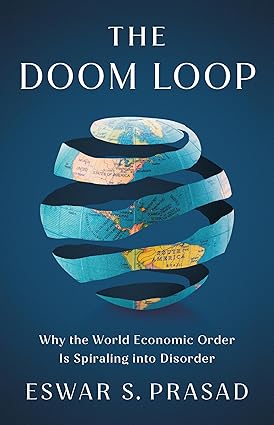
Why Is the Global Economy Being Pulled into a Loop of Disorder?
The forces once believed to stabilize the global economy are now becoming sources of instability. Globalization expanded prosperity, but it also deepened inequality and political backlash, while great-power rivalry is turning the language of cooperation into the language of power. Now that the postwar economic order led by the United States is shaking, what is needed is not a return to the past, but a redesign of new rules and institutions.
[Key Message]
* The forces once believed to stabilize the global economy - globalization, free trade, and multilateralism - are now becoming sources of new instability by deepening inequality, political backlash, and protectionism.
* The postwar economic order led by the United States still holds enormous influence, but the rise of China, India, and middle powers has made it harder to bind the global economy under a single set of rules.
* The problem with globalization is not openness itself, but the failure of domestic social contracts and institutions to fairly distribute its benefits and absorb its costs.
* The rivalry between the United States and China is not merely a trade dispute, but a power struggle over technology, finance, supply chains, security, and international rules, deepening uncertainty in the global economy.
* Breaking the loop of disorder does not require returning to the old model of globalization, but redesigning international economic rules and institutions around resilience, fairness, representation, and trust.
***
The Global Economic Order Built by the United States No Longer Works as It Once Did
After World War II, the global economy was reorganized around the United States. The dollar became the central currency of international finance, and the American market became the largest consumer market that companies around the world wanted to enter. The International Monetary Fund, the World Bank, the General Agreement on Tariffs and Trade, and later the World Trade Organization became institutional pillars supporting the postwar global economy. After the end of the Cold War, expectations grew that this order would expand to a wider world. Free trade, capital mobility, open economies, multilateralism, and a rules-based order came to be accepted almost as the common language of the global economy.
However, this order was never a perfectly neutral or universal system from the beginning. It was possible because it was backed by American economic power, military power, financial power, and technological power. During the period when the United States maintained overwhelming productive capacity, consumer power, and financial credibility, even conflicts in the global economy could be managed within a certain framework. The dollar-centered order functioned as a safety valve in times of crisis, the American market became a space that absorbed the growth of exporting countries, and American political influence worked as a force that determined the direction of international institutions.
The problem is that while the center of gravity in the global economy has shifted, the way institutions operate still remains largely within the structure of the past. China has risen as a central axis of global manufacturing and trade, while India has emerged as a new economic power based on its population, growth potential, and digital industries. Countries such as those in Southeast Asia, as well as Brazil, Indonesia, Saudi Arabia, and South Africa, no longer remain on the periphery. The West’s share of global gross domestic product has declined, while the voice of non-Western economies has grown stronger.
Even so, the rules and institutions that manage the global economy have not sufficiently absorbed this change. Emerging economies demand greater representation and a stronger voice, while existing great powers do not easily give up the rules and influence they created. The United States emphasizes a rules-based order, yet demands exceptions when its own interests are at stake, while China makes active use of the benefits of the existing order even as it challenges rules that are unfavorable to it. International institutions are losing their ability to mediate under pressure from both sides.
At this point, the global economy loses a stable center. In the past, America’s overwhelming power held the center of the order together. Now, American power remains enormous, but it is no longer absolute, and China’s power has grown, but it has not secured enough universality to create a trusted alternative order. India and middle powers are rising, but it is still difficult for them to provide the institutional leadership needed to bind the global order together. The world is not smoothly moving from a unipolar order to a multipolar one; it is caught in an intermediate zone where the old center is weakening and a new center has not yet taken root.
It is in this intermediate zone that the loop of disorder is formed. Rules remain, but they are not respected enough; institutions exist, but their power to resolve conflict is weakening. Countries understand the benefits of cooperation, yet they suspect that others may use rules to pressure them. The crisis of the global economy is not simply a matter of declining growth rates. It is a collapse of trust over who makes the rules, who bears the costs, and who takes responsibility in times of crisis.
Why Did the Success of Globalization Return as Political Backlash?
Globalization clearly changed many things. Goods became cheaper, companies gained access to broader markets, and many developing countries seized opportunities for growth through exports and investment. China’s rapid industrialization, India’s growth in the service sector, the expansion of manufacturing in Southeast Asia, and the transformation of Eastern Europe into a production base were all changes created by globalization. Countries integrated into the global economy experienced urbanization and the expansion of the middle class, while global companies lowered costs and increased productivity through complex supply chains.
But the gains of globalization were not shared evenly. Within some countries, large cities and the finance and technology sectors grew rapidly, while manufacturing regions and low-skilled workers faced job insecurity. Workers in advanced economies experienced factories moving overseas, and the stability of middle-class life weakened. Corporate profits and asset prices grew quickly, but wages and local economies did not keep pace. Even if globalization increased the wealth of a country as a whole, the question of who benefited and who bore the costs within that country was an entirely different matter.
Political backlash grew precisely in this gap. There were many explanations of the advantages of free trade and open economies, but the compensation given to workers who lost jobs and communities that declined was not sufficient. Economically, it may have been possible to explain that overall welfare had increased, but in real life, the experience of certain classes and regions being steadily pushed aside accumulated. As domestic politics failed to properly manage the costs of globalization, economic discontent gradually turned into distrust of institutions and elites.
The 2008 global financial crisis was the event that caused this distrust to explode. Excessive risk-taking in the financial system drove the entire world into crisis, and the damage fell heavily on ordinary households and workers. Financial institutions that had helped cause the crisis were rescued, while many citizens had to bear unemployment, debt, and housing insecurity. Afterward, asset markets recovered quickly, but the stability of daily life did not recover at the same speed. People began to ask whom the rules of the global economy were protecting.
After that, globalization began to be received not as a promise of prosperity, but as a symbol of insecurity. Free trade was blamed as a cause of job loss, immigration was politicized as a threat to wages and cultural identity, and international institutions were attacked as bodies representing the interests of global elites rather than the lives of citizens. Trade wars, tariff increases, national-first policies, anti-immigration politics, and industrial subsidy competition were all political expressions of this distrust.
The important point is that the failure of globalization was not simply a failure of globalization itself. Globalization created opportunities for growth, but it did not sufficiently create the social mechanisms needed to distribute those benefits fairly and absorb the shocks. If worker retraining, regional industrial transition, social safety nets, tax reform, and fair competition rules had worked together, the backlash might not have grown to its current level. In the end, the crisis of globalization is the result of a broken balance between an open economy and the domestic social contract.
This breakdown in balance again shakes the international order. When resentment toward globalization grows in domestic politics, governments become more likely to choose protectionism and national-first policies. Protectionism invites retaliation from other countries, retaliation increases trade conflict, and trade conflict heightens supply-chain insecurity. Supply-chain insecurity stimulates inflation, and rising prices intensify citizens’ dissatisfaction with daily life. That dissatisfaction then leads back to attacks on globalization and international cooperation. The doom loop of the global economy operates in this way, through a structure in which domestic politics and the international economy worsen each other.
The Rise of China and India: Why Has Multipolarity Not Led to Stability?
China’s rise has been the greatest change in the global economic order. Through cheap labor, a vast domestic market, state-led industrial policy, and integration into global supply chains, China rose to become the center of global manufacturing. At one time, many countries expected that the more deeply China was integrated into the global economy, the closer it would move toward existing rules. There was optimism that trade and investment would pull China toward a market economy and international norms.
The reality, however, was more complex. China actively used the benefits of globalization while maintaining state-led economic management, industrial policy, and a strategy of technological self-reliance. State-owned enterprises, subsidies, restrictions on market access, pressure for technology transfer, data controls, and financial management continued to clash with the existing liberal economic order. China’s growth provided the global economy with enormous demand and supply capacity, but at the same time, it created deep anxiety for existing great powers and industrial competitors.
The competition between the United States and China is therefore not a simple trade dispute. Tariff conflict was only the beginning, and the competition has expanded into semiconductors, artificial intelligence, telecommunications networks, batteries, rare earths, space, finance, and military technology. The United States sees China’s technological rise as a strategic threat, while China views American sanctions and export controls as containment aimed at blocking its rise. The moment each side interprets the other’s intentions in the worst possible way, interdependence becomes not a foundation for peace, but a channel of vulnerability.
India’s rise carries another meaning. Based on its enormous population, young workforce, digital infrastructure, service industries, and geopolitical position, India is taking on an increasingly important role in the global economy. It is drawing attention as a production base that can replace or complement China; for the United States and the West, it is seen as a partner in checking China; and in the Global South, it is emerging as a representative country capable of voicing an independent position. But India’s rise also does not automatically mean a stable multipolar order.
India cooperates with the United States, but it does not stand completely on America’s side. It competes with China, but it does not want separation in every area. Its relationship with Russia, energy imports, defense cooperation, leadership in the Global South, and policies to protect domestic industry show that India is pursuing an independent strategic space. This is not just India’s issue. Middle powers such as Brazil, Indonesia, Saudi Arabia, Turkiye, and South Africa are following similar paths. They are not subordinate partners of one camp, but are trying to maximize their own interests by using great-power competition.
On the surface, multipolarity may appear to be a more balanced order. One could expect that if no single superpower controls everything and several countries share power, the world will become fairer. But multipolarity does not automatically guarantee stability. The more centers of power there are, the more difficult coordination becomes, and the more complex agreement on rules becomes. When countries move with different interests and political systems, it becomes harder to create a single common norm.
The dilemma of middle powers arises here. As competition between the United States and China intensifies, middle powers are pressured to choose. Which side’s technological standards should they follow? Which semiconductor supply chain should they connect to? With whom should they cooperate on military security? Where should they procure energy and raw materials? Which system should they adopt for data and digital regulation? A choice on one side may endanger markets and relationships on the other.
South Korea, too, stands at the center of this dilemma. Its security is deeply connected to the United States, while its economy has long been intertwined with China. Core industries such as semiconductors, batteries, automobiles, shipbuilding, displays, and defense operate on global supply chains. Simply standing on one side is not enough, and continuing to endure through ambiguity is not enough either. Principled flexibility, supply-chain diversification, securing core technologies, solidarity among middle powers, and domestic industrial transition are all needed at the same time.
Disorder in the global economy does not arise only from clashes among great powers. It arises from the entire process in which rising countries demand a larger voice, existing great powers try to preserve their influence, and middle powers try to delay or adjust their choices. When a new distribution of power fails to be organized into new rules, multipolarity appears not as stability, but as uncertainty.
Competition Makes Markets Efficient, but It Does Not Stabilize the World Order
In a market economy, competition is an important principle. When companies compete, better products and services emerge, prices fall, and innovation accelerates. Consumers gain more choices, and inefficient companies are forced out. For this reason, competition has been understood as a force that increases efficiency and productivity.
But it is difficult to apply this logic directly to international politics and the global economic order. Competition among companies takes place within institutions and a legal order that enforce rules. Competition among great powers, by contrast, takes place over the rules themselves. Which country will set the standards, which currency will become the center of international payments, which technologies can be exported and which must be blocked, and how far sanctions and subsidies should be permitted all become objects of competition.
The competition between the United States and China is dangerous precisely for this reason. The two economic giants are deeply dependent on each other, yet each sees the other as a strategic threat. The United States is wary of China’s industrial policy and technological catch-up, while China interprets American export controls and financial sanctions as a strategy to maintain hegemony. When each side decides that the other cannot be trusted, even areas where cooperation is possible turn into matters of security. Economic interdependence becomes not a means of easing conflict, but a weapon of conflict.
Semiconductors are a representative example. Semiconductors are a core technology connecting smartphones, automobiles, data centers, artificial intelligence, military equipment, and satellite systems. In the past, what mattered was building the most efficient production system through global division of labor. Now, who possesses design technology, who controls advanced equipment, and which country has production facilities have become security issues. Efficient supply chains have been reinterpreted as strategic vulnerabilities.
Finance is the same. The dollar-centered financial order has provided liquidity and stability to the global economy, but it has also strengthened America’s power to impose sanctions. The fact that the United States can restrict access to financial networks makes other countries think about the risks of dollar dependence. But there is still no sufficiently credible international currency system to replace the dollar. Dissatisfaction with the existing order is growing, but an alternative order is not yet ready. This vacuum heightens instability.
Competition also does not lead to stability in technological standards and data rules. If different digital regulations, artificial intelligence ethics standards, data transfer rules, and cybersecurity systems are created, companies and countries must make complicated choices. When standards are divided, the cost of innovation rises and international cooperation declines. Technological competition may stimulate innovation, but technological competition conducted amid distrust can block knowledge exchange, joint research, and the movement of talent, thereby lowering long-term productivity.
The kind of competition needed in the global economy is rules-based competition. But today’s competition is increasingly turning into competition that shakes the rules. Countries increase subsidies to support their own companies, expand export controls to check rival technologies, and try to reorganize supply chains around their own country or friendly countries. Such measures may appear to increase security in the short term, but in the long term, they raise the cost of the global economy and entrench conflict.
Competition itself is not the problem; the problem is that the institutions and trust needed to manage competition have weakened. If rules are clear and dispute settlement procedures work, competition can produce innovation and efficiency. But when rules are shaken and countries distrust each other’s intentions, competition turns into a chain of retaliation and blockage. The doom loop of the global economy spins faster not through market competition, but through ruleless power competition.
The IMF and the WTO: Old Institutions Cannot Handle the New Order
The institutions that have long represented the management of the international economic order were the International Monetary Fund and the World Trade Organization. The International Monetary Fund served as a safety net in financial and foreign-exchange crises, while the World Trade Organization functioned as the center of trade rules and dispute settlement. These two institutions played important roles in the expansion and stability of the postwar global economy. But the reality of the 21st-century global economy has changed greatly from the era in which these institutions were created.
The International Monetary Fund has provided funds to countries in crisis and demanded structural adjustment. However, many developing countries feel that they have experienced excessive austerity and social pain in this process. When the responsibility for a crisis is connected not only to domestic policy failures, but also to global interest rates, dollar strength, raw-material prices, climate disasters, and geopolitical shocks, traditional prescriptions are not enough. In a situation where food and energy prices are soaring, the burden of foreign-currency debt is rising, and fiscal spending is increasing because of climate crises, simple austerity can intensify political instability.
The difficulties of the World Trade Organization are also deep. Rules designed on the assumption of expanding free trade do not sufficiently address new issues such as national security, industrial subsidies, digital trade, data mobility, climate regulation, and supply-chain restructuring. If the dispute settlement function weakens, countries come to depend more on the logic of power than on multilateral rules. Great powers use tariffs, sanctions, export controls, and subsidies as strategic tools, while weaker countries lose room for choice.
Changes in the trade order do not stop at the issue of tariffs. Trade is now connected to industrial policy, technological security, labor standards, carbon emissions, and data sovereignty. Even when producing a single battery, the mining of raw materials, methods of power generation, labor conditions, subsidies, and market-access rules all become issues. It is difficult to solve these complex issues with old trade rules alone.
Another reason international institutions have weakened is the problem of representation. Emerging economies demand greater authority in decision-making structures as their economic weight grows. But the existing structure centered on advanced economies does not change quickly. Countries that feel they are not sufficiently represented lose trust in institutions, and institutions whose trust has weakened find it difficult to exercise coordinating power in times of crisis.
In this situation, countries look for alternative paths. Regional agreements, bilateral agreements, friend-centered supply chains, currency swaps, competition in development finance, and new multilateral consultative bodies are increasing. These can supplement the limits of existing institutions, but they can also make global economic rules more complicated. If the world becomes a structure where multiple rules and blocs overlap rather than a single common order, companies and countries face greater uncertainty.
The weakening of international institutions makes the doom loop of the global economy stronger. Even when a financial crisis occurs, there is a shortage of trusted coordinators, and even when trade disputes grow, judgment and enforcement are difficult. Problems that cross borders, such as climate crises and debt crises, require more cooperation, but the institutional foundation for cooperation is weakening. Crises reveal institutional weaknesses, and institutional weaknesses make crises larger.
New Solutions Do Not Mean Returning to the Old Order
When seeing the confusion of the global economy, it is easy to say that we should return to the stable globalization of the past. But that path is not realistic. Past globalization achieved many things, but it also failed to sufficiently resolve inequality, regional decline, financial instability, and political backlash. It is also difficult to return to an era when the United States managed the order with overwhelming power. The rise of China, India, and middle powers has already transformed the structure of the global economy.
Therefore, what is needed is not return, but redesign. The global economy must change in a direction that preserves the benefits of openness while reducing vulnerabilities. Supply chains must be diversified so that they are not excessively concentrated in one place, but they must not move toward complete disconnection. Core technologies must be managed from a security perspective, but not all technological exchange should be blocked. Financial stability must be strengthened, but not in a way that blocks the growth opportunities of developing countries.
New international economic rules must deal more honestly with the costs of globalization. A system that emphasizes only the benefits of free trade while neglecting workers and regions that suffer damage is no longer sustainable. For an open economy to gain political support, it must work together with domestic social safety nets, job-transition education, regional regeneration, fair taxation, and monopoly regulation. The international order cannot be separated from the domestic social contract. If citizens feel that globalization is a force threatening their lives, no international cooperation can last long.
The debt problem also requires a new approach. Many developing countries are facing a compound crisis caused by the pandemic, high interest rates, a strong dollar, rising food and energy prices, and climate disasters. It is difficult to solve the crisis simply by demanding austerity. More realistic solutions that combine debt restructuring, climate finance, development investment, and social protection are needed. If the debt crisis is neglected, economic problems will soon spread into political instability, migration, conflict, and security problems.
Trade rules are also no longer sufficient if they rely only on 20th-century free-trade logic. New agreements are needed on how far exceptions based on national security should be recognized, by what standards industrial subsidies should be allowed, how carbon reduction and trade rules should be harmonized, and by what principles digital trade and data mobility should be managed. It is difficult for every country to accept exactly the same rules, but without minimum common standards, the global economy will continue to tilt toward the logic of power.
Mechanisms to manage great-power competition are also needed. It may be difficult for the United States and China to restore trust in all areas, but in areas such as financial stability, climate change, health, food, core supply chains, and artificial intelligence safety, they must maintain at least minimal channels of cooperation. Even if complete cooperation is impossible, complete disconnection is more dangerous. What is needed is not to eliminate conflict, but to create rules that prevent conflict from destroying the entire order.
The role of middle powers must also grow. India, Brazil, Indonesia, South Korea, Japan, Australia, and European countries are not merely objects of great-power competition; they are actors that can participate in making new rules. If middle powers create practical coalitions in supply chains, digital rules, climate finance, development cooperation, and health security, the global economy does not have to flow only into bipolar confrontation. In an era when multilateralism has weakened, smaller and more flexible combinations of cooperation become more important.
The Forces That Can Break the Doom Loop Are Trust and Institutional Reform
The doom loop of the global economy is a structure in which one crisis calls forth another. Inequality caused by globalization produces backlash in domestic politics, political backlash strengthens protectionism, and protectionism creates trade conflict and supply-chain insecurity. Great-power competition weaponizes technology and finance, and the weaponization of technology and finance further deepens distrust among rival countries. As international institutions weaken, crises cannot be coordinated, and uncoordinated crises again destroy trust in institutions.
To break this loop, we must first see the connected structure of the crisis accurately. Trade problems cannot be viewed only as trade, financial problems only as finance, technological problems only as technology, and domestic political problems only as domestic politics. The instability of the global economy is the result of the interlocking of economics, politics, and geopolitics. It cannot be solved with a single prescription, nor can it be stabilized by the choice of one country alone.
The most important task is the restoration of trust. Trust does not arise from declarations. Predictable rules, fair burden-sharing, institutions that work in times of crisis, and politics capable of persuading domestic citizens must exist together. Great powers must not emphasize rules only when those rules are favorable to them, and emerging economies must accept greater responsibility along with greater authority. International institutions must increase both representation and effectiveness.
The recovery of the global economic order is not a return to the globalization of the past. It is a move from globalization that prioritized only efficiency to globalization that considers resilience and fairness together. A balance is needed that uses the power of the market while not neglecting social costs, recognizes competition while preventing it from becoming ruleless retaliation, and accepts the need for national security while not turning every economic relationship into a security issue.
An open economy like South Korea must understand the meaning of this change more sensitively. The more the world order shakes, the more exports, finance, exchange rates, energy, raw materials, and technology supply chains are affected at the same time. Protecting domestic industry and expanding international cooperation are not opposites. A country must strengthen core technologies while diversifying markets, maintain security alliances while widening the scope of middle-power cooperation, and design institutions so that society as a whole can bear the costs of industrial transition.
The ability needed to pass through an age of disorder is not the skill of building higher walls. Walls are sometimes necessary, but walls alone cannot stabilize the global economy. What is truly needed is for countries with different interests to rebuild minimum rules, and to establish a fair social contract so that domestic citizens can accept those rules.
The global economy does not collapse by itself. It collapses when it is neglected. Conversely, it does not recover by itself either. It requires a process of redesigning, adjusting, persuading, and sharing responsibility. The age of the doom loop does not demand only the language of pessimism. Rather, it demands that we accurately see what repeats the crisis and imagine a new order capable of breaking that loop.

.jpg)
.jpg)
.jpg)