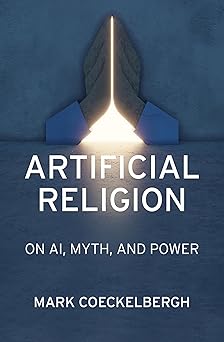
Why Is Artificial Intelligence Believed in Like a Religion?
AI no longer remains merely a tool that calculates and recommends. People entrust AI with judgment, seek comfort from it, and even expect answers about the future. As belief in technology grows stronger, AI is becoming a new myth and a language of power.
[Key Message]
* AI is becoming not merely a technology, but a new object of belief onto which human anxiety and desire are projected.
* The enthusiasm surrounding artificial intelligence contains not only expectations for a more accurate tool, but also an old mythical imagination that longs for a being beyond human limits.
* The more AI is accepted as an objective and omniscient judge, the more human beings may be tempted to hand over judgment and responsibility to the machine.
* Belief in AI becomes a powerful form of power when it combines with corporate and platform authority, reshaping social order and decision-making.
* What the AI era requires is neither worship nor fear, but critical distance that uses technological possibilities while preserving human judgment and responsibility.
***
When Did Technology Become an Object of Belief?
People often think of religion as the language of an older world. Words such as myth, ritual, prayer, salvation, and prophecy seem more suited to an age before science and technology had developed. Modern people no longer read signs in the sky, interpret lightning as the anger of the gods, or explain disease and disaster only as the will of a transcendent being. Science turned nature into something calculable, and technology strengthened the sense that human beings could control the world. For that reason, modernity appears to be an age in which religious belief has retreated and rational judgment has taken its place.
But belief has not disappeared. It has merely changed its clothes. If human beings in the past soothed their anxiety about the future through temples, prophets, and sacred texts, human beings today hold similar expectations through data centers, algorithms, and artificial intelligence models. What is right, which choice is better, what will happen in the future?human beings still want certain answers. It seems as though anxiety would decrease as science and technology develop, but reality is closer to the opposite. More information creates more choices, and more choices create greater anxiety. At this moment, artificial intelligence is accepted not simply as a convenience technology, but as a new authority that will interpret a complex world on our behalf.
A smartphone’s recommendation algorithm decides what we will watch, while search engines and chatbots organize what we need to know. Financial algorithms calculate investment possibilities, medical AI identifies signs of disease, and hiring systems evaluate who is a suitable candidate. People still believe they are making their own judgments, but in reality, they increasingly move according to the suggestions, classifications, and predictions of invisible machines. Technology appears to be a tool, but at some point, it becomes a force that shapes the order of life.
Here, an important question arises. Why do human beings want to believe in AI so much? Is it simply because its performance is good? Because it is fast, processes vast amounts of data, and seems likely to make fewer mistakes than humans? Of course, those are part of the reason. But the enthusiasm surrounding AI cannot be explained by efficiency alone. People expect something deeper from AI. They expect an intelligence that exceeds human limits, judgment that is not shaken by emotion, the ability to analyze both past and present in order to predict the future, and even an insight that can discover things human beings do not know about themselves. This is not merely technological expectation. It is close to religious expectation.
Religion has always existed alongside human limits. In the face of problems that human beings struggle to solve on their own?death, suffering, uncertainty, failure, ignorance, guilt, loneliness?religion provided meaning and order. Myths explained why the world exists as it does, rituals created forms through which anxiety could be endured, and prophecies made it possible to imagine time that had not yet arrived. Today, AI is placed in a similar position. Through AI, human beings want to know more, judge more accurately, predict more safely, live longer, and become stronger. In the end, the desire directed toward AI is not a problem of technology, but a problem of humanity’s old desires.
Old Religious Imagination Is Hidden Inside AI
If we look just a little more closely at the language surrounding AI, we can see familiar religious language hidden within it. People say that AI will transcend humanity. They expect that one day, an intelligence superior to human beings will appear and solve all the world’s problems. Some imagine that AI will be able to solve disease and aging, labor and poverty, war and the climate crisis. The belief is also spreading that human beings will no longer be trapped within their own limits, but will rise to a new stage through technology.
This is not an entirely new imagination. Human beings have long dreamed of beings that surpass themselves. They wanted to become closer to gods, overcome death, and possess wisdom that knows everything. In ancient myths, stories repeatedly appear in which human beings try to approach the realm of the gods and fail. There were heroes who dreamed of immortality, humans who built towers reaching the heavens, magicians who tried to create life, and figures who sought forbidden knowledge. Modern AI discourse may be retelling these old stories in the language of science and technology.
Artificial intelligence is therefore not simply an invention, but a mirror of imagination. When human beings talk about AI, they are in fact talking about themselves. What do human beings fear? What do they want to solve? What abilities do they want to possess? To what kind of being do they want to entrust judgment? Stories about AI ask about the future of machines while also revealing human desire.
The emergence of generative AI has made this issue even clearer. Machines of the past mainly performed repetitive tasks. They calculated, assembled, transported, and stored. But generative AI speaks, writes, draws, and converses. It has entered the domains of language, creation, and interpretation, which human beings long considered uniquely their own. That is why it has become difficult for people to treat AI merely as a machine. In front of a being that answers when asked a question, offers comfort when worries are shared, and organizes complex problems, human beings easily fall into the feeling of anthropomorphism. Even while knowing that there is no actual mind beyond the screen, they feel as if something understands them.
This feeling is not trivial. Human beings have long conversed with invisible beings. Prayer was a conversation in which one could not be certain of receiving an answer, divination was a way of asking about an uncertain future, and confession was an act of laying down the burden of the inner self before another being. Today, some people ask AI about their career paths, seek relationship advice, share their loneliness, and ask for guidance before important decisions. Of course, AI is not a god, nor is it a conscious being. But within human experience, it sometimes occupies a place similar to a religious function. That is because it explains, comforts, predicts, judges, and lowers anxiety.
At this point, discussions about AI can no longer be sufficiently handled only through ethics or regulation. Privacy protection, copyright, bias, safety, and employment issues are all important. But beneath them lies the deeper issue of human attitudes toward AI. How are people imagining AI? What kind of power are they granting to AI? To what extent are they willing to trust AI’s judgment? There is always a gap between what technology can actually do and what people expect technology to do. It is precisely in that gap that myth grows.
The Myth of the Omniscient and Omnipotent Machine
The most powerful myth about AI is the image of an omniscient and omnipotent machine. People think that because AI has learned from vast amounts of data, it must know almost everything. They believe that because it is faster than humans, does not get tired, and is not swayed by emotion, it must be more objective. In some situations, AI’s judgment may indeed be more accurate than human judgment. But the moment we move directly from that to the conclusion that AI is a neutral and perfect judge, technology becomes myth.
AI is not a being that sees the world on its own. It operates within data created by human beings, goals designed by human beings, standards determined by human beings, and industrial structures organized by human beings. AI’s answers are not revelations descended from the heavens, but outputs produced by data, models, and systems. Yet people often accept AI’s judgment as something purer and more objective than human judgment. The phrase “AI said so” becomes, at some point, a powerful authority. In meeting rooms, schools, hospitals, financial institutions, and legal review processes, AI analysis sometimes goes beyond being a reference opinion and becomes a basis for decision-making.
The problem is not only that AI can be wrong. The bigger problem is that how AI was wrong, why it made such a judgment, and who should be responsible for that judgment can become blurred. Human authority has a face, a name, and responsibility. But algorithmic authority is often anonymous. The moment people say that the system classified it that way, the model predicted it that way, and the data showed it that way, responsibility becomes dispersed. A person made the decision, but the burden of decision hides behind the machine.
The myth of the omniscient and omnipotent machine also works favorably for AI companies and platform power. The stronger the belief becomes that AI can save the world, the more the companies that develop and control AI appear not merely as businesses, but as authorities designing the future. The images of massive data centers, giant models, enormous investments, and genius founders and researchers are sometimes packaged like new priests and temples of a new age. People consume announcements from technology companies like prophecies, receive the emergence of new models like revelations, and expect that life will fundamentally change when a more powerful AI appears.
Of course, technological development does in fact change life. AI is already creating substantial changes in numerous fields, including translation, search, education, medicine, design, software development, customer service, and content creation. The problem is that the usefulness of technology does not justify worship of technology. Just because a knife is useful does not mean we can entrust ethics to the knife, and just because a compass points the way does not mean it determines the destination. The same is true of AI. AI can be an astonishing tool, but it cannot replace the values and responsibilities of human society.
As AI becomes more powerful, human beings are tempted more often. The temptation to entrust judgment instead of judging, the temptation to follow the system instead of taking responsibility, and the temptation to end complex debates with the answer of data. But important problems in human society are not simply problems of finding correct answers. What should be considered fair, whose interests should be prioritized, what risks should be accepted, and what kind of life should be seen as a good life cannot be decided by calculation alone. These are matters of value, politics, and community. No matter how sophisticated AI becomes, the realm in which human beings must deliberate together and take responsibility does not disappear.
When Does Belief Become Power?
Belief does not remain only inside an individual’s mind. When people begin to believe in something, that belief moves institutions, markets, and power. Belief in AI is the same. The belief that AI is more accurate, efficient, and representative of the future changes the direction of corporate investment, moves government policy, and changes the evaluation methods of schools and workplaces. At some point, organizations that do not adopt AI appear to be falling behind, and people who doubt AI are treated as unable to adapt to change.
At this point, the myth of AI gains very real power. Regardless of how effective a technology actually is, the moment people believe that technology is an essential future, enormous resources move toward it. Talent gathers, capital gathers, policy follows, and social attention is concentrated. Conversely, areas outside that belief are pushed aside as old and inefficient. Values that are difficult to convert into numbers?care, education, art, local communities, workers’ skills, human judgment?can be pushed to the background within an AI-centered order.
The way AI becomes the language of power is more powerful when it is not overt. Power in the past often appeared in the form of commands and punishment. But today’s digital power operates in the form of recommendation, classification, scores, and prediction. What becomes more visible, and what becomes less visible? Who is classified as risky, and who is evaluated as trustworthy? Which resume passes, which content spreads, and which consumer receives better conditions? In these processes, AI plays the role of an invisible gatekeeper.
The more serious problem is that people may mistake this gatekeeper for being neutral. The belief that human judgment contains bias but AI judgment must be fair is extremely dangerous. AI can be a device that removes human bias, but it can also become a device that repeats the biases of human society more precisely. If data contains past inequality, AI can transform that inequality into future prediction. If a certain group was hired less often in the past, AI can learn that pattern and continue to make similar decisions in the future. If a certain region or class was classified as more risky in the past, AI can reproduce that gaze in the new language of technology.
Therefore, the core of AI power is not simply who has built a better model. Who possesses the data? Who determines the purpose of the model? Who bears the risk, and who gains the benefit? Who can demand an explanation, and who can challenge the decision? AI discussions that leave out these questions only look at the surface of technology. The stronger the myth surrounding AI becomes, the more persistently we must ask about the structure of power.
The danger becomes even greater when AI combines with religious imagination. Religious belief can sometimes give human beings comfort, community, and meaning, but on the other hand, it can also make them stop asking questions. What is regarded as sacred is not easily criticized. The same is true of AI. If AI is sanctified as the inevitability of the future, voices asking who owns and controls that technology are pushed aside. The point is not to doubt technological development itself, but to examine what interests are hidden behind the name of technological development.
The greatest danger of the AI era is not only the science-fiction scene in which machines suddenly dominate human beings. The more realistic danger is that human beings become accustomed to giving up their own judgment and accepting power structures that put AI forward. When technical reasons are attached to every decision, every change is packaged under the name of innovation, and every inequality is explained as a data-based result, society loses the language of criticism. At that moment, AI becomes not merely a tool, but a myth that justifies an order.
What the AI Era Needs Is Not Worship, but Distance
To look at AI critically does not mean rejecting technology. It is closer to the opposite. The more important AI becomes, the more accurately we need to understand it. We need to know what it actually does well and what it cannot do. We need to distinguish in which areas it is helpful and in which areas it is dangerous. We need an attitude that recognizes the possibilities of AI without turning those possibilities into an exaggerated narrative of salvation.
Human beings have long lived by making tools. Fire, the wheel, writing, printing, electricity, computers, and the internet all changed human life. But no tool has ever completely replaced human ethics and responsibility. Writing expanded the range of memory, but what to record and how to interpret it remained the task of human beings. The internet increased access to information, but what to believe and how to judge remained a human task. The same is true of AI. AI can expand human ability, but it cannot erase human responsibility.
Distance is different from cynicism. Cynicism is close to an attitude of believing in nothing, but distance is an attitude of examining how belief is made. The fact that AI is useful and the belief that AI should have absolute authority are entirely different. The possibility that AI can solve many problems and the myth that AI will solve all human problems are also different. A mature attitude toward technology begins by finding balance between enthusiasm and fear.
The most necessary question in discussions surrounding AI is not only “Will AI replace human beings?” The more important question is “What do human beings want to believe through AI?” Why do human beings want a perfect adviser? Why do they think an emotionless judge is more fair? Why do they try to rely on prediction systems instead of enduring an uncertain future? Why do they want to simplify complex social problems into technological solutions? When we ask these questions, AI becomes not merely a machine, but a mirror reflecting human society.
The reason AI is believed in like a religion is not that AI is a god. It is because human beings still want salvation. They want certain answers in an uncertain age, simple order in a complex world, and a being that will bear the burden of failure and responsibility on their behalf. AI becomes myth at the place where those desires gather. And when myth combines with power, technology becomes not merely innovation, but a force that organizes society.
Therefore, the task of the AI era does not lie in worshiping or fearing AI. It lies in reading AI within humanity’s old desires and structures of power. We must move beyond questions that ask only about technological performance and examine how belief in technology is created and who benefits from it. Just as important as asking what AI can do is asking why human beings want to entrust such a role to AI.
In the end, understanding artificial intelligence cannot be separated from understanding human beings. AI is a machine made by humans, but at the same time, it is changing the way humans look at themselves. The desire to know more, live longer, choose more safely, and obtain more perfect judgment is projected into AI. That is why the debate surrounding AI is a debate about the future of technology and, at the same time, a debate about what kind of beings human beings will remain.
The moment artificial intelligence becomes a new religion is not when machines acquire divinity. It is when human beings stop asking questions, hand over judgment, blur responsibility, and justify power in the name of technology. Conversely, for AI to remain a good tool, we must continue to ask questions. Who made it? What data did it feed on and grow from? Whose worldview does it reflect? Whom does it benefit, and whom does it exclude? And finally, why do human beings want to believe in this machine so much?
The wisdom of the AI era does not come only from possessing more powerful machines. It comes from deciding what attitude human beings will take before those machines. An attitude that does not worship, does not blindly believe, and does not fear without reason. An attitude that uses possibilities without handing over authority. An attitude that expands human life through technology while protecting human judgment and responsibility. That is the minimum condition for AI to remain a tool for human beings rather than becoming a device of myth and power.

.jpg)
.jpg)
.jpg)