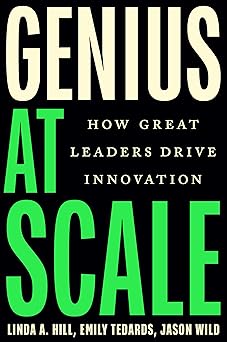
Stop Looking for Geniuses and Build an Organization Where Genius Can Flourish
Innovation has long been explained as the ability of exceptional individuals. The people placed at the center of innovation were those who discovered opportunities before anyone else, proposed new ideas, and drove organizations forward with powerful determination. Companies searched for outstanding founders, brilliant engineers, and creative planners, expecting their abilities to change the future of the organization.
Today, however, innovation is difficult to achieve through the insight of a single person alone. Technology has become more complex, markets are changing rapidly, and even a single product or service requires multiple areas of expertise at the same time. Generating a new idea has become less difficult than connecting the knowledge and capabilities of many people and expanding a small experiment into organization-wide change.
The competitiveness of innovation is no longer determined by whether an organization possesses a genius. What matters is how freely the potential of its members can be connected, repeatedly expressed, and extended beyond organizational boundaries. The capabilities required of leaders are also shifting from the ability to provide answers to the ability to design an environment in which collective genius can operate.
[Key Message]
* Innovation is completed not by ideas, but by the ability to scale them. Discovering a good idea alone does not create organizational change. Innovation scales when that idea is transformed into an executable business and a repeatable organizational capability.
* The role of leaders is shifting from providing answers to designing environments. Leaders who drive innovation do not provide every answer themselves. They design an environment in which people can share different perspectives, experiment, and develop solutions together.
* Collective genius scales through architects, bridgers, and catalysts. Architects build internal structures for innovation, bridgers combine capabilities across organizational boundaries, and catalysts extend innovation into broader industrial and social change. As innovation grows in scale, leaders must move flexibly among these three roles.
* Conflict is not something to eliminate, but a resource for learning. Conflict arising from different areas of expertise and perspectives can obstruct innovation, but it can also become the starting point for better decisions. Leaders must combine psychological safety with rigorous validation to transform conflict into productive learning.
* Sustainable innovation comes not from individual talent, but from organizational systems. Innovation that depends on a particular genius or powerful leader is difficult to sustain. When organizations build systems in which problem discovery, experimentation, learning, and scaling occur repeatedly, ordinary people can create extraordinary results together.
***
Innovation Fails More Often in Scaling Than in Ideation
New ideas constantly emerge within companies. Employees identify customer inconveniences, suggest ways to improve existing products, and discover business opportunities using new technologies. Organizations also gather countless ideas through external consulting, internal competitions, research and development teams, and dedicated new-business units. Yet few of these ideas develop into actual businesses or lead to organization-wide change.
This is not because organizations lack innovation, but because they lack the ability to scale it. An experiment that succeeds within a small team may not work in another department, while a service that receives a positive response in one region may be rejected in another market. A pilot project may attract attention and support from employees, only to encounter established procedures, evaluation standards, and budget structures once it is incorporated into regular operations. New ideas lose their strength within outdated organizational systems.
Many companies approach innovation as a matter of discovering ideas. They believe that change will occur if they find more original ideas and recruit more creative talent. However, the ability to generate ideas and the ability to transform them into organizational capabilities are different. Proposing a new product is an entirely different challenge from manufacturing and selling that product and building a customer support system around it.
For innovation to scale, multiple departments, ranks, and areas of expertise must move together. Technology developed by the research and development department must be connected to the production processes of the manufacturing department, while the marketing department must explain its value in the language of customers. The finance department must establish standards for allocating resources to uncertain businesses, and senior management must avoid evaluating new attempts solely by short-term results. If even one of these elements is disconnected, innovation cannot move beyond the laboratory or the conference room.
The central question of innovation, therefore, is not whether a good idea exists. What matters is whether the organization has the capacity to accept, develop, and execute that idea on a larger scale. Innovation is not a single act of creation but a process involving countless adjustments, choices, and cycles of learning.
Leaders Are Not People Who Have the Answers but People Who Create the Environment
Under traditional leadership, leaders determined the direction and employees carried out their instructions. Leaders were expected to find the best answers based on their experience, information, and authority. In environments where clear goals and efficient execution were important, this approach was effective.
In situations that require innovation, however, no one is likely to possess a complete answer. Customer needs change rapidly, and the impact of emerging technologies is difficult to predict accurately. Past experience does not guarantee future success, and even a chief executive cannot fully understand every problem in the field or every change in the market.
When leaders are overly confident in their own answers, the organization can easily stop thinking. Employees begin trying to anticipate the direction their leaders prefer rather than presenting new perspectives, and they withdraw proposals that carry a risk of failure. Agreement is reached quickly in meetings, but important problems remain hidden. The organization may appear efficient on the surface, yet it becomes one in which learning and discovery have disappeared.
Leaders who drive innovation do not monopolize the correct answer. They clearly define the problems that need to be solved and the purpose the organization should pursue, while allowing employees to discover specific solutions together. They create spaces in which different perspectives can collide and support the testing of hypotheses through experimentation.
This kind of leadership is not the same as giving up authority. It is, rather, a more sophisticated way of exercising authority. Leaders must judge when to intervene and when to step back. Instead of making every decision themselves, they provide the standards and principles that allow employees to make sound decisions. They define both the range within which people may experiment freely and the boundaries that must be respected.
When an organization’s purpose is clear, employees can align their direction without receiving instructions for every action. When everyone understands what value the organization intends to provide to customers, what problems it aims to solve, and which principles cannot be compromised, different teams can experiment in different ways while still moving toward a shared objective.
The role of a leader is not to generate the most brilliant ideas. It is to create an environment in which the many ideas within the organization can be discovered, connected, and developed. Innovation leadership should be evaluated not by how effectively a leader displays personal ability, but by how effectively that leader amplifies the abilities of others.
Architects, Bridgers, and Catalysts Expand the Scale of Innovation
As the scale of innovation grows, the roles required of leaders also change. Executing a new idea within a single team cannot be managed in the same way as creating industry-wide change through collaboration among multiple organizations. Depending on how far innovation is intended to spread, leaders must act as architects, bridgers, and catalysts.
Architects create structures within an organization that enable innovation to occur repeatedly. Rather than relying on the passion of a particular individual or the temporary attention of senior management, they design systems and cultures that allow employees to continuously identify problems and test solutions.
Architects do not leave innovation solely to a department assigned to manage it. They enable frontline employees, engineers, salespeople, and support teams to identify opportunities for improvement from their respective positions. They create channels through which ideas can be proposed and provide the time and resources required for small experiments. They also establish processes for reviewing what has been learned from failed experiments instead of treating them merely as losses.
Evaluation and reward systems are equally important. When organizations demand innovation but evaluate employees only by short-term performance, no one will be willing to take risks. New initiatives involve uncertainty, and results may not be visible at an early stage. Collaboration, learning, and the quality of experiments must also be recognized and rewarded for innovation to become part of everyday work.
Bridgers connect people and resources across organizational boundaries. Modern innovation begins with the reality that no single company can possess every technology and every form of knowledge. New solutions emerge only when capabilities scattered across universities, research institutions, startups, suppliers, governments, and local communities are combined.
Collaboration between organizations, however, is more difficult than cooperation within one organization. Each participant has different goals, languages, and decision-making methods. Companies may prioritize business performance and speed, while research institutions may place greater importance on accuracy and the long-term value of knowledge. Governments may consider the public interest and established procedures, while startups may prioritize rapid experimentation and growth.
Bridgers do not try to eliminate these differences. They help participants maintain their different perspectives while discovering a shared objective. They clarify the purpose of the collaboration and the role of each participant, while creating communication structures through which trust can be built. Coordinating interests so that no single organization monopolizes all the benefits is also part of the bridger’s role.
Catalysts extend innovation beyond the performance of a specific organization and into broader industrial and social change. Instead of directly controlling every project, they present a purpose and direction that allows multiple participants to become involved voluntarily. They create new standards, platforms, and shared understandings of problems so that change can spread on its own.
The influence of a catalyst does not come from issuing commands. It comes from helping people understand why they should participate in change and enabling them to discover their own roles within it. Participation remains limited when innovation appears to serve only the interests of a specific company. When it is connected to a broader social value, a wider range of organizations and individuals can be mobilized.
Architects, bridgers, and catalysts are not entirely separate roles. One leader may move among all three depending on the stage and scope of innovation. In the early stage, the leader may design internal organizational structures, then connect external partners in the next stage, and finally encourage participation across an entire industry to create broader change.
Do Not Eliminate Conflict; Use It Productively
Bringing diverse people together does not automatically create collective intelligence. Different experiences and areas of expertise offer new possibilities, but they also generate conflict and delay. Meetings may be comfortable when everyone thinks in the same way, but they are unlikely to produce innovative answers.
Conflict in the innovation process is not a problem to be avoided but a resource to be managed. Technology teams may emphasize completeness and stability, while sales teams may place greater importance on speed to market. Finance teams examine costs and risks, while customer support teams worry about problems that may occur during actual use. These differences may appear to obstruct innovation, but when managed properly, they become the foundation for better decisions.
Leaders must enable employees to present opposing opinions safely. Ideas should not be dismissed because of rank or departmental affiliation, and employees should not fear that raising a problem will place them at a disadvantage. In a psychologically safe environment, people do not conceal mistakes, and flawed assumptions can be discovered early.
A safe environment, however, does not mean a lax environment. Respecting every opinion does not mean that every idea has equal value. Claims must be tested through evidence and experimentation, and employees must take responsibility for execution once a decision has been made. Open discussion and strict execution discipline must coexist.
Innovative organizations are not organizations that debate for a long time. They are organizations that learn more quickly. When disagreements arise, they design small experiments and examine the results instead of allowing authority to determine the conclusion. Rather than arguing over who is right, they investigate which hypothesis works in reality.
The way failure is viewed must also change. A culture of learning cannot be created merely by declaring that failure will always be accepted. A lack of preparation or the repetition of the same mistakes should not be disguised as innovation. What matters is controlling the scale of failure and extracting clear lessons from the experience.
Rapid, small-scale experimentation can reduce the cost of failure. Organizations can confirm customer reactions and technical feasibility at an early stage, then boldly revise or stop ideas that lack sufficient evidence. The later a failure is discovered, the greater the loss becomes. Innovative capability is demonstrated not by the absence of failure, but by the ability to identify failure early and transform it into learning.
Leaders must also manage the tension between autonomy and control. Giving employees excessive freedom can blur the organization’s direction, while controlling every process eliminates creativity and initiative. Organizations need an approach that establishes a clear purpose and principles while permitting a variety of methods within those boundaries.
There is also tension between short-term performance and long-term innovation. Organizations must protect their existing customers and revenue while continuing to experiment for the future. When new businesses are evaluated according to the standards of existing businesses, innovation is likely to be terminated at an early stage. Leaders must distinguish between businesses operating on different timelines and apply evaluation standards appropriate to each stage.
Turning Innovation from Individual Talent into Organizational Capability
Exceptional people can lead innovation. Leaders with outstanding insight and drive can create powerful change within an organization. However, when innovation depends on a particular individual, its sustainability and scalability are limited. The moment that person leaves or shifts attention elsewhere, the change may also stop.
To make innovation an organizational capability, a repeatable process is required. A continuous flow must become embedded in everyday operations: employees identify problems, propose ideas, experiment and verify them, and then extend successful methods to other parts of the organization.
For this to happen, the purpose of innovation must first be clear. Simply calling on employees to try something new does not tell them what they should do. The organization must explain specifically which customer problems it intends to solve, what kind of future it is preparing for, and why change is necessary now.
The distribution of authority must also change. Employees closest to the field are the first to identify shifts in customer needs and inefficiencies in work processes. Yet when decision-making authority is concentrated too heavily at the top, even a small improvement must pass through multiple stages of approval. Instead of personally approving every decision, leaders must distribute authority so that employees can experiment and exercise judgment within a defined range.
At the same time, organizations need systems for accumulating what they have learned. When only successful cases are shared, the organization loses important lessons gained from failure. It must record and share what hypotheses were formed, what was tested, and why the results differed from expectations. Innovation becomes repeatable when individual experience is transformed into organizational knowledge.
Digital technologies and artificial intelligence can accelerate this process. They help employees share data, visualize ideas, and rapidly analyze customer reactions. However, simply introducing technology does not create an innovative organization. Authority to use new tools, methods of collaboration, and decision-making structures must change together.
A strong innovation organization is not a place where everyone thinks in the same way. It is a place where different forms of expertise and different perspectives are connected, conflict is transformed into learning, and the results of experiments are reflected in the next decision. Leaders do not pull the organization forward solely through their own abilities. They create the conditions that allow the organization to move on its own.
The most dangerous organizations in the age of innovation are not those that lack ideas. They are organizations that discover good ideas but cannot execute them, organizations that cannot expand a small success into broader change, and organizations that depend only on the abilities of specific individuals.
The leaders of the future should not try to become the smartest people in the room. They should enable more people to exercise their wisdom. They must present a purpose, create structures for collaboration, transform conflict into opportunities for learning, and connect capabilities inside and outside the organization.
Innovation created by a single genius can be powerful. An organization in which the genius of many people operates repeatedly, however, can endure for much longer. Great leadership is not completed by placing exceptional individuals at the forefront. Its true power is revealed in building a system in which ordinary people expand one another’s abilities and produce extraordinary results.

.jpg)
.jpg)
.jpg)