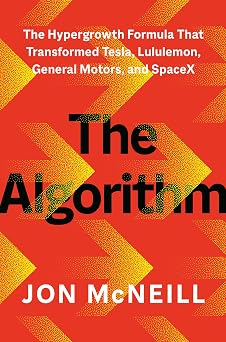
[The Algorithm: The Hypergrowth Formula That Transformed Tesla, Lululemon, General Motors, and SpaceX]
“The Algorithm” Behind the Hypergrowth of Tesla and SpaceX
- Redesigning Organizational Speed in Five Steps
What holds back organizational growth may not be a lack of people or technology, but requirements that no one questions and procedures that have accumulated unnecessarily. “The Algorithm” used at Tesla sought to raise execution speed by questioning the assumptions behind problems, eliminating unnecessary elements, and simplifying what remained instead of merely improving existing tasks incrementally. However, extreme goals and compressed execution methods could accelerate innovation while also causing quality problems and employee burnout, making their scope of application and safeguards critically important.
[Key Message]
* Accumulated complexity, rather than a lack of resources, may be what prevents an organization from growing. Innovation begins by questioning rules and procedures whose necessity no one can clearly explain.
* Unnecessary work must be eliminated before existing processes are improved. Optimizing processes and approvals that should not exist only enables an organization to repeat low-value work faster and more efficiently.
* Simplification increases the speed of both execution and learning. When responsibilities and workflows are clearly defined, bottlenecks become visible and teams can experiment and adapt in shorter cycles.
* Automation is not the starting point of innovation but its final stage. Automating an untested process with AI or robotics allows flawed outcomes and structural defects to spread more rapidly and at greater scale.
* Stretch goals can disrupt conventional thinking, but they require safeguards. For ambitious targets to produce innovation, employees need decision-making authority, room to learn from failure, and clear boundaries protecting safety and ethics.
***
An Operating System Beyond Incremental Improvement
Companies became more complex as they grew. As the number of customers increased, products and services diversified, and as organizations expanded, departments and management layers multiplied. Rules and approval procedures designed to prevent failure also continued to accumulate. Although they were initially created to solve problems, over time those mechanisms became problems themselves. Rules whose necessity no one could explain, meetings that merely dispersed accountability, and reports that provided no value to customers piled up throughout organizations.
Leaders generally responded to such situations by demanding greater efficiency. They sought to reduce meeting time by 10 percent, lower production costs by 5 percent, or increase sales by 7 percent from the previous year. This approach attempted to achieve slightly better results while preserving the existing structure. It was useful for companies operating in stable environments, but it was often insufficient when industry structures changed rapidly or corporate survival was at stake. If the methods used to manufacture products, sell them, and serve customers had lost their competitiveness, incremental improvement alone could not reverse the widening gap.
Jon McNeill’s *The Algorithm: The Hypergrowth Formula That Transformed Tesla, Lululemon, General Motors, and SpaceX* challenged the limitations of incremental improvement. McNeill, who led Tesla’s global sales and service operations, was a business leader accustomed to optimizing existing processes. He had founded and sold several companies and had also been influenced by the Toyota Production System and the principles of lean management. After joining Tesla in 2015, however, he encountered goals and execution pressures on an entirely different scale.
At the time, Tesla was not a company with a stable production foundation like a conventional automaker. It had to cope with rapidly rising demand while expanding its production, sales, delivery, and service systems simultaneously. During the production ramp-up of the Model 3 in particular, problems involving automated equipment, delays in parts supply, and complicated manufacturing processes emerged all at once. The situation was so urgent that meeting production targets was directly linked to the company’s survival.
Tesla’s response went beyond carefully refining existing processes. It questioned requirements, eliminated unnecessary processes and components, simplified what remained, and then dramatically shortened execution cycles. Automation was placed last. Elon Musk called this sequential problem-solving method “the algorithm.” McNeill organized it into five management steps: Question every requirement. Delete every possible step in the process. Simplify and optimize. Accelerate cycle time. Automate last.
When reduced to five sentences, the method appeared similar to familiar management principles. What made it different was not so much the content of the principles as the order and intensity with which they were applied. Many companies introduced digital technology while leaving complicated processes intact. Tesla’s approach moved in the opposite direction. It verified why something existed, deleted what was unnecessary, and only then allowed optimization and automation to begin.
Fundamental Scrutiny of Requirements
The first step was to question every requirement. Among the activities regarded as mandatory within an organization, fewer than expected were genuinely unavoidable. Some constraints could not be avoided, including laws, safety standards, and the laws of physics. Many other requirements, however, arose from long-standing customs, the preferences of individual departments, or decisions made by former managers.
Rules often acquired an anonymous authority. Explanations such as “company policy does not allow it,” “this is how we have always done it,” or “the quality department requires it” were repeated, but it was rarely clear who had made the decision, when it had been made, or on what grounds. When a requirement had neither an identifiable owner nor a clear rationale, no one took responsibility for it and no one felt empowered to change it. As a result, rules introduced as temporary remedies became permanent procedures.
The algorithm required every requirement to have an accountable owner who could explain why it was necessary. No exception was granted merely because a requirement had been introduced by someone with a senior title or specialized expertise. Every requirement had to be reexamined against the standards of law, safety, physical constraints, or customer value. If no sufficient justification could be found, it had to be revised or removed.
This process differed from conventional cost-cutting. Cost reduction focused on performing an established task more cheaply, whereas questioning requirements began by asking why the task was being performed at all. Rather than reducing the time needed to prepare a report, the organization first determined whether the report was actually used in decision-making. Instead of digitizing an approval stage, it asked whether the approval itself was necessary. Before efficiently producing a complicated product specification, it examined whether customers truly wanted that specification.
To ask such questions, leaders had to enter the operational frontline. Unnecessary requirements were difficult to identify through dashboards and summary reports alone. Leaders needed to observe directly why production workers entered the same information several times, why customers had to click dozens of times during an online purchase, and why service employees needed approval from several departments before resolving a problem.
Tesla’s online vehicle-purchasing process illustrated this principle. The process reportedly required more than 60 clicks at the time. Tesla did not use the average automobile-purchasing process as its benchmark. Instead, it compared the experience with ordering a pizza online and set a goal of dramatically reducing the number of clicks. An expensive automobile and a pizza were entirely different products, but they could be compared from the perspective of the inconvenience customers experienced during the ordering process. A benchmark drawn from outside the automobile industry exposed the weakness of existing requirements.
Innovation Beginning with Deletion
The second step was to delete every possible process and component. Conventional improvement activities considered how existing elements could be used more effectively, but the algorithm first asked whether those elements needed to exist at all. Complexity that was not removed continued to generate costs at every subsequent stage.
When a component was added, purchasing, inventory, quality inspection, assembly, and maintenance requirements increased along with it. When an approval procedure was added, additional documents, meetings, delays, and fragmented accountability followed. The cost of each individual element might appear small, but complexity multiplied across the entire system. Deletion was therefore not a one-time cost-reduction measure. It eliminated costs that would otherwise recur across multiple stages.
Aggressive deletion included the possibility of failure. Organizations feared eliminating something only to encounter problems later. As a result, they often changed nothing while continuing to review whether deletion was possible. The algorithm called for sufficiently aggressive deletion that some eliminated elements might later need to be restored. If nothing ever had to be reinstated, the organization had probably not removed enough in the first place.
This principle was highly provocative because not every organization could experiment with failure. In industries such as aviation, healthcare, finance, and nuclear energy, even a small error could threaten human life and public trust, placing clear limits on deletion. Requirements imposed by regulators or safety-verification procedures could not simply be dismissed as bureaucracy. The critical task was therefore not indiscriminate deletion but distinguishing reversible areas from irreversible ones.
Bold experimentation was possible with items that could be restored quickly, such as buttons on software screens, internal reports, and duplicate approvals. By contrast, elements such as safety systems, quality inspections, and legal obligations required much stricter verification because failures could cause severe harm. The speed and scope of deletion had to vary according to the cost of failure and the reversibility of the decision.
Deletion also collided with organizational politics. Procedures and reports represented someone’s work and authority. Eliminating a meeting was not merely a matter of saving time; it could reduce the influence of the department that had managed the meeting. Reducing management layers was similarly connected to managers’ status. Removing complexity therefore required more than a declaration from the CEO. Employees whose previous roles disappeared needed new responsibilities and opportunities for growth, while performance had to be evaluated by the value created rather than by the volume of procedures administered.
The Proper Sequence of Simplification and Speed
The third step was to simplify and optimize the structure that remained after deletion. The sequence was essential. Optimizing a process that should have been eliminated merely made the organization more proficient at performing unnecessary work. Even if software processed a complicated approval procedure more quickly, the technological investment was wasteful if the approval itself served no necessary purpose.
Simplification did not mean performing work carelessly. It meant redesigning the system so that its core purpose became clearly visible. Options were reduced, accountability was clarified, and the distance that information needed to travel was shortened. Work previously handled sequentially by several departments could be assigned to a single team with end-to-end responsibility. Product structures that customers found difficult to understand could be streamlined, while excessive component variety in production could be standardized.
The fourth step was to accelerate cycle time. Speed was both a means of increasing output and a diagnostic tool for identifying problems. In slow organizations, problems were concealed behind schedules, inventories, and additional staffing. When the pace increased, bottlenecks and gaps in accountability became visible more quickly. Leaders could identify whether decisions were concentrated around a particular manager, where information stopped moving, and at which stage quality problems repeatedly occurred.
Shorter execution cycles were also connected to the speed of learning. A company that revised a product once a month and one that conducted several experiments a day accumulated very different amounts of learning over the same period. Even when the first attempt was imperfect, rapid feedback and revision made it possible to respond more quickly to market change. The essence of hypergrowth was not simply making employees work longer hours. It lay in reducing the time required to formulate a hypothesis, execute it, and evaluate the result.
Speed, however, did not always lead to better performance. If the goal was unclear, moving faster merely sent the organization more rapidly in the wrong direction. When employees lacked time to report problems, warnings about quality and safety could be buried. If rapid decision-making depended excessively on the intuition of a single leader, the judgment capacity of the broader organization could also deteriorate.
Speed therefore required criteria for when to stop and deliberate. Decisions affecting customer safety and legal responsibility, large-scale investments that were difficult to reverse, and personnel decisions capable of leaving lasting damage on organizational culture required sufficient review. By contrast, experiments with limited costs that could easily be reversed should be executed quickly by empowering frontline teams. The important capability was not performing every task rapidly, but distinguishing which tasks could safely be accelerated.
The Principle of Automating Last
The fifth step was automation. Companies increasingly regarded automation as the starting point of innovation. They expected productivity to rise naturally once artificial intelligence, robotics, and workflow-automation software were introduced. Automating an unnecessary or badly designed process, however, did not eliminate the problem. It merely produced incorrect outcomes faster and at a larger scale.
Tesla paid a substantial price for placing automation too early during the Model 3 production ramp-up. Under the vision of building “the machine that builds the machine,” it installed automation equipment on a massive scale. Because robots were introduced into processes that had not been sufficiently validated, production bottlenecks and maintenance problems followed. Some tasks had to be returned to human workers. The fact that a process could be automated was different from the judgment that it should be automated.
The sequence proposed by the algorithm made this distinction clear. Requirements first had to be questioned, unnecessary work deleted, and the remaining process simplified. The process then needed to be repeated manually long enough to verify its stability. Only afterward did automation become meaningful. Automation was not magic capable of resolving confusion. It was the final instrument for scaling a flow that had already been tested and validated.
This principle could also be applied to companies introducing generative AI. Many organizations sought to incorporate AI into report writing, customer service, recruitment, and performance evaluation while leaving the purposes and accountability structures of existing tasks unchanged. Using AI to produce reports that no one read more quickly, or automating biased evaluation criteria through algorithms, did not represent higher productivity. Such applications risked making errors more difficult to detect while obscuring accountability.
Organizations first needed to decide what should be eliminated before introducing AI. They had to determine which reports genuinely supported decision-making, which approvals could be delegated to frontline employees, and which judgments should remain under human responsibility. The degree of automation needed to be determined not by what technology made possible, but by the potential harm of failure and the need for human intervention.
Stretch Goals That Changed How People Thought
For the five stages of the algorithm to work, the organization’s approach to goal-setting also had to change. Goals achievable through existing methods reinforced existing ways of thinking. When an organization was given a target 5 percent above the previous year’s performance, it generally requested more budget and personnel or made modest improvements to current processes. When it was asked to achieve a tenfold improvement, however, the same methods could not provide an answer. The organization had to rethink product architecture, supply chains, sales channels, and organizational responsibilities from the ground up.
The purpose of Tesla-style stretch goals lay less in the number itself than in the shift in thinking it provoked. When employees were given a seemingly impossible goal, they stopped asking how to increase existing resources and began considering how to redefine the problem. The demand to make vehicle purchasing as simple as ordering a pizza, instead of modestly reducing the number of clicks, was a representative example. A goal impossible to reach within the conventions of the automobile industry produced a new benchmark and a new design.
Unrealistic targets, however, did not always produce innovation. When leaders presented ambitious numbers without providing resources or authority, employees could hide problems or manipulate data. The likelihood of sacrificing quality, safety, and customer trust to meet short-term targets also increased. In a culture where missing a target was immediately interpreted as incompetence, defensive reporting grew while bold experimentation declined.
Several conditions were needed for stretch goals to create productive tension. Goals had to be connected to the organization’s core purpose, and frontline employees needed the authority to question and change existing rules. The organization also needed room to learn from failure. Above all, it had to define clear boundaries involving safety, ethics, and human rights that could not be violated in pursuit of performance.
The leader’s role did not end with announcing a target and demanding results. Leaders had to use products and services themselves, identify bottlenecks in the field, and remove unnecessary requirements. Ambitious goals demanded equally ambitious managerial participation. If leaders imposed extreme speed on the organization while preserving existing reporting systems and their own authority, the algorithm could be reduced from an execution tool to a language of pressure.
The Promise and Perils of Hypergrowth
The algorithm organized by McNeill posed a powerful question to companies trapped in complexity. An organization might be slow not because its employees were failing to work hard enough, but because they were performing too much work that created no value. Its message was clear: before investing more resources in growth, companies had to decide what they would stop doing and what they would delete.
During McNeill’s roughly 30-month tenure at Tesla, the company’s revenue reportedly increased from approximately $2 billion to $20 billion. This growth could not, of course, be explained solely by the five-step algorithm. Many factors contributed, including expansion of the electric vehicle market, product competitiveness, capital financing, brand power, technological capabilities, and charging infrastructure. Even so, converting rapidly rising demand into actual revenue required the simultaneous expansion of sales, delivery, and service systems. The algorithm became one operating language for building that execution capacity.
Tesla-style organizational management also came at a substantial cost. Extreme schedules and targets produced intense concentration, but they could also contribute to long working hours, burnout, and high executive turnover. Rapid decisions by leaders could break through bureaucracy, but they also risked narrowing the space available for dissent and careful deliberation. A “special-forces organization” effective during a crisis was not suitable for every person or every period.
The algorithm was not a universal formula capable of solving personal relationships or every organizational problem. Processes could be deleted, but the time required to build trust could not. Decision cycles could be shortened, but employee anxiety and conflict could not be optimized mechanically. Creativity and commitment could not be sustained through pressure alone. Without psychological safety, fair compensation, and opportunities for growth, a high-speed organization rapidly depleted its most important people.
What other companies needed to learn, therefore, was not how to imitate the behavior of a particular business leader. The transferable lesson was the sequence of thought: question requirements, remove unnecessary procedures, simplify what remained, increase speed, and automate only validated processes. Each organization then needed to combine that sequence with the safety standards of its industry, its internal capabilities, and the long-term sustainability of its workforce.
This sequence also raised meaningful questions for Korean companies. Which reports should be eliminated before a new system was introduced? Why was a particular approval necessary before AI was used to automate it? Which procedures caused customers to abandon a purchase before sales targets were raised? What obstacles should managers remove before demanding greater speed from employees?
The future competitiveness of an organization did not arise solely from doing more work more quickly. It depended on the ability to distinguish work that did not need to be performed and to concentrate resources on the flow through which core value was created. The most practical lesson left by the algorithm lay not in the glamorous outcomes of automation or hypergrowth, but in the three verbs that preceded them: question, delete, and simplify. Speed followed when those choices were made well.

.jpg)
.jpg)
.jpg)