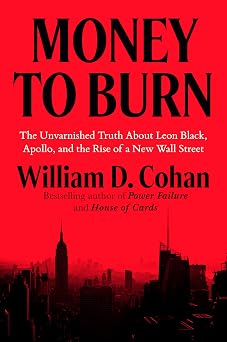
[Money to Burn: The Unvarnished Truth About Leon Black, Apollo, and the Rise of a New Wall Street]
Leon Black and Apollo Built a Financial Empire from the Ruins of Wall Street
When Everyone Else Ran Away, He Bought Everything
In February 1990, Drexel Burnham Lambert, the investment bank that had shaken corporate America with junk bonds, collapsed. Employees packed their belongings, but Leon Black, who had led the firm’s mergers and acquisitions division, looked first at the bonds left behind in the wreckage. Even assets discarded by the market as worthless could turn into gold if their prices fell far enough. Armed with that principle, Black and his partners founded Apollo and transformed it into a financial empire that moved corporate, insurance, and pension money once controlled primarily by banks. Yet Black, who excelled at calculating and controlling financial risk, turned a blind eye to the danger arising from his personal relationships. William D. Cohan traced the rise and fall of one financier to reveal how private capital became Wall Street’s new center of power.
[Key Message]
* A crisis does not destroy the value of assets; it changes who owns them. The deeper the market’s fear, the greater the opportunity for investors capable of measuring risk accurately.
* Apollo chose mispriced debt rather than conventionally attractive companies. It acquired distressed securities at low prices and used creditors’ rights to secure profits and corporate control.
* Private capital has grown from a supplement to banks into a central force in finance. It now extends beyond buyouts and direct lending to control vast pools of insurance and pension assets.
* Behind high investment returns are costs borne by someone else. A restructuring that generates profits for investors may bring layoffs and business contraction to employees and communities.
* The ability to control financial risk does not guarantee the protection of trust and reputation. Leon Black’s downfall showed that greater power demands ethical standards extending beyond legal responsibility.
***
Opportunity Discovered in Wall Street’s Collapse
On February 13, 1990, Drexel Burnham Lambert, one of Wall Street’s most aggressive investment banks, filed for bankruptcy protection. Only a few years earlier, Drexel had been reshaping the landscape of corporate America. It used high-yield bonds issued by companies with low credit ratings?so-called junk bonds?to supply enormous amounts of capital for mergers and acquisitions. Corporate raiders and leveraged-buyout specialists in need of large sums of money flocked to Drexel.
The architect of the junk-bond market was Michael Milken. He overturned the conventional financial practice of lending only to highly rated companies. Milken believed that investing in bonds issued by lower-rated companies could be worthwhile if investors received sufficiently high interest and diversified their holdings across many issuers. A new funding channel opened for midsized companies that had previously struggled to raise capital. At the same time, leveraged buyouts exploded as investors borrowed heavily against corporate assets and used the money to seize control of companies.
Leon Black stood at the front line of these transactions as the head of Drexel’s mergers and acquisitions division. He looked at a company’s capital structure before examining its products or brand. He studied what debts the company carried, what collateral supported them, and which creditors would be paid first in bankruptcy. Even when an entire company was faltering, particular bonds could retain substantial value. When panic swept through the market and investors dumped every bond indiscriminately, those who could identify the differences among individual contracts had an opportunity to make a fortune.
Drexel’s success unraveled rapidly after Milken came under investigation for securities-law violations. Milken pleaded guilty, and the firm lost both its credibility and its funding. Drexel’s bankruptcy was also a devastating blow to Black. Once among Wall Street’s highest-paid financiers, he suddenly found himself without an organization or a position.
Most people tried to distance themselves from the failed firm. Black responded differently. He focused less on the stigma Drexel had left behind than on the prices of the assets flooding the market. Financial institutions hurried to dispose of junk bonds, while investors abandoned them simply because their issuers had low credit ratings. As fear intensified, prices fell much faster than the assets’ actual recovery values.
Black believed that a crisis did not erase an asset’s value; it changed who owned it. If he could accurately calculate a company’s chances of survival, the amount recoverable in bankruptcy, and the value of its collateral in liquidation, market turmoil looked more like an opportunity than a threat.
He joined forces with Josh Harris and Marc Rowan, two former Drexel colleagues. The three founded Apollo in 1990. Although the firm took its name from the Greek god of the sun and prophecy, its beginnings were far from glamorous. The stigma of their Drexel background followed them, and persuading investors was difficult. They had neither enormous capital nor a long history. What they possessed instead was the ability to dissect debts that others struggled to understand and identify the most advantageous rights buried within them.
Drexel’s collapse appeared to mark the end of the junk-bond era. For Black and his partners, however, it released a flood of raw material for an entirely new financial business. The men who bought the remnants of one era began building an even larger empire on top of them.
Turning Abandoned Bonds into Gold
Apollo did not pursue companies everyone wanted to own. Businesses with strong finances and attractive growth prospects drew crowds of investors, and competition drove acquisition prices higher. When a good company was purchased at an excessive price, even a small mistake could wipe out the expected return.
Black moved in the opposite direction. He targeted companies burdened by debt, short of cash, and sometimes approaching bankruptcy. The more serious their problems appeared, the lower their prices fell and the fewer competitors remained. He did not rely on overly optimistic expectations of recovery. His first question was how much money could be recovered if the business failed.
The strategy did not depend solely on buying companies outright. Apollo acquired their bonds at steep discounts and then exercised influence during debt restructurings. Not every stakeholder in a bankrupt company receives equal treatment. Senior secured creditors are paid before unsecured creditors and shareholders. Depending on which bond an investor owns, that investor may be forced to absorb a loss?or may emerge as the company’s new owner.
Apollo sought the most advantageous position within a complex capital structure. If bond prices rose, it captured the gain. If a company entered bankruptcy, it converted debt into equity or took control of key assets. Transactions were designed to produce returns if the business recovered while limiting losses if it collapsed. The real contest began not after the company was acquired, but at the moment the bonds were purchased.
One of the defining opportunities behind Apollo’s early growth emerged with the collapse of the American insurer Executive Life. The company held a large portfolio of junk bonds sold by Drexel. When the insurer failed, that enormous bond portfolio came onto the market. To most investors, it resembled a vast heap of hazardous assets tangled together.
To Black, however, the assets were familiar. His years at Drexel had given him an intimate view of the market, the issuers, and the structure of the bonds. He knew they were not all equally impaired. A frightened market had stopped distinguishing good assets from bad and pushed down the prices of both. Apollo turned that gap into profit.
Apollo played an important role when the French financial institution Credit Lyonnais moved to acquire Executive Life’s insurance business and bond portfolio. The structure of the transaction was complicated, and legal controversies followed. Yet when the bond market recovered, the value of the assets purchased at distressed prices rose sharply. Apollo generated enormous returns early in its history and established its reputation among investors.
There was nothing romantic about Black’s approach. He did not invest in troubled companies out of a desire to rescue them. He examined whether risk had been excessively reflected in the price and whether legal protections would allow him to recover his money even if the investment failed. While corporate executives spoke about hope and recovery, he studied contracts and collateral lists.
Apollo expanded into industries highly sensitive to economic cycles, including chemicals, airlines, real estate, retail, telecommunications, casinos, and resorts. When the economy weakened and financing dried up, more companies came looking for help. At the moment banks and other investors retreated, Apollo supplied capital in exchange for higher returns and stronger rights.
The investment formula Apollo developed remains central to the alternative-investment market. The ability to secure an advantageous price in a difficult situation can matter more than the ability to identify an excellent company. Instead of predicting the future perfectly, the investor claims a position strong enough to survive when the forecast proves wrong. Fear is not eliminated; the price distortion created by fear is exploited.
Yet the same transaction tells a completely different story depending on who is looking at it. A corporate crisis represented an investment opportunity to Apollo, but it threatened the livelihoods of the people working inside the company. Business units were sold in the name of restoring profitability, and employees lost their jobs. Existing shareholders lost their stakes, while creditors fought to shift losses onto one another. The possibility that high returns for one party may arrive as termination notices for another remains an enduring controversy surrounding the rise of private capital.
Controlling Companies Without Buying Them
Private equity is often understood as a business in which wealthy investors purchase entire companies. Its actual mechanics are far more complex. An investment firm does not acquire a company solely with its own money. It borrows heavily against the target company’s assets and future cash flow. This makes it possible to control a large business with relatively little equity, but it also leaves the acquired company carrying a substantial debt burden.
When the business improves, leverage magnifies the investment return. Even a modest increase in the company’s value can produce a dramatic rise in the return on the investor’s equity. When performance deteriorates, however, interest payments place intense pressure on the company. A defining feature of the leveraged buyout is that the reward received by the investment firm and the risk borne by the acquired company do not always move in equal measure.
Apollo used this structure more aggressively than most. It pushed down acquisition prices, secured strong contractual protections, and recovered capital through cost reductions, asset sales, additional borrowing, and dividends. In some cases, operational improvements strengthened a company’s competitiveness. In others, the transaction left the business carrying debt for years.
The practice of borrowing more money after an acquisition and using it to pay dividends to investors also attracted controversy. The investment firm could recover a substantial portion of its original capital early, while the debt remained on the company’s balance sheet. If the business later encountered trouble, the fund’s exposure had already been reduced. The market principle that investors deserved compensation for taking risks remained in force, but who actually carried those risks to the end was a separate question.
Black became known as a formidable negotiator. He cared less about making a favorable impression than about improving the terms of a transaction, however slightly. In a deal worth hundreds of millions of dollars, a seemingly minor contractual provision could produce a vast difference in returns. He scrutinized figures and agreements relentlessly and kept applying pressure until the other side gave way.
That culture became both Apollo’s competitive advantage and a source of internal tension. Co-founders Josh Harris and Marc Rowan also played essential roles in the firm’s growth, but Black remained Apollo’s public face. While the judgment and relationships of a powerful founder accelerated the company’s rise, disputes over authority and succession also intensified.
The center of Wall Street was quietly shifting during this period. In the past, companies in need of capital turned to banks. Commercial banks accepted deposits and issued loans, while investment banks connected businesses with markets by underwriting bonds. The power to decide who received capital was concentrated in major banks.
The situation changed after the 2008 global financial crisis. Banks had to hold more capital and reduce risky lending. Stricter regulations made it harder to extend credit to companies with low ratings or complicated financial structures. The demand for corporate funding, however, did not disappear.
Alternative-asset managers such as Apollo filled the void. They raised money from institutional investors and began lending directly to companies. They charged higher interest rates than banks, but they made decisions quickly and tailored repayment terms to each borrower’s circumstances. For companies unable to issue bonds in public markets, private credit became a new source of funding.
That transformation is still under way. Apollo and other major asset managers no longer remain hunters of distressed companies. They operate as shareholders acquiring businesses, creditors lending to those businesses, and financial platforms managing insurance and pension assets. Where banks retreat, they become the new lenders capable of determining whether companies survive.
Wall Street’s power is also moving from skyscrapers bearing the names of global banks to the investment committees of large asset-management firms that remain largely invisible to the public. Private capital once handled risky transactions at the margins of finance. It now occupies the center of global capital allocation.
An Empire Completed with Insurance Money
Traditional private equity carried an inherent limitation. Firms raised commitments from investors, acquired companies, sold them after a set period, and returned the proceeds. When one fund reached the end of its life, another had to be raised. If markets were weak or previous investments had performed poorly, attracting new money became difficult.
Black and his partners wanted a more stable and permanent source of long-term capital. They found the answer in insurance.
Insurance companies collect premiums today and pay claims far into the future. In the case of annuities, money may be invested for decades. The enormous asset pools held by insurers represent long-term capital that does not have to be returned immediately. By securing the right to manage that money, a private-equity firm can maintain a steady supply of capital without repeatedly searching for investors whenever a new deal appears.
Apollo developed a close relationship with Athene, an insurance company established after the global financial crisis. Athene expanded rapidly by acquiring annuity businesses from other insurers, while Apollo managed its assets. As premiums flowed in, Apollo invested the money in corporate bonds, structured products, private credit, and other assets. The growth of Athene expanded the pool of assets under Apollo’s management.
This structure fundamentally changed Apollo’s business. In the past, the firm searched for distressed companies and developed individual transactions. Now it also had to create enough investment products to absorb a continuous inflow of insurance capital. When Apollo lent money to a company, that loan could become an investment held in an insurer’s portfolio. The firm developed a vast circular structure: capital was gathered on one side, while credit products capable of absorbing that capital were manufactured on the other.
This combination has become a central growth model in today’s alternative-asset industry. Insurance companies supply money that can be invested over long periods, and asset managers create corporate loans and structured products in which that money can be placed. As assets under management grow, fee revenue increases. As the supply of investment products expands, the platform can attract even more insurance capital.
Premiums paid by ordinary people preparing for retirement flow into acquisition financing, real-estate loans, and private-credit products. Policyholders may believe they have no connection to Apollo, but part of the money intended to support their future is tied to Apollo’s investment strategy.
The combination of insurance and private capital offers benefits to both sides. Insurers can pursue higher returns even in a low-interest-rate environment, while asset managers gain access to vast pools of long-term capital. Because insurance liabilities mature over many years, these assets are less likely to require immediate sale during a temporary market decline.
Yet those advantages can also become the source of risk. Policyholders want more than high investment returns; they want confidence that promised benefits will be paid. Asset managers, by contrast, seek stronger returns and higher fees. Complex and infrequently traded assets may appear stable on a balance sheet, but their actual sale price during a crisis can be difficult to determine.
When one financial group creates investment products and then buys them with affiliated insurance money, the fairness of their prices and fees must also be examined. The interests of the asset manager and the safety of policyholders do not always align. When returns are high, the manager receives compensation. When losses mount, the insurer and its policyholders may bear the consequences.
Private capital has assumed many functions once performed by banks, but it is not supervised in exactly the same way. When loans do not trade in public markets, outsiders struggle to verify their prices and risks. As private credit grows, determining where debt and vulnerability are accumulating across the financial system becomes increasingly difficult.
The most powerful asset Apollo acquired was not control of any single company. It was a continuous stream of long-term capital. Black’s financial empire began by buying bonds others had abandoned and evolved into a major supplier of capital managing the insurance and retirement money of ordinary citizens. His transactions ceased to be contests confined to Wall Street and became connected to the financial futures of millions of people.
The Arrogance of Believing Risk Can Be Controlled
Leon Black’s success gave him extraordinary influence beyond Wall Street. He became one of the world’s most prominent art collectors and held important positions at cultural institutions, including the Museum of Modern Art in New York. Large donations and arts patronage elevated him from a financier to a powerful figure in the cultural world.
For Black, art was more than a decoration used to display wealth. The pursuit of rare works, the judgment of value, and the desire to outbid competitors resembled his approach to investing. The impulse to discover value and price before the rest of the market connected his financial deals with his art collection.
Yet the scandal that shattered his reputation and standing did not originate in a complicated financial transaction. It arose from his relationship with the convicted sex offender Jeffrey Epstein.
Epstein maintained extensive relationships with wealthy financiers, politicians, academics, and celebrities. Even after his 2008 conviction for procuring a minor for prostitution, he continued to associate with members of the social elite. Black was among them.
Black said he had received advice from Epstein on taxation, estate planning, and asset management. The problem was the amount of money involved. According to the findings of a publicly released investigation, Black paid Epstein well over $150 million. It was an extraordinary sum even for a leading accounting firm or law firm. A substantial part of their financial relationship continued after Epstein’s conviction.
An external investigation commissioned by Apollo’s board concluded that it had found no evidence that Black had been involved in Epstein’s criminal conduct. It also stated that the advice had helped Black obtain substantial tax savings. From a legal perspective, there appeared to be an explanation for the financial relationship.
The public, however, was asking a different question. Why had a financier capable of hiring the world’s best lawyers and accountants continued to rely on a convicted offender? What services justified such enormous fees, and why had Black ignored the damage the relationship could inflict on his company, cultural institutions, and investors’ trust?
The decision appeared even more incomprehensible when measured against the investment principles Black had followed throughout his career. He scrutinized the smallest contractual clause and calculated how much he might lose in the worst possible outcome. No one was more sensitive to risk in a company’s capital structure. Yet in his relationship with Epstein, he ignored the clearest warning signs.
The two sides of Black appeared completely different, yet they were rooted in a similar conviction. He did not see risk as something to avoid. He believed that sufficient information, money, and influence allowed him to control it. In the distressed-debt market, that confidence produced immense profits. In his personal life, the same confidence led to a disastrous misjudgment.
As the controversy intensified, Black stepped down as Apollo’s chief executive and chairman. Control of the firm he had founded passed to his co-founder Marc Rowan. The founder who had built a global financial institution had changed from one of its greatest assets into its most serious reputational liability.
Black’s departure was more than the fall of one individual. It demonstrated that when a financial institution grows around a founder’s abilities and relationships, that person’s private decisions can become corporate risks. Compliance with the law was not enough. An organization entrusted with the insurance and retirement assets of its clients must meet standards of trust broader than legal liability alone.
His major donations to cultural institutions also became a subject of debate. Philanthropy supported art and public institutions, but it simultaneously granted prestige and social authority to the donor. Institutions accepting that money could not remain entirely separate from his name or reputation. A circular relationship came into view: wealth created in finance was converted into cultural authority, while cultural authority helped protect the public image of the financier.
A New Distribution of Money, Risk, and Responsibility
Reading Leon Black’s life simply as a story of triumph followed by disgrace would obscure the much larger transformation created by Apollo. The firm did not disappear after Black left. It continued to expand from a founder-driven investment company into a vast asset manager spanning insurance, credit, real estate, and infrastructure.
Black’s most important legacy was not a handful of brilliant transactions. It was a system for purchasing assets during periods of market panic, controlling companies through complex debt structures, and transforming insurance money into long-term investment capital. The instincts of a gifted individual were converted into organizational processes and financial products.
That system supplies capital needed by the modern economy. Companies that struggle to obtain bank loans can continue operating with private credit, while businesses approaching bankruptcy may recover after receiving new capital. Investors willing to assume risk when markets freeze can absorb part of the economic shock.
But the reasons private capital profits from a crisis must also be examined. Someone is forced to sell an asset quickly, someone can no longer obtain a loan, and someone loses the power to negotiate. A crisis does not mean the same thing to everyone. For a cash-rich investor, it is a season of discounts. For a heavily indebted company and employees fighting to preserve their jobs, it is a time when choices disappear.
The recovery of a company does not mean that every stakeholder has been protected. Unprofitable divisions are closed, employees are dismissed, and factories are shut down or sold. Management comes under pressure to improve cash flow within a short period. Investors earn strong returns, but the social costs required to generate those returns are not fully recorded in financial statements.
The question becomes even more important as private capital extends into insurance and pensions. The money managed by Apollo does not belong only to billionaires. It also includes premiums and retirement savings contributed by ordinary citizens. Private capital can own a company that dismisses workers while simultaneously managing the retirement assets of other workers.
When the roles of shareholder, creditor, lender, and asset manager converge within one organization, interests become more complicated. Returns created by cutting costs at one company may flow to pension beneficiaries elsewhere. Employment security on one side and retirement security on the other can collide within the same financial structure. It becomes increasingly difficult to see who receives the benefit and who bears the cost.
Apollo’s history reveals how far the role of finance has expanded within modern capitalism. Major asset managers do more than act as intermediaries. They own companies, extend loans, direct restructurings, invest insurance premiums, and participate in the operation of infrastructure. Some functions once performed by governments and banks are moving into the hands of private asset managers.
Their power has grown, but public scrutiny has not kept pace. Prices and trading information for publicly listed stocks and bonds are visible, while the contracts governing private markets are difficult for outsiders to examine. It is not easy to determine how assets are valued, what fees flow among affiliated companies, or where the ultimate risk of loss resides.
Black found opportunities in the gaps left by the market. In the decades since he founded Apollo, those gaps have grown into a vast industry. The territory of private capital now includes the space abandoned by banks, the debts of bankrupt companies, the long-term assets of insurers, and risks that public markets are unwilling or unable to absorb.
The sharpest question raised by his life is not how much wealth he accumulated. It is whether those who calculate risk should also have the power to transfer that risk to other people. Financiers can convert the probability of loss into a number, but they cannot measure a dismissed worker’s life, a policyholder’s anxiety, or the collapse of public trust in the same way.
Leon Black bought when everyone else ran away. That decision made him one of Wall Street’s great winners. Yet not every risk can be purchased cheaply and converted into profit. His financial formula failed when confronted with trust, reputation, and responsibility?forces that no contract could fully control.
The Wall Street reshaped by Apollo continues to expand even after Black’s departure. Money has moved from bank vaults into private-equity funds and insurance accounts, while asset managers have become a new class of power capable of determining the fate of companies. The necessary question is no longer whether private capital is inherently good or bad. It is whose money supports that power, to whom it is accountable, and who absorbs the cost when it fails.
Black discovered money in the ruins. Apollo used that money to transform the financial order. What society must now examine is not the glamorous success of one billionaire, but the way money, risk, and responsibility are distributed among different people within the system he left behind.

.jpg)
.jpg)
.jpg)










.jpg "money-to-burn-graphic-large-text(2).jpg")