Who Is Telling Us Not to Follow the News?
- Distrust, Platforms, Well-Being, and Democracy Behind News Avoidance
There was a time when news was something we were supposed to know more about. Now, advice telling us to do the exact opposite is everywhere. Politicians tell us not to trust the media, health experts advise us to cut back on news to protect our peace of mind, and platforms make it easy to hide information we do not want to see. In an age when people turn away from news not because there is too little information but because there is too much, the important question is shifting from why people switch off the news to who tells them that it is acceptable to distance themselves from it.
[Key Message]
* News avoidance does not begin only when an individual turns off the screen. When people repeatedly hear that news is biased, harmful, and unnecessary, the distance between citizens and news has already begun to widen.
* Distrust in news is not simply an emotion that arises on its own. Political attacks, failures by the media, competition within the media industry, and platform structures interact to shape what people believe and what they exclude.
* There are different reasons why people choose not to follow the news. Some do so to protect themselves from fatigue and safeguard their mental health, while others are protesting distorted coverage or rejecting the authority of established media institutions.
* In the platform era, what people do not see matters just as much as what they do see. Blocking, hiding, personalized recommendations, and algorithms are changing the very place that news occupies within citizens’ information environments.
* Democracy does not simply require more news. What comes first is proving the value and responsibility of journalism so that citizens once again feel they have a reason to know and a reason to trust.
***
Why Are People Fleeing from the News When There Is So Much of It?
The moment we open our smartphones after waking up in the morning, the world is already pushing dozens of events at us. War and disasters that unfolded overnight, plunging stock prices, remarks by politicians, crimes, the climate crisis, and celebrity controversies pour onto the screen all at once within minutes. Unlike the era when people had to buy a newspaper or wait for the evening news, there is no longer any need to seek out the news. News comes looking for us all day long.
For this reason, the modern problem is becoming less about “not knowing” and more about “knowing too much.” Advice such as not checking the news in the morning, turning off notifications before bed, and taking a break from political news on holidays is spreading like a form of self-care. On the other side, people are encouraged to do exactly the same thing for a different reason. The argument is that mainstream media is biased and unreliable, so it is better not to watch or read it.
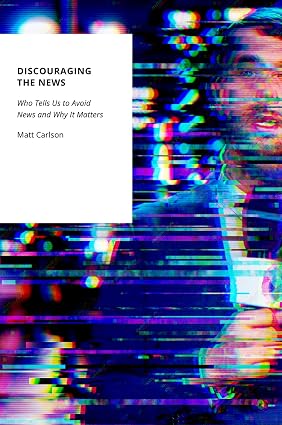
The starting points are different, but the destination is the same: keep your distance from the news. This is also where Carlson directs his attention. Rather than treating news avoidance simply as a matter of individual choice?“Why do some people not follow the news?”?he examines the words and actions that discourage access to news or diminish its value.
From this perspective, news avoiders are not limited to people who delete news apps from their smartphones. Different forces, such as political attacks, platform design, advice about mental health, and media criticism from particular communities, can all widen the distance between citizens and news. If news avoidance is merely an individual behavior, the solution may be limited to persuading people to follow the news again. But if news discouragement is a socially produced phenomenon, the story becomes far more complicated.
How Is Distrust Created?
The media has always been criticized. Errors, bias, sensationalism, and collusion with power have all existed, and pointing out the failures of the press is essential in a democracy. But criticizing a particular article for being wrong is completely different from claiming that “the media always lies.” The former demands better journalism, while the latter eliminates the very need to evaluate journalism at all.
In politics, this distinction is especially important. Attacking a media organization’s motives and legitimacy can be far more effective than rebutting every unfavorable report one by one. When phrases such as “that media outlet hates us,” “it represents the establishment,” or “it is fake news” are repeated, the question of who reported something can become more important than whether the report itself is true. It is a strategy that does not refute the reporting but instead strips the media of its authority to act as an arbiter.
Donald Trump’s repeated attacks on the press as “the enemy of the people” are a representative example of how powerful this approach can become as a political tool. Once the media is grouped together as a hostile force, even unfavorable reports that appear later can be interpreted as attacks from an enemy before their contents are examined. Distrust becomes more than an emotion. It becomes a political resource that gives people a reason not to look at certain information at all.
But responsibility cannot be placed solely on politicians. Exaggerated headlines designed for clicks, the excessive repetition of conflict, stereotypes about particular groups, and a failure to explain reporting errors adequately all accumulate into genuine dissatisfaction with the news. While outsiders may actively cultivate distrust, failures within journalism itself also provide the soil in which that distrust can take root.
This is why blaming people who distance themselves from news as simply ignorant or indifferent to democracy does little to solve the problem. What matters is distinguishing between distrust deliberately manufactured through attacks and disappointment that arises from actual experiences with news. If journalism wants to regain trust, it needs to explain first why that trust was lost rather than simply insisting, “Trust us.”
Platforms Also Decide Which News We Do Not See
In the age of print newspapers, avoiding the news was simple. You did not buy the paper or turn on the television news. In the digital age, news can disappear from view naturally even when users do not consciously reject it. An information environment can be created without people even realizing what they have not chosen to see.
Social media platforms offer features such as hiding, blocking, muting, and unfollowing. In an environment overflowing with information, these tools are necessary. No one can live while absorbing every post and every opinion. Yet when convenient filters continue to accumulate, they can also become tools for pushing away entire parts of reality that are uncomfortable or uninteresting.
Recommendation algorithms wield even greater influence. Users do not personally select everything that appears in their feeds. Platforms construct the next screen based on what users clicked before, how long they watched, and which content they responded to. Deciding what to show also means deciding what not to show.
News receives no special treatment in this competition. A report on war appears next to a friend’s vacation photo, a short comedy video follows an economic article, and serious policy analysis competes with shopping advertisements for the user’s time. If the platform’s primary goal is not to increase citizens’ public knowledge but to keep users engaged for as long as possible, difficult and uncomfortable news is more likely to be pushed aside.
At this point, news discouragement no longer even requires someone to say, “Do not watch the news.” The news only needs to slide farther down the feed while more stimulating and entertaining content takes its place. Citizens may not think they have rejected the news, yet they can gradually end up living inside an information environment that has moved away from it.
A comfortable information environment can give individuals satisfaction, but it creates a different problem for democracy. People have fewer opportunities to encounter the realities of those who think differently from them, social issues they had not cared about, and uncomfortable facts they nevertheless need to know. News consumption in the platform era creates a new tension between freedom of choice and the minimum shared reality that a community needs.
When News Is Treated as “Pollution”
There are exceptions to the idea that the more widely news circulates, the better. If particular crime coverage reinforces stereotypes about race or region, if sensational reporting of suicide increases the risk of imitation, or if the uncritical repetition of extremist messages gives them a propaganda platform, then the formula that “more information serves the public interest” begins to break down. This is the moment when news is treated not as a public good but as a kind of pollutant that can harm society.
It is difficult to dismiss such criticism as simply an attack on journalism. Reporting always involves choices. News organizations decide which events become stories, whether attention is placed on victims or perpetrators, which photographs are used, and how often particular images are repeated. The same event can leave entirely different social meanings depending on how it is edited and presented.
Especially for communities that have long been repeatedly portrayed in negative ways by the media, the demand “Do not report on us like this” may not be a call to eliminate news itself. It may instead be a demand for more accurate and less harmful reporting. Choosing not to consume a media outlet that one believes persistently misrepresents one’s community can also be a critical response to journalistic practices rather than an expression of political indifference.
This is where the complexity of news discouragement becomes clear. When a powerful figure attacks a news organization as a liar after it reports on corruption, and when a community rejects a particular outlet in protest against distorted representation, both may appear on the surface to take the form of “Do not follow that news.” Yet one may be an attempt to weaken scrutiny of power, while the other may be a demand for greater media accountability.
For this reason, judging the meaning of news avoidance requires asking not only who is telling people to stay away, but also why. Once we abandon the assumption that news is always inherently good, it becomes possible to look at press freedom and press responsibility at the same time.
Does Turning Off the News Bring Peace of Mind?
Among the arguments for avoiding news, the most persuasive often comes not from politics but from health. When war, disasters, crime, economic crises, climate disasters, and political conflict arrive on our phones in real time, citizens can become exhausted before they have even had a chance to understand the world. Unlike the era when a single evening broadcast summarized the day, events now intrude into daily life through notifications from morning to night.
As a result, the idea of a “news diet” has become a lifestyle practice. People check the news only at fixed times, avoid it before going to sleep, and deliberately distance themselves from it on weekends. In this context, news avoidance is reinterpreted not as irresponsible behavior but as a sensible way to manage one’s mental energy.
Yet democracy operates on the assumption that citizens possess at least some knowledge about the society in which they live. To make decisions in elections, people need to understand policy, and to understand inequality and conflict outside their own lives, they need news. If everyone blocks out whatever makes them uncomfortable, the shared basis of reality that allows a community to talk together may also weaken.
At the same time, it is unrealistic to demand that people consume disaster and outrage all day long in order to be good citizens. Here, the question shifts from the responsibility of citizens back to the responsibility of news. Perhaps people are not leaving because news is unimportant, but because it is too repetitive, too negative, and leaves them feeling powerless to change anything through their own actions.
News fatigue is not produced by quantity alone. It is also intensified by a style of journalism that endlessly repeats the same conflicts, gives insufficient explanation of background and possible solutions, and relies on the most shocking images to capture attention. Before lecturing people who want to consume less news and telling them to consume more, it is far more productive to ask why news has become such an exhausting product.
When Not Watching Becomes a Form of Resistance
Rejecting news can sometimes become a highly active political act. Canceling a newspaper subscription, refusing to watch a particular broadcaster, or boycotting advertisers turns news consumption into a means of expressing one’s position. Here, avoidance is not a matter of leaving because one is uninterested. It becomes a declaration: “I will no longer give my time or money to journalism produced in this way.”
Digital environments greatly reduce the cost of making such choices. Canceling a subscription takes only a few clicks, and on social media, unfollowing and blocking can communicate a position instantly. News consumers are no longer merely passive readers or viewers. Through their attention, subscription fees, and advertising value, they become participants who influence the flow of resources through the media market.
But not every boycott has the same meaning. Consumer pressure aimed at changing recurring harmful reporting practices can increase media accountability. On the other hand, attacking a news organization simply because it reported uncomfortable facts, or trying to intimidate journalists and discourage reporting, can weaken the media’s role in holding power to account.
This is why someone who does not follow the news is not necessarily a bad citizen, just as someone who consumes news all day is not necessarily a good one. It is also difficult to claim that a person who repeatedly consumes one type of biased information understands reality better than someone who checks multiple sources more selectively. In a democracy, what matters is not the quantity of news consumption but the kind of information environment in which citizens make judgments.
This perspective unsettles the familiar moral divide surrounding news avoidance. Instead of separating society into “citizens who follow the news” and “citizens who do not,” it asks which news people choose or reject, why they do so, and who influences that process. News discouragement can sometimes damage democracy, but at other times it can become pressure for better journalism.
Will Artificial Intelligence Become the New Gatekeeper of News?
Another intermediary is now moving between news and citizens: artificial intelligence. Rather than opening several articles from search results, people increasingly ask, “Summarize today’s most important news for me,” and use conversational artificial intelligence to explain the meaning of public policy or international conflicts. The speed and convenience of access to information are becoming difficult to compare with anything in the past.
Yet as convenience increases, the sources of news may become less visible. If artificial intelligence summarizes reporting from multiple news organizations into a single answer, users may gain information without knowing which journalist verified the facts or what process was used to confirm them. A new form of news consumption becomes possible in which people consume news without directly encountering news organizations.
This brings the question of authority back into focus. In the past, “Which news organization reported this?” was an important clue for judging the reliability of information. In the age of artificial intelligence, the fact that “AI said so” may itself begin to function as a new kind of authority. But if users cannot see which sources were selected, what was omitted, or how competing information was weighted, the filtering process may become even less transparent.
This does not mean that the need for reporting organizations disappears. If artificial intelligence does not travel the world and verify every event directly, someone still has to go into the field, ask questions, check documents, and produce verified facts. What may change is that, at the final stage when information reaches citizens, the traces of that reporting process may become faint.
For this reason, future news avoidance will be difficult to explain simply in terms of whether people “watch the news or not.” More people may consume facts produced by news organizations every day without directly reading a single article. The news does not disappear. Rather, the form of news and the presence of the people who produced it move behind the screen.
A Reason to Return, Rather Than More News
If the phenomenon of people not following the news is defined only as a crisis of democracy, the solution appears simple: tell citizens to consume more news. But the reasons people distance themselves from news include political manipulation, distrust, fatigue, mental health concerns, failures of journalism, and legitimate criticism from communities. Once people with very different motives are grouped together as “citizens who are not interested in news,” the solution also begins to move in the wrong direction.
The question therefore needs to change. Instead of asking why people do not follow the news, we need to ask why news has come to feel as though it is not worth following. This question shifts part of the responsibility from citizens back to journalism.
The media cannot expect to be trusted automatically simply because journalism is important to democracy. It must verify what is true accurately, explain its errors when they occur, and show why particular events deserve attention. If news has become disconnected from people’s lives, journalism needs to rebuild that connection. If certain communities have been repeatedly misrepresented, those reporting practices must also change.
At the same time, correcting the failures of journalism must be clearly distinguished from weakening journalism itself. When powerful actors deliberately manufacture distrust in order to suppress unfavorable reporting, it is not enough for journalists simply to accept all criticism humbly. Legitimate criticism should be answered with change, while attacks aimed at destroying journalistic authority for self-interest should be confronted with facts and reporting.
For Carlson, news discouragement therefore does not remain simply a story about the end of journalism. If we properly understand why people turn away from news, it becomes much clearer what journalism needs to fix. News discouragement is uncomfortable for the media, but it is also a signal showing what citizens want from news and what has disappointed them.
What good citizens need is not the habit of following the news all day long. They need an information environment in which they can understand what matters, judge why certain information deserves to be trusted, and comprehend the realities in which people different from themselves live. The value of news is not determined by how much of it is consumed, but by whether it gives people a reason to return in order to understand the world they share with others.
So in an age when voices telling us “do not follow the news” are growing louder, the question journalism must ask also needs to change. It is not how to make people consume more news. It is how to create news that gives people a reason to come back.