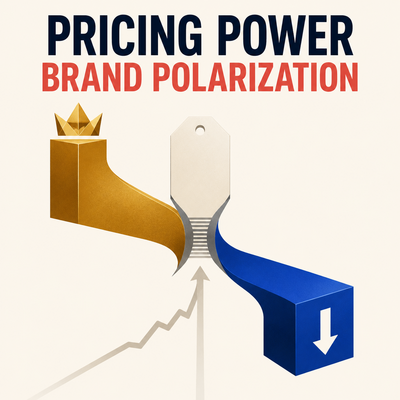
원재료비와 인건비, 물류비가 함께 오르더라도 모든 기업이 같은 충격을 받는 것은 아니다. 어떤 브랜드는 가격을 올리고도 고객과 이익을 지키지만, 어떤 브랜드는 가격을 동결해도 선택받지 못한다. 비용 상승의 시대에 기업의 운명을 가르는 것은 원가 자체보다 고객이 인정하는 ‘가격의 정당성’이다.
[Key Message]
* 같은 비용 상승을 겪어도 고객이 인정하는 가치를 가진 브랜드만 가격을 올리면서 수익성과 충성도를 지킬 수 있다.
* 가격 결정력은 가격표의 숫자를 높이는 능력이 아니라, 높은 가격에도 고객이 떠나지 않을 선택의 이유를 만드는 능력이다.
* 소비시장은 프리미엄과 초저가로 양극화되고 있으며, 차별성과 가격 경쟁력이 모두 불분명한 중간 브랜드가 가장 큰 압박을 받는다.
* 반복적인 할인은 정가에 대한 신뢰를 무너뜨리고, 브랜드의 가격 결정력을 약화시키는 악순환을 만든다.
* 강한 브랜드는 고객이 중요하게 생각하지 않는 비용은 줄이고 제품력·신뢰·경험·정체성처럼 체감할 수 있는 가치에는 더 투자한다.
***
비용 상승보다 무서운 가격 전가력의 격차
인플레이션이 둔화됐다는 통계가 발표돼도 기업이 체감하는 비용 압박은 쉽게 사라지지 않는다. 물가상승률이 낮아졌다는 것은 가격이 과거 수준으로 내려갔다는 뜻이 아니라, 오르는 속도가 느려졌다는 의미이기 때문이다. 이미 높아진 원재료비와 임금, 임차료, 물류비, 에너지 비용은 기업의 손익계산서에 그대로 남아 있다. 여기에 관세와 공급망 재편, 환율 변동, 지정학적 불확실성까지 더해지면서 기업은 비용을 내부에서 흡수할 것인지, 소비자 가격에 반영할 것인지 선택해야 한다.
표면적으로 보면 모든 기업이 비슷한 문제를 겪는 것처럼 보인다. 그러나 비용 상승이 실제 수익성에 미치는 영향은 브랜드마다 크게 다르다. 고객에게 가격 인상의 이유를 납득시킬 수 있는 기업은 비용 부담을 일정 부분 시장에 전가한다. 반면 대체재가 많고 차별성이 약한 기업은 가격을 올리는 순간 고객을 잃을 수 있다. 가격을 동결하면 판매량은 유지할 수 있을지 몰라도 마진이 줄어들고, 가격을 올리면 매출과 시장점유율이 흔들리는 딜레마에 빠진다.
가격 결정력은 단순히 가격표의 숫자를 바꿀 수 있는 권한이 아니다. 가격을 인상하고도 고객이 이탈하지 않으며, 판매량과 브랜드 신뢰를 일정 수준 이상 유지할 수 있는 능력이다. 같은 제품군에서도 어떤 기업은 원가 상승분 이상으로 가격을 올려 이익을 방어하지만, 다른 기업은 할인과 판촉을 확대하면서도 판매량 감소를 막지 못한다. 비용 상승은 모든 기업에 공통으로 주어지는 충격이지만, 그 충격을 견디는 능력은 공평하게 분배되지 않는다.
과거에는 대규모 생산시설과 유통망을 가진 기업이 가격 경쟁에서 유리했다. 규모의 경제가 원가를 낮춰주었기 때문이다. 지금은 규모만으로 충분하지 않다. 온라인 유통의 확산으로 가격 비교가 쉬워졌고, 유통업체의 자체 브랜드가 품질과 디자인을 빠르게 끌어올렸다. 소비자는 익숙한 이름에 무조건 높은 가격을 지불하지 않는다. 반대로 명확한 효용과 경험을 제공하는 브랜드에는 이전보다 높은 가격도 받아들인다.
가격 결정력의 격차는 경기 침체기에 더욱 선명해진다. 소비가 위축될수록 고객은 모든 지출을 똑같이 줄이지 않는다. 중요하지 않은 소비는 과감히 없애고, 중요하다고 판단한 상품에는 오히려 더 많은 돈을 쓴다. 브랜드 간 경쟁은 ‘누가 더 싸게 파느냐’만의 싸움이 아니라 ‘누가 고객의 제한된 예산 안에 끝까지 남느냐’의 경쟁으로 바뀐다.
가격을 올려도 고객이 떠나지 않는 브랜드
강한 가격 결정력은 유명세만으로 만들어지지 않는다. 오랜 역사와 높은 인지도를 가진 브랜드라도 고객이 가격의 근거를 찾지 못하면 외면받는다. 반대로 규모가 작고 신생 브랜드라 해도 독특한 기능과 분명한 철학, 뛰어난 고객 경험을 제공한다면 높은 가격을 인정받을 수 있다. 핵심은 고객이 가격을 숫자가 아니라 가치와 연결해 해석하게 만드는 데 있다.
첫 번째 기반은 대체하기 어려운 제품력이다. 성능과 품질, 디자인, 사용 편의성 가운데 적어도 하나는 경쟁자가 쉽게 복제하기 어려워야 한다. 고객이 “더 싼 제품으로 바꿔도 큰 차이가 없다”고 판단하는 순간 브랜드의 가격 결정력은 약해진다. 기술적 차별화가 어렵다면 서비스와 구매 과정, 사후관리, 커뮤니티, 콘텐츠 등 제품 외부에서 차이를 만들어야 한다.
두 번째는 신뢰다. 소비자는 가격이 높은 제품을 구매할수록 실패 가능성을 줄이고 싶어 한다. 브랜드에 대한 신뢰는 선택의 위험을 낮춰주는 일종의 보험이다. 품질이 일정하고, 문제가 발생했을 때 책임 있게 대응하며, 과장된 약속을 하지 않는 브랜드는 가격 비교에서 한발 벗어날 수 있다. 고객은 상품만 사는 것이 아니라 구매 이후의 안심까지 함께 구매한다.
세 번째는 정체성이다. 오늘날 브랜드는 기능을 제공하는 데 그치지 않고 고객이 자신을 표현하도록 돕는다. 어떤 옷을 입고, 어떤 자동차를 타며, 어떤 식품을 선택하는지는 개인의 취향과 가치관을 드러내는 언어가 됐다. 자신이 되고 싶은 모습과 연결된 브랜드는 단순한 상품보다 강한 충성도를 얻는다. 이런 브랜드의 가격은 제조원가에 일정한 이윤을 더해 결정되지 않는다. 고객이 느끼는 상징적 가치와 정서적 만족이 가격의 상한선을 높인다.
네 번째는 습관과 생태계다. 하나의 제품이 다른 서비스와 연결되거나, 사용 경험이 누적될수록 전환비용은 커진다. 데이터와 멤버십, 콘텐츠, 액세서리, 커뮤니티가 하나의 생태계를 형성하면 고객은 단순히 더 싼 상품이 등장했다는 이유만으로 이동하지 않는다. 다만 전환비용에만 의존해 가격을 올리면 반발이 쌓일 수 있다. 생태계는 고객을 가두는 울타리가 아니라 계속 머물고 싶은 환경이어야 한다.
강한 브랜드도 가격을 무한정 올릴 수 있는 것은 아니다. 가격 결정력은 고객의 관용을 시험하는 면허가 아니다. 반복적인 가격 인상에도 제품과 서비스가 나아지지 않으면 고객은 어느 순간 브랜드가 자신의 충성심을 이용한다고 느낀다. 가격 인상이 매출 증가로 나타나더라도 판매량과 재구매율, 추천 의향이 함께 떨어진다면 가격 결정력은 이미 약해지고 있을 수 있다.
프리미엄과 초저가로 갈라지는 소비시장
최근 소비시장에서 두드러지는 현상은 프리미엄과 초저가의 동시 성장이다. 한쪽에서는 고가의 경험과 품질을 원하는 수요가 살아 있고, 다른 한쪽에서는 최저가와 실용성을 앞세운 상품이 빠르게 확산한다. 두 흐름은 서로 모순되는 것처럼 보이지만, 실제로는 같은 소비자의 선택 안에서도 동시에 나타난다.
소비자는 더 이상 소득수준에 따라 일관되게 고가 또는 저가 상품만 구매하지 않는다. 평소에는 자체 브랜드 식품과 할인 상품을 구매하면서도 건강, 취미, 여행, 반려동물처럼 자신이 중요하게 여기는 영역에는 프리미엄 제품을 선택한다. 생필품에서는 단가를 꼼꼼히 따지고, 특별한 경험에는 높은 비용을 지불한다. 한 사람 안에 절약형 소비자와 프리미엄 소비자가 함께 존재하는 것이다.
초저가 브랜드의 경쟁력은 단순히 가격이 낮다는 데 있지 않다. 고객이 무엇을 포기하고 무엇을 얻는지 분명히 알 수 있다는 점이 중요하다. 화려한 포장과 불필요한 기능, 과도한 서비스는 줄이되 기본적인 품질을 안정적으로 제공한다. 가격이 낮은 이유가 품질 부족이 아니라 효율적인 구조에 있다는 확신을 주면 저가는 하나의 브랜드 철학이 된다.
유통업체 자체 브랜드도 이러한 변화를 보여준다. 자체 브랜드는 한때 유명 제품을 저렴하게 모방한 대체품으로 인식됐지만, 이제는 품질과 디자인, 건강, 지속가능성, 독창적인 맛까지 내세우는 독립적인 브랜드로 진화했다. 2025년 NIQ 조사에서는 세계 소비자의 53%가 자체 브랜드 구매를 늘리고 있다고 답했으며, 동시에 세계 상위 브랜드의 판매 흐름도 회복됐다. 저가와 강한 브랜드가 함께 성장하는 양극화가 나타난 것이다.
프리미엄 브랜드 역시 높은 가격만 붙인다고 성공하지 않는다. 소비자는 경기 불확실성이 커질수록 고가 상품에 더 엄격한 기준을 적용한다. 소재와 완성도, 기술, 희소성, 서비스, 브랜드 서사 중 무엇이 가격 차이를 만드는지 확인한다. 유명한 로고만으로 프리미엄을 정당화하기는 어려워졌다. 가격이 높을수록 설명해야 할 가치도 커진다.
이 때문에 소비의 양극화는 소득계층만의 분화를 의미하지 않는다. 소비자가 상품군별로 지출의 우선순위를 재배치하는 현상에 가깝다. 선택받은 영역에는 더 많은 돈이 몰리고, 중요도가 낮은 영역에서는 최저가 경쟁이 심해진다. 기업이 평균적인 소비자를 상정해 적당한 가격과 적당한 품질을 제공하는 방식은 점점 힘을 잃고 있다.
어중간한 브랜드를 압박하는 중간지대의 붕괴
가격과 가치의 양극화에서 가장 위험한 위치는 중간이다. 중간 가격대 자체가 사라진다는 의미는 아니다. 가격을 더 지불해야 할 이유도, 더 저렴하게 구매할 이유도 분명하지 않은 브랜드가 어려워진다는 뜻이다. 소비자의 눈에 차이가 보이지 않으면 중간 가격은 합리적인 선택이 아니라 애매한 선택이 된다.
과거의 중간 브랜드는 대중적인 인지도와 안정적인 유통망을 바탕으로 성장했다. 품질은 평균 이상이었고 가격도 지나치게 높지 않았다. 소비자가 상품 정보를 충분히 비교하기 어려웠던 시기에는 익숙함 자체가 경쟁력이었다. 그러나 검색과 리뷰, 가격 비교, 소셜미디어가 일상화되면서 정보의 비대칭이 줄었다. 고객은 비슷한 품질의 저렴한 대체재를 쉽게 발견하고, 높은 만족을 주는 소규모 전문 브랜드도 찾아낸다.
중간 브랜드가 비용 상승에 대응해 가격을 올리면 문제가 더 커질 수 있다. 프리미엄 브랜드와의 가격 차이는 줄어들고, 자체 브랜드나 저가 상품과의 격차는 벌어진다. 고객은 “조금 더 내고 더 좋은 제품을 살 것인가, 훨씬 덜 내고 비슷한 효용을 얻을 것인가”를 고민한다. 어느 쪽에서도 선택 이유를 제시하지 못하면 판매량이 줄고, 이를 만회하기 위해 할인을 늘리면서 브랜드 가치가 다시 약해진다.
모든 중간 브랜드가 프리미엄이나 초저가로 이동해야 하는 것은 아니다. 중간 가격대에서도 강한 경쟁력을 만들 수 있다. 다만 누구에게나 무난한 상품을 제공하기보다 특정 고객의 구체적인 문제를 더 잘 해결해야 한다. 예를 들어 사용 시간을 줄여주거나, 유지비용을 낮추거나, 구매 실패를 줄이거나, 접근성을 높이는 식으로 가치의 기준을 분명히 해야 한다.
‘합리적 프리미엄’도 하나의 선택이 될 수 있다. 최고가 제품만큼 화려하지 않지만 핵심 성능에서는 부족하지 않고, 저가 제품보다 신뢰와 서비스가 뛰어난 위치다. 이 전략이 성공하려면 고객이 무엇을 덜어내고 무엇을 지켰는지 알아볼 수 있어야 한다. 모든 기능을 조금씩 제공하는 것이 아니라 고객이 중요하게 생각하는 기능에 자원을 집중해야 한다.
중간지대의 붕괴는 가격대의 소멸보다 정체성 없는 브랜드의 퇴장을 뜻한다. 선명한 가치 제안이 있다면 중간 가격에서도 살아남을 수 있다. 반대로 유명하고 규모가 크더라도 선택의 이유가 흐릿하면 양극화된 시장에서 가장 먼저 압박받는다.
할인 의존이 만드는 가격 결정력의 악순환
비용 부담과 판매 부진이 동시에 나타날 때 기업이 가장 쉽게 선택하는 방법은 할인이다. 할인은 단기간에 고객의 반응을 끌어내고 재고를 줄이며 매출을 높일 수 있다. 그러나 반복적인 할인은 고객에게 정가가 진짜 가격이 아니라는 사실을 학습시킨다. 고객은 구매를 미루고 다음 행사를 기다리며, 정상가격을 지불한 소비자는 손해를 봤다고 느낀다.
할인이 일상화되면 판매량은 유지되더라도 수익성이 나빠진다. 낮아진 이익을 보완하려고 비용을 줄이면 품질과 서비스가 흔들리고, 브랜드의 매력도 약해진다. 고객이 이탈하면 더 큰 할인을 제공해야 하고, 할인 폭이 커질수록 정상가격의 설득력은 더 떨어진다. 가격 결정력을 잃은 브랜드가 할인에 의존하고, 할인 의존이 다시 가격 결정력을 훼손하는 악순환이다.
가격 프로모션이 모두 나쁜 것은 아니다. 신제품 체험을 유도하거나 특정 기간에 수요를 집중시키고, 재고를 효율적으로 관리하는 할인은 유용하다. 문제는 할인의 목적과 종료 조건이 없을 때 발생한다. 판매가 줄 때마다 동일한 할인 행사를 반복하면 고객은 제품의 가치보다 할인율에 반응하게 된다. 브랜드가 고객에게 가르친 구매 규칙이 “필요할 때 사라”가 아니라 “쌀 때까지 기다려라”로 바뀌는 것이다.
과도한 할인 대신 기업은 가격 구조를 세분화할 필요가 있다. 기본형과 고급형을 구분하고, 소용량과 대용량을 함께 운영하며, 구독이나 묶음 상품을 통해 고객의 예산과 사용 목적에 맞는 선택지를 제공할 수 있다. 가격을 일괄적으로 낮추지 않고도 구매 진입 장벽을 조정하는 방식이다.
소용량 제품은 대표적인 사례다. 소비자가 한 번에 지불하는 금액을 낮춰 브랜드 경험을 유지하게 해준다. 다만 용량 축소를 숨기거나 단위가격을 과도하게 높이면 ‘슈링크플레이션’이라는 반발을 부를 수 있다. 가격 구조를 바꿀수록 투명성이 중요하다. 고객이 선택권을 얻었다고 느껴야지, 교묘하게 더 많은 돈을 지불하게 됐다고 느껴서는 안 된다.
가격 결정력을 높이려면 할인율뿐 아니라 할인 이후의 행동을 측정해야 한다. 행사 기간 판매량만 볼 것이 아니라 정상가격 재구매율, 고객 생애가치, 브랜드 전환율, 제품별 수익성을 함께 살펴야 한다. 매출을 만든 고객과 할인만 소비한 고객을 구분하지 못하면 외형은 성장해도 브랜드의 기초체력은 약해질 수 있다.
가격이 아니라 선택의 이유를 설계하라
가격 결정력은 마케팅 부서나 영업 부서만의 과제가 아니다. 제품 개발과 구매, 생산, 물류, 유통, 고객 서비스, 재무가 함께 만드는 조직 역량이다. 광고가 아무리 뛰어나도 제품 경험이 약하면 높은 가격을 유지할 수 없고, 제품이 훌륭해도 유통 과정에서 잦은 할인이 반복되면 가치가 훼손된다.
기업은 먼저 고객이 실제로 비용을 지불하는 이유를 찾아야 한다. 내부에서는 기술과 기능을 차별점이라고 생각하지만, 고객은 시간 절약과 편리함, 실패 위험 감소, 사회적 인정, 정서적 만족에 돈을 지불할 수 있다. 가격 조사는 “얼마까지 낼 수 있는가”만 묻는 작업이 아니라 “무엇 때문에 더 낼 수 있는가”를 발견하는 과정이어야 한다.
고객을 평균값으로 바라보는 습관에서도 벗어나야 한다. 같은 상품을 구매하는 사람도 가격 민감도와 사용 목적은 다르다. 핵심 기능을 원하는 고객, 편리한 서비스를 원하는 고객, 최고 수준의 경험을 원하는 고객을 구분하면 가격과 제품 구성을 다양화할 수 있다. 모든 고객에게 같은 가격을 제시하고 할인으로 반응을 조절하는 방식보다 선택 가능한 가치의 층을 만드는 편이 지속 가능하다.
원가 관리도 가격 결정력과 분리할 수 없다. 브랜드가 강하다고 해서 비효율을 가격에 계속 전가할 수는 없다. 불필요한 품목과 포장, 복잡한 유통 구조를 줄이면 가격 인상 폭을 낮추면서도 수익성을 지킬 수 있다. 고객이 중요하게 생각하지 않는 비용은 제거하고, 고객이 분명하게 체감하는 가치에는 더 투자해야 한다. 비용 절감의 기준도 일률적인 삭감이 아니라 고객가치에 따른 재배분이어야 한다.
가격 인상의 방식도 중요하다. 기업은 원재료비가 올랐다는 이유만 설명하는 경향이 있다. 그러나 고객에게 기업의 원가 사정은 구매 이유가 되기 어렵다. 가격이 오르는 동시에 무엇이 개선됐는지, 품질과 서비스가 어떻게 유지되는지, 고객이 어떤 새로운 효용을 얻는지를 보여줘야 한다. 가격 인상의 정당성은 기업의 어려움보다 고객에게 돌아가는 가치에서 만들어진다.
향후 시장에서는 가격 결정력의 양극화가 더욱 심해질 가능성이 크다. 인공지능 기반 가격 비교와 구매 대행이 확산하면 차별성이 약한 상품은 더 빠르게 최저가 경쟁에 노출된다. 동시에 개인의 취향과 상황에 맞춘 추천이 정교해지면서 독특한 가치를 지닌 전문 브랜드가 고객을 만날 기회는 늘어난다. 대형 브랜드와 소규모 브랜드의 경쟁보다 ‘설명 가능한 가치가 있는 브랜드’와 ‘대체 가능한 브랜드’의 격차가 중요해질 것이다.
또한 자체 브랜드는 저가 시장에 머물지 않고 프리미엄 영역으로 확장될 가능성이 높다. 유통업체는 고객 데이터와 판매 접점을 모두 보유하고 있어 수요 변화에 빠르게 대응할 수 있다. 전통적인 제조 브랜드는 인지도만으로 가격 프리미엄을 유지하기 어려워지고, 제품 혁신과 경험, 커뮤니티처럼 유통업체가 쉽게 복제하기 힘든 자산을 만들어야 한다.
가격은 기업이 고객에게 보내는 가장 직접적인 메시지다. 지나치게 낮은 가격은 품질에 대한 의심을 만들고, 근거 없는 높은 가격은 불신을 부른다. 할인과 인상을 반복하면 브랜드가 무엇을 약속하는지 흐려진다. 반면 가격과 가치가 일관된 브랜드는 고객의 판단 비용을 줄이고 장기적인 신뢰를 쌓는다.
같은 비용 상승 속에서도 승자와 패자가 갈리는 이유는 비용을 얼마나 많이 부담했느냐에만 있지 않다. 어떤 기업은 비용 상승을 이유로 가격표부터 바꾸지만, 어떤 기업은 고객이 계속 선택할 이유부터 강화한다. 가격 결정력은 숫자를 올리는 능력이 아니라 높은 가격에도 남아 있는 가치를 증명하는 능력이다. 양극화된 시장에서 살아남는 브랜드는 가장 비싼 브랜드도, 가장 저렴한 브랜드도 아니다. 자신이 왜 선택돼야 하는지를 가장 분명하게 보여주는 브랜드다.
Reference
McKinsey & Company, June 2026, Anna Pione, Clarisse Magnin, Danielle Bozarth, Jessica Moulton, and Kari Alldredge, State of the Consumer 2026: When Tech Acceleration and Cost Pressures Collide
Bank for International Settlements, November 2025, Fiorella De Fiore, Marco Jacopo Lombardi, and Giacomo Mangiante, The Asymmetric and Heterogeneous Pass-Through of Input Prices to Firms’ Expectations and Decisions
NIQ, March 2025, NielsenIQ Research Team, Finding Harmony on the Shelf: 2025 Global Outlook on Private Label and Branded Products
Circana, February 2025, Circana Research Team, Circana Global Research Illuminates New Era of Private Label Transformation
McKinsey & Company, December 2024, Brian Henstorf, Pieter Reynders, Sheldon Lyn, Stefano Zerbi, and Leigh Phillips, Harnessing Revenue Growth Management for Sustainable Success

Pricing Power and Brand Polarization
- Why the Same Cost Increases Create Winners and Losers
Even when raw material costs, labor costs, and logistics expenses rise together, not every company suffers the same impact. Some brands raise prices while retaining both customers and profits, while others fail to remain competitive even when they keep prices unchanged. In an era of rising costs, what determines a company? fate is not the cost itself but the ?쐋egitimacy of the price??recognized by customers.
[Key Message]
* Even under the same cost pressures, only brands with customer-recognized value can raise prices while protecting profitability and loyalty.
* Pricing power is not the ability to increase the number on a price tag; it is the ability to create compelling reasons for customers to stay despite higher prices.
* The consumer market is polarizing between premium and ultra-low-cost offerings, placing the greatest pressure on mid-market brands that lack both clear differentiation and price competitiveness.
* Repeated discounting undermines trust in regular prices and creates a vicious cycle that weakens a brand?셲 pricing power.
* Strong brands reduce costs that customers do not value while investing more in tangible sources of value, including product performance, trust, experience, and identity.
***
The Gap in Cost Pass-Through Capacity Is More Dangerous Than Rising Costs
Even when statistics indicate that inflation has slowed, the cost pressure experienced by businesses does not easily disappear. A lower inflation rate does not mean that prices have returned to their previous levels. It merely means that the pace of price increases has slowed. Raw material costs, wages, rents, logistics expenses, and energy costs that have already risen remain embedded in corporate income statements. Tariffs, supply chain restructuring, exchange-rate fluctuations, and geopolitical uncertainty are adding further pressure, forcing companies to decide whether to absorb the costs internally or pass them on through consumer prices.
On the surface, every company appears to be facing a similar problem. However, the actual impact of rising costs on profitability varies significantly from one brand to another. Companies capable of convincing customers of the reasons for a price increase can pass part of the burden on to the market. By contrast, companies with numerous substitutes and weak differentiation risk losing customers as soon as they raise prices. If they freeze prices, they may preserve sales volume but suffer shrinking margins. If they raise prices, both revenue and market share may decline. They become trapped in a dilemma.
Pricing power is not simply the authority to change the number on a price tag. It is the ability to raise prices while preventing customer defection and maintaining sales volume and brand trust above a certain level. Even within the same product category, some companies can raise prices by more than the increase in costs and protect their profits, while others cannot prevent declining sales volumes even after expanding discounts and promotions. Rising costs are a common shock imposed on all companies, but the ability to withstand that shock is not distributed equally.
In the past, companies with large-scale production facilities and distribution networks held an advantage in price competition. Economies of scale lowered their costs. Today, scale alone is no longer sufficient. The expansion of online retail has made price comparisons easier, while retailers??private-label brands have rapidly improved their quality and design. Consumers no longer pay higher prices unconditionally for familiar names. At the same time, they are willing to accept higher prices than before when a brand delivers clear benefits and distinctive experiences.
The gap in pricing power becomes even more pronounced during an economic downturn. As consumption weakens, customers do not reduce every category of spending equally. They eliminate expenditures they consider unimportant while spending more on products they consider essential or meaningful. Competition among brands is no longer merely a contest over who can sell at the lowest price. It has become a competition over which brand can remain within the customer?셲 limited budget until the very end.
Brands That Retain Customers Even After Raising Prices
Strong pricing power is not created by fame alone. Even brands with long histories and high recognition can be rejected if customers cannot find a valid reason for the price. Conversely, even a small or newly established brand can command a higher price if it offers distinctive features, a clear philosophy, and an outstanding customer experience. The key is to encourage customers to interpret price not merely as a number but as something connected to value.
The first foundation is a product advantage that is difficult to replace. At least one element?performance, quality, design, or ease of use?must be difficult for competitors to replicate. The moment customers conclude that ?쐓witching to a cheaper product would make little difference,??the brand?셲 pricing power weakens. If technological differentiation is difficult, the company must create distinctions outside the product itself through service, the purchasing process, after-sales support, community, or content.
The second foundation is trust. The more expensive a product is, the more consumers want to reduce the possibility of making a failed purchase. Trust in a brand functions as a form of insurance that lowers the perceived risk of a decision. Brands that maintain consistent quality, respond responsibly when problems arise, and avoid exaggerated promises can partially escape direct price comparisons. Customers are not purchasing only the product. They are also purchasing peace of mind after the transaction.
The third foundation is identity. Today, brands do more than provide functions. They help customers express who they are. The clothes people wear, the cars they drive, and the food they choose have become a language through which they reveal their tastes and values. A brand connected to the person a customer wishes to become gains stronger loyalty than an ordinary product. The price of such a brand is not determined simply by adding a fixed profit margin to manufacturing costs. The symbolic value and emotional satisfaction perceived by the customer raise the upper limit of what the brand can charge.
The fourth foundation is habit and ecosystem. When one product is connected to other services, or when the user experience accumulates over time, switching costs increase. If data, membership, content, accessories, and community form a single ecosystem, customers do not move simply because a cheaper product appears. However, repeatedly raising prices by relying only on switching costs can generate resentment. An ecosystem should not be a fence that traps customers but an environment in which they want to remain.
Even strong brands cannot raise prices without limit. Pricing power is not a license to test the limits of customer tolerance. If products and services do not improve despite repeated price increases, customers will eventually feel that the brand is exploiting their loyalty. Even when a price increase produces higher revenue, pricing power may already be weakening if sales volume, repurchase rates, and willingness to recommend are falling at the same time.
A Consumer Market Divided Between Premium and Ultra-Low-Cost Offerings
One of the most prominent recent developments in the consumer market is the simultaneous growth of premium and ultra-low-cost offerings. On one side, demand remains strong for high-priced experiences and superior quality. On the other, products emphasizing the lowest possible price and practical utility are spreading rapidly. Although these two movements may appear contradictory, they often occur simultaneously within the choices of the same consumer.
Consumers no longer purchase only high-priced or low-priced products consistently according to their income level. They may ordinarily buy private-label foods and discounted products while choosing premium offerings in areas they consider important, such as health, hobbies, travel, and pets. They scrutinize unit prices when purchasing daily necessities but spend generously on special experiences. A value-conscious consumer and a premium consumer coexist within the same individual.
The competitiveness of ultra-low-cost brands does not come simply from offering lower prices. What matters is that customers can clearly understand what they are giving up and what they are receiving. These brands reduce elaborate packaging, unnecessary functions, and excessive services while consistently providing acceptable basic quality. When consumers are convinced that the low price results from an efficient structure rather than inferior quality, affordability itself becomes a brand philosophy.
Retailers??private labels also demonstrate this transformation. Private labels were once regarded as inexpensive imitations of well-known products, but they have evolved into independent brands that emphasize quality, design, health, sustainability, and distinctive flavors. In a 2025 NIQ survey, 53 percent of consumers worldwide said they were increasing their purchases of private-label products. At the same time, sales momentum among the world?셲 leading brands also recovered. The result was a polarization in which low-cost offerings and powerful brands grew together. [NIQ](https://nielseniq.com/global/en/news-center/2025/niqs-global-report-reveals-challenges-and-opportunities-for-private-label-and-branded-product-growth/)
Premium brands do not succeed merely by attaching high prices to their products. The greater the economic uncertainty, the stricter the standards consumers apply to expensive purchases. They examine what justifies the price difference?materials, craftsmanship, technology, scarcity, service, or brand narrative. A famous logo alone can no longer justify a premium. The higher the price, the greater the value the brand must explain.
For this reason, consumer polarization does not refer only to the separation of income groups. It is closer to a phenomenon in which consumers rearrange their spending priorities across product categories. More money flows into categories selected as important, while competition for the lowest price intensifies in less important categories. The business model of assuming an average consumer and offering moderate quality at a moderate price is steadily losing its strength.
The Collapse of the Middle Ground Squeezes Indistinct Brands
The most dangerous position amid the polarization of price and value is the middle. This does not mean that mid-priced products will disappear. It means that brands without a clear reason for customers either to pay more or to spend less will face increasing difficulty. When consumers cannot perceive a difference, a middle price is no longer a reasonable choice. It becomes an ambiguous one.
In the past, mid-market brands grew on the strength of widespread recognition and stable distribution networks. Their quality was above average, and their prices were not excessively high. At a time when consumers could not easily compare detailed product information, familiarity itself was a competitive advantage. However, the spread of search engines, customer reviews, price-comparison services, and social media has reduced information asymmetry. Customers can easily discover cheaper alternatives of similar quality and identify small specialist brands that offer higher satisfaction.
When a mid-market brand raises its prices in response to rising costs, the problem can become even more serious. The price gap with premium brands narrows, while the difference from private labels and low-cost products widens. Customers begin to ask whether they should pay a little more for a better product or pay considerably less for similar utility. If the brand cannot provide a convincing reason to be chosen in either direction, sales volume declines. It then increases discounts to compensate, further weakening its brand value.
Not every mid-market brand must move toward either the premium or the ultra-low-cost end of the market. Strong competitiveness can still be built at a middle price point. Instead of offering a generally acceptable product to everyone, however, the brand must solve a specific problem for a particular customer more effectively. It can establish value by reducing the time required for use, lowering maintenance costs, decreasing the risk of a failed purchase, or improving accessibility.
?쏛ffordable premium??can also be a viable position. Such a product may not be as elaborate as the most expensive alternative, but it does not compromise on core performance and offers greater reliability and service than low-cost products. For this strategy to work, customers must be able to recognize what has been removed and what has been preserved. Resources should be concentrated on the functions customers consider important rather than spread thinly across a broad collection of features.
The collapse of the middle ground signifies the exit of brands without identity rather than the disappearance of a price range. A brand with a clear value proposition can survive at a middle price point. By contrast, even a famous and large-scale brand will be among the first to face pressure in a polarized market if its reason for being chosen becomes unclear.
The Vicious Cycle Created by Dependence on Discounts
When cost pressure and declining sales occur at the same time, the easiest option for a company is to offer discounts. Discounts can generate an immediate customer response, reduce inventory, and increase revenue. Repeated discounting, however, teaches customers that the list price is not the real price. Customers postpone purchases and wait for the next promotion, while consumers who paid the regular price feel that they have suffered a loss.
When discounts become routine, profitability deteriorates even if sales volume is maintained. If the company cuts costs to compensate for lower profits, quality and service may weaken, making the brand less attractive. As customers leave, the company must offer even larger discounts, and the wider the discounts become, the less convincing the regular price appears. A brand that has lost pricing power becomes dependent on discounts, while its dependence on discounts further damages its pricing power. This creates a vicious cycle.
Not every price promotion is harmful. Discounts can be useful for encouraging customers to try a new product, concentrating demand during a specific period, or managing inventory efficiently. The problem arises when discounts have neither a clear purpose nor a defined end point. If a company repeats the same promotion whenever sales decline, customers begin responding to the discount rate rather than the product?셲 value. The purchasing rule taught by the brand changes from ?쐀uy it when you need it??to ?쐗ait until it becomes cheaper.??/div>
Instead of relying on excessive discounts, companies need to segment their pricing structures. They can distinguish between basic and premium versions, offer both small and large packages, and provide subscriptions or bundles suited to different budgets and purposes. This approach adjusts the barrier to purchase without reducing prices across the board.
Small-package products are a representative example. They lower the amount consumers must pay at one time, allowing them to continue experiencing the brand. However, if a company conceals the reduction in quantity or raises the unit price excessively, it may provoke a backlash over ?쐓hrinkflation.??The more a pricing structure changes, the more important transparency becomes. Customers should feel that they have gained a choice, not that they have been manipulated into paying more.
To strengthen pricing power, companies must measure not only the discount rate but also customer behavior after the discount ends. They should examine regular-price repurchase rates, customer lifetime value, brand-switching rates, and profitability by product rather than looking only at sales volume during the promotion. If a company cannot distinguish between customers who generate lasting revenue and customers who merely consume discounts, its outward scale may grow while the brand?셲 fundamental strength deteriorates.
Design the Reason for Being Chosen, Not Merely the Price
Pricing power is not the responsibility of the marketing or sales department alone. It is an organizational capability jointly created by product development, procurement, production, logistics, distribution, customer service, and finance. No matter how effective the advertising may be, a high price cannot be sustained if the product experience is weak. Even an excellent product can lose value if frequent discounts are repeated throughout the distribution process.
Companies must first identify why customers actually pay. Internally, a business may regard its technology and features as points of differentiation, while customers may be paying for time savings, convenience, reduced risk of failure, social recognition, or emotional satisfaction. Price research should not merely ask, ?쏦ow much are customers willing to pay???It should discover, ?쏻hat are customers willing to pay more for???/div>
Companies must also move beyond the habit of viewing customers as an average. Even people purchasing the same product differ in their price sensitivity and reasons for using it. If a company distinguishes between customers seeking core functions, those seeking convenient service, and those wanting the highest level of experience, it can diversify its pricing and product structure. Creating multiple layers of selectable value is more sustainable than offering every customer the same price and using discounts to manipulate demand.
Cost management cannot be separated from pricing power. A strong brand cannot continue passing inefficiencies on to customers through higher prices. Reducing unnecessary product variants, packaging, and complex distribution structures can protect profitability while limiting the scale of price increases. Costs that customers do not consider important should be removed, while greater investment should be directed toward value they can clearly perceive. The standard for cost reduction should not be indiscriminate cuts but the reallocation of resources according to customer value.
The way a price increase is implemented also matters. Companies tend to explain that they raised prices because raw material costs increased. However, a company?셲 cost circumstances rarely constitute a compelling reason for customers to buy. A company must demonstrate what has improved along with the higher price, how quality and service will be maintained, and what new benefits customers will receive. The legitimacy of a price increase is created not by the company?셲 hardship but by the value delivered to the customer.
The polarization of pricing power is likely to intensify in the years ahead. As AI-based price comparison and purchasing agents become more widespread, products with weak differentiation will be exposed more rapidly to lowest-price competition. At the same time, increasingly sophisticated recommendations tailored to individual tastes and circumstances will create more opportunities for specialist brands with distinctive value to reach customers. The crucial divide will not be between large and small brands but between ?쐀rands with explainable value??and ?쐒eplaceable brands.??/div>
Private labels are also likely to expand beyond the low-cost market into premium territory. Retailers possess both customer data and direct sales channels, allowing them to respond quickly to changes in demand. Traditional manufacturers will find it increasingly difficult to maintain a price premium through recognition alone. They will have to build assets that retailers cannot easily replicate, such as product innovation, distinctive experiences, and communities.
Price is the most direct message a company sends to its customers. An excessively low price creates doubts about quality, while a high price without justification breeds distrust. Repeatedly alternating between discounts and price increases blurs what the brand promises. By contrast, a brand with consistent alignment between price and value reduces the customer?셲 decision-making burden and builds long-term trust.
The reason winners and losers emerge under the same cost pressures is not determined solely by how much additional cost each company must bear. Some companies respond to rising costs by changing the price tag first, while others first strengthen the reasons customers should continue choosing them. Pricing power is not the ability to raise a number. It is the ability to prove that value remains even at a higher price. The brands that survive in a polarized market will be neither the most expensive nor the cheapest. They will be the brands that show most clearly why they deserve to be chosen.
Reference
McKinsey & Company, June 2026, Anna Pione, Clarisse Magnin, Danielle Bozarth, Jessica Moulton, and Kari Alldredge, State of the Consumer 2026: When Tech Acceleration and Cost Pressures Collide
Bank for International Settlements, November 2025, Fiorella De Fiore, Marco Jacopo Lombardi, and Giacomo Mangiante, The Asymmetric and Heterogeneous Pass-Through of Input Prices to Firms??Expectations and Decisions
NIQ, March 2025, NielsenIQ Research Team, Finding Harmony on the Shelf: 2025 Global Outlook on Private Label and Branded Products
Circana, February 2025, Circana Research Team, Circana Global Research Illuminates New Era of Private Label Transformation
McKinsey & Company, December 2024, Brian Henstorf, Pieter Reynders, Sheldon Lyn, Stefano Zerbi, and Leigh Phillips, Harnessing Revenue Growth Management for Sustainable Success