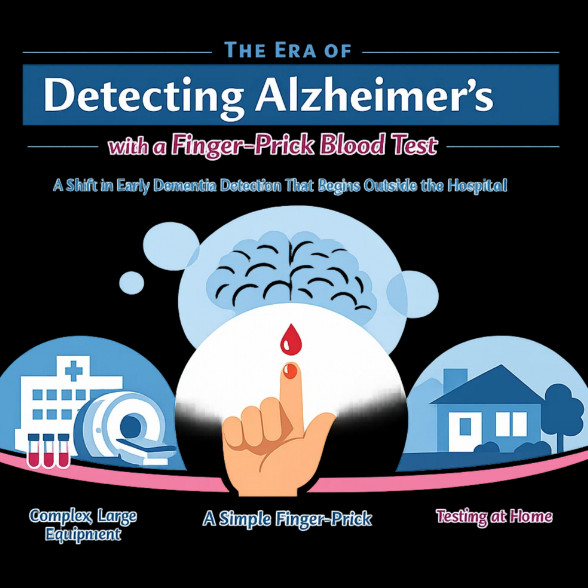
* 알츠하이머 조기 발견의 핵심은 검사 정확도만이 아니라, 얼마나 쉽고 편하게 검사받을 수 있느냐에 있다.
* 손가락 채혈 기반 검사는 치매 검사의 시작점을 대형병원 밖, 즉 집과 지역사회로 넓힐 가능성을 보여준다.
* 이 방식의 진짜 가치는 한 번의 확진이 아니라, 부담을 줄여 여러 번 반복적으로 상태 변화를 살필 수 있게 한다는 데 있다.
* 다만 간편한 검사만으로는 충분하지 않으며, 상담·추가 진단·추적 관찰로 이어지는 의료 연결 구조가 함께 마련되어야 한다.
* 결국 치매 검사는 병원 중심의 늦은 발견에서, 생활 가까이에서 더 빨리 알아차리고 더 오래 관리하는 방식으로 바뀔 가능성이 크다.
***
알츠하이머를 빨리 찾는 일은 이제 검사 장비의 성능만으로 결정되지 않는다. 아무리 좋은 검사라도 받기 어렵고 번거로우면 널리 퍼지기 힘들다. 손가락 끝의 작은 혈액 한 방울은 치매 검사를 병원 밖으로 꺼내올 가능성을 보여준다.
손끝에서 시작된 큰 변화
2026년 초, 국제 학술지에 흥미로운 연구가 발표됐다. 병원에서 정맥으로 피를 뽑는 대신, 손가락 끝에서 아주 적은 양의 혈액을 얻어 종이에 묻혀 말린 뒤 분석하는 방식으로 알츠하이머 관련 변화를 살펴보려는 시도였다. 겉으로 보면 단순한 방법처럼 보이지만, 이 연구가 던지는 질문은 결코 작지 않다. 치매 검사를 꼭 큰 병원 안에서만 시작해야 하느냐는 질문이다.
지금까지 알츠하이머 검사는 대체로 병원이라는 공간에 묶여 있었다. 의사가 진료를 보고, 의료진이 채혈을 하고, 샘플을 일정한 조건에서 보관하고 옮겨야 했다. 이 과정은 의료 현장에서는 익숙하지만, 일반 사람들의 일상에서 보면 생각보다 큰 장벽이다. 병원에 가야 하고, 시간을 내야 하고, 보호자가 함께 움직여야 할 때도 많다. 그래서 이 연구의 핵심은 단순히 “새로운 검사법이 나왔다”는 데 있지 않다. 검사의 시작점을 병원 바깥으로 넓힐 수 있느냐는 데 있다.
이 변화가 중요한 이유는 분명하다. 의료는 종종 더 정교한 기계나 더 비싼 기술로 발전한다고 생각되지만, 실제로 삶을 바꾸는 순간은 오히려 절차가 쉬워질 때 찾아오는 경우가 많다. 손가락 끝의 작은 채혈만으로도 의미 있는 정보를 얻을 수 있다면, 검사는 더 이상 멀고 어려운 일이 아니라 생활 가까이에 놓이는 일이 된다.
문제는 기술보다 문턱이었다
많은 사람은 알츠하이머 검사가 어려운 이유를 복잡한 의학 기술에서 찾는다. 물론 맞는 말이다. 하지만 실제 생활에서는 훨씬 더 현실적인 문제가 있다. 검사를 받기까지의 과정 자체가 힘들다는 점이다.
예를 들어 70대 후반의 노인이 최근 들어 같은 말을 반복하고, 약속을 잊고, 물건을 자주 놓고 다닌다고 해보자. 가족은 걱정이 되지만, 곧바로 큰 병원으로 향하기란 쉽지 않다. 예약을 잡아야 하고, 보호자가 시간을 내야 하며, 병원까지 이동해야 한다. 긴 대기 끝에 진료를 보고 채혈을 하고, 결과를 들으러 다시 가야 할 수도 있다. 이 모든 일은 젊은 사람에게도 번거롭지만, 고령자에게는 훨씬 큰 부담이다. 그래서 “조금 더 지켜보자”는 말이 반복되고, 중요한 시기를 놓치는 경우가 생긴다.
지역에 따라 차이도 크다. 대형병원이 가까운 사람은 비교적 쉽게 검사를 받을 수 있지만, 병원까지 한참 이동해야 하는 사람은 상황이 완전히 다르다. 특히 고령 인구가 많은 지역일수록 이런 격차는 더 크게 드러난다. 기술은 발전했지만, 그 기술이 있는 장소까지 가는 길이 너무 멀다면 많은 사람에게는 그림의 떡이 된다.
이 문제는 개인의 불편에서 끝나지 않는다. 연구에도 영향을 준다. 새로운 검사법을 시험하거나 장기 연구를 하려면 다양한 사람들이 참여해야 한다. 그런데 채혈과 병원 방문의 부담이 크면 참여자는 특정 지역, 특정 계층에 몰릴 수밖에 없다. 그러면 연구 결과가 사회 전체를 충분히 반영하지 못하게 된다. 결국 검사 문턱은 단순한 불편의 문제가 아니라, 과학의 대표성과 공정성까지 건드리는 문제다.
쉬워지는 순간 판이 바뀐다
의료 기술이 널리 퍼지는 순간을 돌아보면 공통점이 있다. 가장 완벽한 기술이 세상을 바꾸는 것이 아니라, 사람들이 쉽게 쓸 수 있는 기술이 판을 바꾸는 경우가 많다는 점이다.
코로나 시기의 자가검사 키트가 대표적이다. 처음에는 정확도를 두고 논란도 있었지만, 누구나 집에서 바로 해볼 수 있다는 점이 검사 문화를 완전히 바꿨다. 병원에 가야만 알 수 있었던 정보를 집에서도 확인할 수 있게 되자, 검사는 특별한 일이 아니라 일상 속 행동이 됐다. 완벽함보다 접근성이 더 큰 변화를 만들어낸 셈이다.
비슷한 일은 이미 다른 질환에서도 일어났다. 당뇨 환자에게 손가락 채혈 혈당측정은 너무도 익숙한 일상이다. 예전에는 병원 검사 결과를 기다려야 했지만, 이제는 식사 전후 혈당을 스스로 확인하며 생활을 조절한다. 혈압도 마찬가지다. 집에서 자주 재기 시작하면서 고혈압은 병원에서만 확인하는 병이 아니라 생활 속에서 관리하는 상태가 됐다.
알츠하이머도 비슷한 길로 갈 가능성이 있다. 앞으로는 병원이 모든 검사의 출발점이 아니라, 더 정밀한 판단을 내리는 곳이 될 수 있다. 처음 이상 신호를 살피고, 변화를 반복해서 확인하는 일은 병원 밖에서 시작될 수 있다. 손가락 채혈 방식이 주목받는 이유는 바로 여기에 있다. 어려운 기술을 완전히 대체한다는 뜻이 아니라, 검사를 훨씬 더 많은 사람의 삶 가까이로 가져올 수 있다는 뜻이다.
한 번보다 여러 번이 더 중요하다
알츠하이머는 하루아침에 갑자기 드러나는 병이 아니다. 몸 안의 변화가 오랜 시간 쌓이다가, 어느 순간 기억력 저하나 판단력 저하 같은 모습으로 나타난다. 그래서 앞으로 더 중요해질 것은 “지금 당장 병이 있느냐 없느냐”를 한 번에 가르는 방식보다, 시간이 지나면서 변화가 어떻게 이어지는지를 보는 일이다.
이 점에서 손가락 채혈은 특히 의미가 크다. 반복해서 살피기 쉬워지기 때문이다. 예를 들어 요양시설에 있는 노인을 생각해보자. 조금만 이상이 보여도 병원까지 이동해 정맥 채혈을 반복하는 것은 시간도 많이 들고, 인력도 필요하고, 당사자에게도 큰 스트레스가 된다. 반면 더 간단한 방식으로 상태를 확인할 수 있다면, 훨씬 자주 변화를 살펴볼 수 있다. 그렇게 쌓인 정보는 병을 더 빨리 알아차리는 데 도움이 될 수 있다.
가족의 입장에서도 다르다. 부모가 최근 들어 계산을 자주 틀리고, 같은 질문을 반복하고, 예전보다 말이 느려졌다고 느낄 때 지금은 병원 방문 자체가 큰 결심이 필요한 일인 경우가 많다. 하지만 생활 가까운 곳에서 먼저 가볍게 확인할 수 있다면 “아직은 괜찮겠지” 하며 미루는 시간은 줄어들 수 있다. 조기 발견은 특별한 의료 행사가 아니라, 조금 더 일찍 꺼내볼 수 있는 선택이 된다.
특히 위험이 높은 집단이나 병원 접근이 어려운 사람들에게는 이런 변화가 더 절실할 수 있다. 반복적인 정맥 채혈이 부담스러운 사람에게 손가락 채혈 기반 방식은 훨씬 현실적인 대안이 될 수 있기 때문이다. 결국 이 기술의 진짜 가치는 “한 번 쉽게 검사하는 것”보다 “여러 번 부담 없이 살펴볼 수 있는 것”에 있다.
검사보다 더 중요한 다음 한 걸음
물론 여기서 오해하면 안 된다. 손가락 채혈이 가능해졌다고 해서 이제 집에서 혼자 알츠하이머를 확진할 수 있다는 뜻은 아니다. 이런 방식은 더 쉽고 빠르게 이상 신호를 찾는 데 도움을 줄 수 있지만, 최종 판단과 치료 계획은 여전히 의료진의 설명과 추가 검사, 상담이 함께 가야 한다.
오히려 더 중요한 것은 검사 이후의 길이다. 예를 들어 집에서 간단히 검사했는데 이상 신호가 나왔다고 해보자. 그다음에 무엇을 해야 하는지가 분명해야 한다. 어느 병원을 가야 하는지, 어떤 검사를 더 받아야 하는지, 지금 당장 얼마나 걱정해야 하는지, 생활에서 무엇을 조심해야 하는지를 차근차근 알려줄 수 있어야 한다. 이런 연결이 없으면 검사는 쉬워졌지만 사람의 불안만 더 빨라질 수 있다.
그래서 손가락 채혈 기반 검사는 단순한 키트 하나로 끝나는 문제가 아니다. 검사와 상담, 추가 진단, 추적 관찰이 이어지는 전체 흐름이 함께 설계되어야 한다. 또 채혈 방법이 간단할수록 오히려 표준화가 중요해진다. 혈액을 어떻게 묻히고, 얼마나 말리고, 어떻게 보내느냐에 따라 결과가 흔들릴 수 있기 때문이다. 결국 이 기술이 실제로 자리 잡으려면 “누가 해도 비슷한 결과가 나오는가”와 “이후의 길이 분명한가”가 함께 해결되어야 한다.
치매 검사가 집 앞으로 다가온다
이번 연구가 던지는 가장 큰 메시지는 분명하다. 알츠하이머 검사는 조금씩 병원 중심에서 생활 중심으로 이동하고 있다는 점이다. 앞으로는 집이나 지역사회에서 먼저 신호를 살피고, 필요할 때 병원에서 더 정밀한 검사를 받는 구조가 점점 중요해질 수 있다. 이렇게 되면 치매는 “늦게 발견하는 병”이 아니라 “더 빨리 알아차리고 더 오래 관리하는 병”으로 인식이 바뀔 가능성이 크다.
이 변화는 고령사회에서 특히 중요하다. 알츠하이머 환자가 늘어난다는 것은 단지 병원 환자가 늘어난다는 뜻이 아니다. 가족의 돌봄 부담이 커지고, 요양시설의 부담이 커지고, 지역사회 전체의 부담이 커진다는 뜻이다. 이런 상황에서 모든 조기 발견을 대형병원과 전문 인력에만 기대는 방식은 오래가기 어렵다. 결국 더 많은 사람이 더 쉽게 검사받을 수 있는 길이 필요하다.
손가락 끝의 작은 혈액 한 방울은 겉으로 보면 아주 사소하다. 하지만 의료는 종종 이런 사소한 변화에서 크게 방향을 튼다. 거대한 장비가 아니라, 검사를 시작하는 방식이 달라지는 것만으로도 사람들의 행동이 바뀌고, 그 행동의 변화가 의료 시스템 전체를 움직일 수 있다. 이번 연구가 보여주는 가능성도 바로 여기에 있다. 그것은 단순히 새로운 채혈법 하나의 이야기가 아니다. 알츠하이머를 더 일찍 발견하고, 더 넓게 관리하는 시대가 조금씩 현실로 다가오고 있다는 신호다.
Reference
Nature Medicine, 2026-01-05, “A minimally invasive dried blood spot biomarker test for the detection of Alzheimer’s disease pathology”, Hanna Huber; Laia Montoliu-Gaya; Nicholas J. Ashton et al.

The Era of Detecting Alzheimer’s with a Finger-Prick Blood Test
- A Shift in Early Dementia Detection That Begins Outside the Hospital
[Key Message]
* The key to early detection of Alzheimer’s is not only the accuracy of the test, but also how easy and convenient it is for people to get tested.
* Finger-prick blood testing suggests the possibility of moving the starting point of dementia screening beyond large hospitals and into homes and local communities.
* The real value of this approach lies not in making a one-time diagnosis, but in reducing the burden so that changes in a person’s condition can be monitored repeatedly over time.
* However, a simple and convenient test alone is not enough; it must be accompanied by a medical pathway that connects counseling, additional diagnosis, and follow-up monitoring.
* In the end, dementia testing is likely to shift from a hospital-centered model of late detection to a model of earlier recognition and longer-term management closer to everyday life.
***
Detecting Alzheimer’s early is no longer determined solely by the performance of testing equipment. No matter how good a test is, if it is difficult and inconvenient to receive, it will be hard for it to spread widely. A single small drop of blood from a fingertip shows the possibility of bringing dementia testing outside the hospital.
A Big Change Beginning at the Fingertip
In early 2026, an intriguing study was published in an international academic journal. It was an attempt to examine Alzheimer’s-related changes by obtaining a very small amount of blood from the fingertip, placing it on paper, drying it, and then analyzing it, instead of drawing blood from a vein in a hospital. On the surface, it may seem like a simple method, but the question this study raises is by no means small. Does dementia testing really have to begin only inside a large hospital?
Until now, Alzheimer’s testing has largely been tied to the setting of the hospital. A doctor examines the patient, medical staff draw the blood, and the sample must be stored and transported under specific conditions. This process may be familiar in the medical field, but in the everyday lives of ordinary people, it is a much bigger barrier than it appears. One has to go to the hospital, make time, and in many cases a caregiver or family member has to come along. That is why the core of this study does not lie simply in the fact that “a new testing method has appeared.” It lies in whether the starting point of testing can be expanded beyond the hospital.
The reason this change matters is clear. People often think medicine advances through more precise machines or more expensive technologies, but in reality, the moment that changes lives often comes when procedures become easier. If meaningful information can be obtained from just a small finger-prick blood sample, then testing is no longer something distant and difficult, but something placed closer to everyday life.
The Real Problem Was the Barrier, Not the Technology
Many people think Alzheimer’s testing is difficult because of complex medical technology. That is true, of course. But in real life, there is a far more practical problem. The process of getting tested itself is hard.
For example, imagine a person in their late seventies who has recently begun repeating the same things, forgetting appointments, and frequently misplacing belongings. Their family is worried, but heading straight to a large hospital is not easy. An appointment has to be made, a family member or caregiver has to find the time, and the patient has to travel to the hospital. After a long wait, there is the examination and blood draw, and then they may have to return again to hear the results. All of this is inconvenient even for a younger person, but for an elderly patient it is a far greater burden. As a result, people often keep saying, “Let’s watch a little longer,” and important timing is lost.
There are also major regional differences. A person who lives near a large hospital can get tested relatively easily, but someone who has to travel a long distance to reach one faces a completely different situation. These gaps become even more pronounced in areas with large elderly populations. Technology may have advanced, but if the place where that technology exists is too far away, then for many people it becomes something they simply cannot benefit from.
This problem does not end with individual inconvenience. It also affects research. In order to test new methods or conduct long-term studies, a wide range of people must participate. But if the burden of blood collection and hospital visits is high, participants inevitably become concentrated in certain regions and social groups. Then the research results fail to fully reflect society as a whole. In the end, the barrier to testing is not just a matter of inconvenience. It is also a problem that touches the representativeness and fairness of science itself.
The Moment It Gets Easier, the Whole Game Changes
When we look back at the moments when medical technologies spread widely, there is a common pattern. It is not the most perfect technology that changes the world, but the technology that people can use easily that often changes the game.
The rapid test kits used during the COVID era are a representative example. At first, there was controversy over their accuracy, but the fact that anyone could use them at home completely changed the culture of testing. Information that once could only be obtained by going to a hospital became something people could check at home. Accessibility, more than perfection, created the bigger transformation.
Something similar has already happened with other diseases. For people with diabetes, finger-prick blood glucose testing is an entirely familiar part of daily life. In the past, they had to wait for hospital test results, but now they can check their blood sugar before and after meals and adjust their lives accordingly. The same is true of blood pressure. Once people began measuring it regularly at home, hypertension ceased to be something identified only in hospitals and became a condition managed in everyday life.
Alzheimer’s may move along a similar path. In the future, hospitals may no longer be the starting point of all testing, but rather the place where more precise judgments are made. The initial checking of abnormal signals and the repeated monitoring of change may begin outside the hospital. This is exactly why finger-prick sampling is drawing attention. It does not mean that difficult technologies will be replaced entirely. It means that testing may be brought much closer to the lives of far more people.
More Important Than Once Is Many Times
Alzheimer’s is not a disease that suddenly appears overnight. Changes build up in the body over a long period of time, and then at some point they begin to show themselves as memory loss or weakened judgment. That is why what will become more important in the future is not a method that draws a one-time line between “disease” and “no disease,” but a way of seeing how changes continue over time.
This is where finger-prick sampling becomes especially meaningful. It makes repeated checking easier. Think of an elderly person living in a care facility. Repeatedly taking them to the hospital for venous blood draws every time something seems slightly wrong requires a great deal of time, manpower, and stress for the person involved. By contrast, if their condition can be checked through a simpler method, then changes can be monitored much more often. The information accumulated that way can help identify the disease earlier.
It is also different from the family’s point of view. When parents begin making more mistakes in simple calculations, repeating the same questions, or speaking more slowly than before, a hospital visit is often still something that requires a major decision. But if people can first check in a lighter, more accessible way close to daily life, then the time spent putting it off by saying, “It’s probably still okay,” may be reduced. Early detection becomes not a special medical event, but a choice that can be brought forward a little sooner.
For people at particularly high risk or those who have difficulty accessing hospitals, this kind of change can be even more urgent. For those who find repeated venous blood draws burdensome, a finger-prick–based method can be a far more realistic alternative. In the end, the true value of this technology lies less in “making testing easy once” than in “making it possible to check repeatedly without much burden.”
The Next Step Matters More Than the Test
Of course, this is where we should not misunderstand things. The fact that finger-prick sampling has become possible does not mean that people can now confirm Alzheimer’s on their own at home. This kind of method may help detect warning signs more easily and quickly, but final judgment and treatment planning still require medical professionals, additional testing, and consultation.
What matters even more is the path after the test. For example, imagine that a simple home-based test shows an abnormal signal. What happens next must be clear. People need to know which hospital to go to, what further tests are needed, how worried they should be right away, and what they should be careful about in everyday life. Without that connection, testing may become easier while people’s anxiety only comes faster.
That is why a finger-prick–based test is not simply a matter of one kit. The entire flow must be designed together: testing, consultation, additional diagnosis, and follow-up observation. Also, the simpler the collection method is, the more important standardization becomes. Results may vary depending on how the blood is placed on the paper, how long it is dried, and how it is sent. In the end, for this technology to truly take root, two things must be solved together: “Does it produce similar results no matter who performs it?” and “Is the path afterward clear?”
Dementia Testing Is Moving Closer to the Front Door
The biggest message this study delivers is clear. Alzheimer’s testing is gradually moving away from being hospital-centered and toward being life-centered. In the future, it may become increasingly important to first check for warning signs at home or in the community, and then go to the hospital for more precise testing when necessary. If that happens, dementia may no longer be seen as “a disease discovered late,” but as “a disease recognized earlier and managed over a longer period of time.”
This change is especially important in an aging society. An increase in Alzheimer’s patients does not simply mean that the number of hospital patients rises. It also means a greater burden on families, care facilities, and the community as a whole. In such a situation, a system that relies on large hospitals and specialized professionals for all early detection cannot last for long. In the end, what is needed is a way for more people to be tested more easily.
A small drop of blood from a fingertip may look trivial on the surface. But medicine often changes direction through precisely such small changes. It is not only giant machines that shape the future. Simply changing the way testing begins can alter people’s behavior, and those changes in behavior can move the entire healthcare system. That is the possibility this study points to. It is not merely the story of one new blood collection method. It is a sign that an era of detecting Alzheimer’s earlier and managing it more broadly is gradually moving closer to reality.
Reference
Nature Medicine, 2026-01-05, “A minimally invasive dried blood spot biomarker test for the detection of Alzheimer’s disease pathology”, Hanna Huber; Laia Montoliu-Gaya; Nicholas J. Ashton et al.