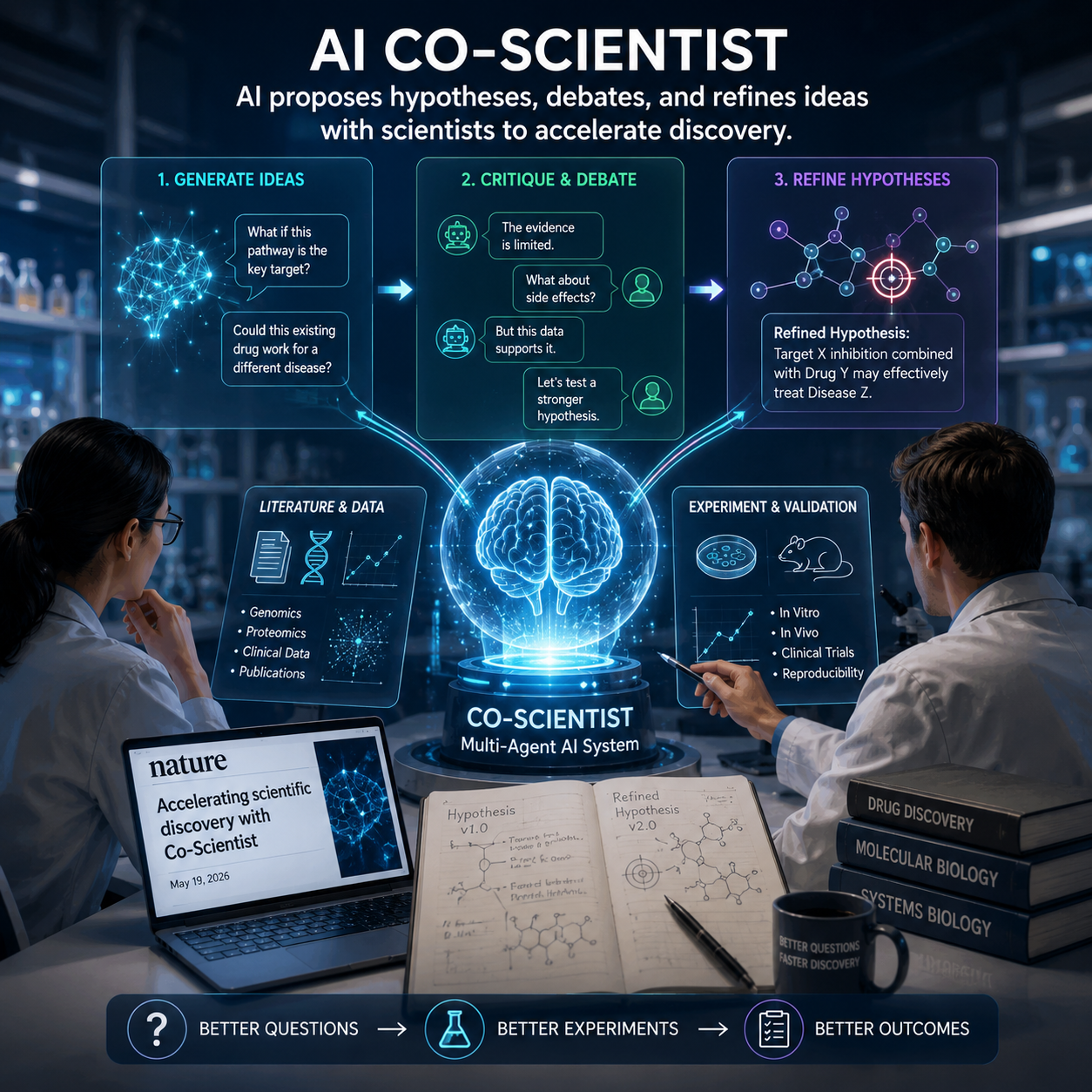
AI는 이제 논문을 요약하는 조수에 머물지 않는다. 구글 딥마인드와 구글 리서치 계열 연구진이 Nature에 발표한 Co-Scientist 연구는 AI가 과학 가설을 만들고, 서로 비판하고, 다시 고치는 단계에 들어섰음을 보여준다. 과학의 미래는 AI가 정답을 대신 찾는 데 있지 않고, 인간이 더 좋은 질문에 더 빨리 도달하도록 돕는 데 있다.
[Key Message]
* AI는 이제 정답을 찾는 도구를 넘어, 과학자가 실험해볼 질문을 제안하는 단계로 들어섰다. 중요한 변화는 AI가 논문을 요약하거나 작성하는 데 그치지 않고, 연구의 출발점인 가설 생성에 참여하기 시작했다는 점이다.
* Co-Scientist의 핵심은 하나의 AI가 답을 내는 것이 아니라, 여러 AI가 서로 아이디어를 만들고 비판하고 고치는 구조에 있다. 이는 실제 연구실 회의처럼 가설을 세우고, 약점을 찾고, 더 나은 방향으로 다듬는 과학적 사고 과정을 모방한다.
* 신약 개발과 생명의학 분야에서는 AI 공동과학자가 연구의 초기 탐색 속도를 크게 높일 수 있다. 기존 약물의 새로운 활용 가능성, 치료 표적, 항생제 내성의 원인처럼 복잡한 단서를 빠르게 연결해 실험 가능한 후보를 제안할 수 있다.
* AI가 과학자의 일을 없애는 것이 아니라, 과학자의 판단을 더 중요하게 만든다. AI가 많은 가설을 제시할수록 인간은 무엇을 믿고, 무엇을 의심하고, 무엇을 검증할지 더 엄격하게 선택해야 한다.
* 발견의 속도가 빨라질수록 검증의 책임은 더 무거워진다. AI가 만든 가설은 결론이 아니라 출발점이며, 실험·재현·윤리적 판단을 통해 검증하는 일은 여전히 인간과 과학 공동체의 몫이다.
***
정답을 찾던 AI, 이제 질문을 만든다
과학에서 가장 어려운 일은 정답을 맞히는 것이 아니다. 정말 어려운 일은 무엇을 물어야 하는지 알아내는 것이다. 암세포는 왜 특정 약물에만 반응하는가. 어떤 세균은 왜 항생제 앞에서도 살아남는가. 이미 실패한 약물 가운데 전혀 다른 질병에 다시 쓸 수 있는 후보는 없는가. 과학의 출발점은 늘 이런 질문이다. 실험은 그 질문을 현실에서 확인하는 과정이고, 논문은 그 결과를 정리한 기록이다.
그동안 AI는 주로 이 기록을 읽고 정리하는 도구로 쓰였다. 방대한 논문을 요약하고, 연구자가 놓친 문헌을 찾아주고, 데이터를 분류하고, 그래프를 만들고, 코드를 작성하는 방식이었다. 이런 AI도 충분히 놀라웠지만, 어디까지나 과학자의 뒤쪽에 서 있는 보조자에 가까웠다. 이미 만들어진 지식을 빠르게 훑어주는 조수였지, 새로운 연구의 출발점을 함께 만드는 동료라고 부르기는 어려웠다.
그런데 이번에는 방향이 조금 다르다. Nature에 발표된 Co-Scientist 연구는 AI가 단순히 자료를 정리하는 단계를 넘어, 과학자가 실험해볼 만한 가설을 직접 제안할 수 있음을 보여준다. 연구진은 Co-Scientist를 Gemini 기반의 다중 에이전트 시스템으로 설계했다. 쉽게 말하면, 하나의 AI가 혼자 답을 내놓는 것이 아니라 여러 개의 AI가 각각 연구원처럼 역할을 나누어 아이디어를 만들고, 서로 반박하고, 더 나은 가설을 남기는 구조다. Nature 논문은 이 시스템이 약물 재창출, 새로운 치료 표적 발견, 항생제 내성 메커니즘 설명 같은 생명의학 과제에서 가설을 만들고 실험 가능한 후보를 제안했다고 설명한다. ([Nature][1])
이 변화가 중요한 이유는 분명하다. 논문은 연구의 끝에 가깝지만, 가설은 연구의 시작에 가깝다. AI가 논문을 대신 써준다는 말보다 AI가 과학자에게 “이 질문을 한번 실험해보면 어떨까”라고 제안하기 시작했다는 말이 훨씬 더 큰 변화다. 과학의 속도를 바꾸는 것은 마지막 문장의 표현이 아니라, 첫 질문의 방향이기 때문이다.
논문 더미 속에서 길을 찾는 새로운 조수
현대 과학은 지식이 부족해서 느린 것이 아니다. 오히려 지식이 너무 많아서 느리다. 매일 새로운 논문이 쏟아지고, 유전자·단백질·질병·약물·임상 데이터가 끝없이 쌓인다. 한 분야만 따라가기도 벅찬데, 실제 중요한 발견은 종종 여러 분야의 경계에서 나온다. 어떤 단서는 암 연구 논문에 있고, 다른 단서는 면역학 데이터에 있으며, 또 다른 힌트는 이미 승인된 약물의 작용 경로 안에 숨어 있을 수 있다.
사람 연구자는 이런 단서를 직관적으로 연결한다. 하지만 인간의 시간과 집중력에는 한계가 있다. 아무리 뛰어난 연구자라도 모든 논문을 읽을 수는 없다. 모든 데이터베이스를 동시에 비교할 수도 없다. 그래서 과학의 많은 시간은 사실상 “찾는 일”에 쓰인다. 무엇이 이미 알려져 있는지 찾고, 어떤 연구가 빠져 있는지 찾고, 어떤 관계가 아직 검증되지 않았는지 찾는 일이다.
Co-Scientist 같은 시스템은 바로 이 지점에서 힘을 발휘한다. AI는 인간보다 훨씬 넓은 범위의 문헌과 데이터를 빠르게 훑을 수 있다. 그리고 흩어진 단서 사이에서 가능성 있는 연결을 제안할 수 있다. 예를 들어 특정 질병에서 어떤 단백질 경로가 과도하게 활성화된다는 연구가 있고, 다른 논문에는 이미 승인된 약물이 그 경로에 영향을 줄 수 있다는 단서가 있을 수 있다. 또 다른 데이터에는 특정 환자군에서 그 경로가 더 두드러진다는 정보가 있을 수 있다. 이 조각들이 서로 떨어져 있으면 단순한 정보에 그치지만, 연결되면 하나의 연구 가설이 된다.
물론 AI가 연결했다고 해서 그것이 곧 발견은 아니다. 이것은 매우 중요하다. AI가 제안한 것은 치료법이 아니라 치료법 후보이고, 결론이 아니라 검증할 질문이다. 과학에서 가설은 출발점일 뿐이다. 세포 실험, 동물 실험, 임상시험, 재현 검증을 거쳐야 비로소 의미 있는 지식이 된다. 하지만 출발점이 달라지면 연구의 시간표도 달라질 수 있다. 더 많은 후보를 더 빨리 검토할 수 있다면, 연구자는 실패할 가능성이 큰 길을 일찍 버리고 가능성이 높은 길에 더 많은 자원을 쓸 수 있다.
이 점에서 AI 공동과학자는 마법사가 아니다. 대신 매우 성실하고 빠른 연구 조수에 가깝다. 밤새 논문을 읽고, 관련 단서를 모으고, 가능한 가설을 정리한 뒤, 아침 회의에서 연구자에게 여러 장의 메모를 내미는 조수다. 그 메모 안에는 엉뚱한 아이디어도 있을 수 있고, 아직 근거가 부족한 제안도 있을 수 있다. 하지만 그중 하나가 연구자의 눈을 멈추게 만들 수 있다. “이건 정말 실험해볼 만한데?” 바로 그 순간이 중요하다.
혼자 똑똑한 AI보다 서로 따지는 AI
Co-Scientist의 특징은 하나의 AI가 한 번에 멋진 답을 내놓는 방식이 아니라는 데 있다. 이 시스템은 여러 역할을 가진 AI 에이전트들이 함께 움직인다. 어떤 에이전트는 새로운 가설을 만들고, 어떤 에이전트는 그 가설의 약점을 찾고, 또 다른 에이전트는 근거를 보강하거나 더 나은 형태로 고친다. 연구실 회의에서 한 사람이 아이디어를 내면, 다른 사람이 “그건 근거가 약하다”고 말하고, 또 다른 사람이 “그렇다면 이 조건을 붙이면 가능성이 있다”고 수정하는 장면과 비슷하다.
이 구조는 과학의 실제 작동 방식과 닮아 있다. 좋은 연구는 한 번의 번뜩임만으로 만들어지지 않는다. 처음 떠오른 아이디어는 대개 거칠다. 동료의 질문을 받고, 반론을 통과하고, 실험 가능성을 따져보고, 기존 연구와 충돌하는 지점을 확인하면서 조금씩 단단해진다. 과학은 영감의 순간도 중요하지만, 그 영감을 의심하고 다듬는 과정이 더 중요하다.
AI도 마찬가지다. AI가 내놓는 첫 답은 그럴듯할 수 있지만, 그럴듯함만으로는 부족하다. 특히 과학에서는 문장이 매끄럽다는 사실이 아무것도 보장하지 않는다. 논리적으로 보여도 실험에서 틀릴 수 있고, 근거가 있어 보여도 실제로는 중요한 조건을 빠뜨렸을 수 있다. 그래서 Co-Scientist의 핵심은 “AI가 가설을 만든다”는 것만이 아니라 “AI가 만든 가설을 다시 AI가 비판하고 고친다”는 데 있다.
이것은 단순한 자동 작성과 다르다. 자동 작성은 빈칸을 채우는 일에 가깝다. 하지만 가설 생성과 비판은 가능성의 경쟁을 만드는 일이다. 여러 아이디어를 세워놓고, 그중 어느 것이 더 근거가 강한지, 어느 것이 실험 가능성이 높은지, 어느 것이 기존 연구의 빈틈을 더 잘 찌르는지 따지는 과정이다. Nature는 이 같은 AI 연구 보조 시스템들이 가설 생성, 데이터 해석, 의약품 개발 방향 제안 등에서 연구 속도를 높일 수 있다고 소개했다. ([Nature][2])
여기서 중요한 것은 AI가 인간처럼 생각한다는 말이 아니다. AI가 인간 연구자의 직관과 책임을 그대로 갖게 됐다는 뜻도 아니다. 다만 과학적 사고의 일부 과정, 즉 후보를 만들고 비교하고 비판하는 과정을 기계가 훨씬 빠른 속도로 반복할 수 있게 됐다는 뜻이다. 이것만으로도 연구 현장은 달라질 수 있다. 과거에는 연구팀이 몇 주 동안 토론해야 했던 후보 목록을 AI가 훨씬 짧은 시간에 만들어낼 수 있기 때문이다.
신약 개발의 첫 단추가 달라진다
Co-Scientist가 특히 주목받는 이유는 생명의학 분야에서 먼저 가능성을 보였기 때문이다. 신약 개발은 과학기술 가운데서도 가장 시간과 비용이 많이 드는 분야 중 하나다. 질병의 원인을 이해하고, 치료 표적을 찾고, 후보 물질을 고르고, 독성과 효능을 검증하고, 임상시험을 통과해야 한다. 이 긴 과정에서 초기에 잘못된 후보를 선택하면 막대한 비용과 시간이 사라진다.
그래서 신약 개발에서 중요한 것은 “정답을 빨리 찾는 것”이 아니라 “시도해볼 만한 후보를 더 잘 고르는 것”이다. AI 공동과학자는 이 초기 단계에서 특히 유용할 수 있다. 이미 존재하는 약물이 전혀 다른 질병에 쓰일 가능성을 찾거나, 특정 질병을 공격할 새로운 생물학적 표적을 제안하거나, 항생제 내성이 생기는 숨은 메커니즘을 설명하는 데 도움을 줄 수 있다.
Nature 논문에 따르면 Co-Scientist는 급성 골수성 백혈병과 관련해 기존 약물의 새로운 활용 가능성과 병용 치료 후보를 제안했고, 일부 제안은 시험관 실험을 통해 검증됐다. 이 대목은 중요하다. AI가 상상력만 발휘한 것이 아니라, 실제 실험으로 확인할 수 있는 후보를 내놓았다는 의미이기 때문이다. 물론 이것이 곧바로 환자 치료법이 됐다는 뜻은 아니다. 하지만 연구의 출발점으로는 충분히 의미 있는 변화다. ([Nature][1])
대중 독자에게 이 변화는 이렇게 설명할 수 있다. 예전의 AI가 도서관 사서였다면, Co-Scientist는 회의에 참여하는 연구 조수에 가깝다. 사서는 필요한 자료를 찾아준다. 연구 조수는 자료를 읽고 이렇게 말한다. “이 논문과 저 논문을 함께 보면, 이 약을 이 질병에 다시 시험해볼 가능성이 있습니다.” “이 경로가 실제 원인이라면, 이 단백질을 막는 방식도 생각해볼 수 있습니다.” “다만 이 가설은 근거가 약하니 먼저 이런 실험으로 확인해야 합니다.”
이런 변화는 제약회사뿐 아니라 대학 연구실, 병원 연구팀, 바이오 스타트업에도 영향을 줄 수 있다. 큰 기업은 이미 막대한 연구 인력과 데이터 인프라를 갖고 있다. 하지만 작은 연구팀은 좋은 아이디어가 있어도 문헌을 넓게 탐색하고 후보를 체계적으로 좁히는 데 시간이 부족하다. AI 공동과학자가 제대로 쓰인다면, 작은 연구팀도 더 넓은 지식 지도를 들여다볼 수 있다. 이는 과학 연구의 출발선을 조금 더 넓히는 효과를 낼 수 있다.
하지만 동시에 격차가 더 커질 가능성도 있다. AI를 잘 활용하는 연구팀과 그렇지 못한 연구팀의 속도 차이가 벌어질 수 있다. 고품질 데이터와 실험 인프라를 가진 기관은 AI가 제안한 가설을 빠르게 검증할 수 있지만, 그렇지 못한 기관은 좋은 가설을 받아도 실험으로 이어가기 어렵다. 결국 미래의 연구 경쟁력은 AI 도구 하나로 결정되지 않는다. AI가 만든 가설을 검증할 실험 능력, 데이터를 정리하는 문화, 실패한 결과까지 학습 자산으로 남기는 체계가 함께 필요하다.
과학자의 일은 사라지지 않고 더 어려워진다
AI가 과학 가설을 만든다는 말은 쉽게 과장된다. 곧 AI가 과학자를 대체할 것처럼 들리기 때문이다. 하지만 실제 변화는 그보다 복잡하다. AI가 잘하는 일과 인간이 반드시 해야 하는 일이 다르기 때문이다.
AI는 넓게 찾는 데 강하다. 많은 논문을 빠르게 읽고, 여러 가능성을 동시에 비교하고, 사람이 놓치기 쉬운 연결을 제안할 수 있다. 반복적인 후보 생성과 평가도 잘한다. 지치지 않고 계속해서 다른 조합을 시도할 수 있다. 이 점에서 AI는 연구자의 탐색 범위를 넓힌다.
그러나 AI는 왜 이 질문이 중요한지 스스로 책임지지 않는다. 어떤 연구가 환자에게 절실한지, 어떤 실험이 윤리적으로 허용되는지, 어떤 결과가 사회적으로 위험한 해석을 낳을 수 있는지 판단하는 것은 여전히 인간의 몫이다. AI는 기존 문헌과 데이터에 크게 의존하기 때문에, 그 안에 들어 있는 편향도 함께 가져올 수 있다. 많이 연구된 질병, 영어권 중심의 논문, 데이터가 풍부한 분야에 강하고, 희귀질환이나 저소득 국가의 보건 문제처럼 데이터가 부족한 영역에는 약할 수 있다.
그래서 AI 공동과학자 시대에 인간 과학자의 역할은 줄어드는 것이 아니라 달라진다. 과거에는 많은 시간이 자료를 찾고 정리하는 데 들어갔다면, 앞으로는 어떤 질문을 선택할 것인지가 더 중요해진다. AI가 후보를 많이 내놓을수록 연구자는 더 엄격하게 골라야 한다. AI가 빠르게 가설을 만들수록 연구자는 더 차분하게 의심해야 한다. AI가 넓은 지식 지도를 펼쳐줄수록 연구자는 그중 어떤 길이 정말 의미 있는지 판단해야 한다.
과학자의 가치는 지식의 양에서 판단의 질로 더 이동할 가능성이 크다. 많이 아는 사람도 중요하지만, 앞으로는 무엇을 믿지 않을지 아는 사람이 더 중요해질 수 있다. AI가 그럴듯한 문장으로 근거를 제시할 때, 그 문장의 빈틈을 보는 능력. AI가 추천한 실험이 실제로 가능한지 따져보는 능력. AI가 놓친 윤리적 문제를 먼저 발견하는 능력. 이런 능력이 과학자의 핵심 역량이 된다.
이는 과학 교육에도 영향을 준다. 앞으로의 연구자는 AI를 쓰는 법만 배워서는 부족하다. AI가 만든 가설을 평가하는 법을 배워야 한다. 문헌 근거가 충분한지, 실험 설계가 편향되지 않았는지, 데이터가 특정 집단에 치우치지 않았는지, 결과가 재현 가능한지 확인하는 훈련이 더 중요해진다. 좋은 프롬프트를 쓰는 기술보다 더 중요한 것은 좋은 의심을 품는 태도다.
빠른 발견의 시대에는 느린 검증이 더 중요하다
AI 공동과학자가 가져올 가장 큰 변화는 속도다. 가설을 만드는 속도, 후보를 좁히는 속도, 문헌을 연결하는 속도가 모두 빨라질 수 있다. 암, 치매, 감염병, 기후 기술, 신소재처럼 시간이 곧 비용이고 생명인 분야에서는 이 속도가 매우 큰 의미를 갖는다. 더 빨리 가능성을 찾는다는 것은 더 빨리 실험을 시작할 수 있다는 뜻이고, 더 빨리 실패를 확인할 수 있다는 뜻이기도 하다.
하지만 과학은 원래 느린 검증의 체계다. 하나의 가설은 여러 실험을 통과해야 하고, 다른 연구자가 재현해야 하며, 시간이 지나도 흔들리지 않아야 한다. AI가 수많은 가설을 빠르게 쏟아내면 과학은 더 빨라질 수 있지만, 동시에 더 혼잡해질 수도 있다. 좋은 가설과 그럴듯한 가설을 구분하는 일이 더 어려워질 수 있기 때문이다.
특히 위험한 것은 “가설의 풍요”가 “검증의 부족”을 가릴 때다. AI가 매일 수백 개의 연구 아이디어를 내놓는다고 해서 과학이 매일 수백 걸음 앞으로 나아가는 것은 아니다. 실험실의 시간, 연구비, 장비, 인력은 여전히 제한되어 있다. 결국 중요한 것은 가설을 많이 만드는 능력이 아니라, 검증할 가치가 있는 가설을 고르는 능력이다.
또 하나의 문제는 연구 자원의 쏠림이다. AI가 높은 가능성을 제시한 분야, 데이터가 풍부한 질병, 상업적 가치가 큰 기술로 연구비가 몰릴 수 있다. 그러면 이미 주목받는 분야는 더 빠르게 발전하고, 데이터는 부족하지만 사회적으로 중요한 분야는 더 뒤처질 수 있다. AI가 과학의 민주화를 도울 수도 있지만, 반대로 과학의 불균형을 키울 수도 있는 것이다.
책임의 문제도 남는다. AI가 제안한 가설을 인간 연구자가 실험해 성과를 냈다면, 그 아이디어의 기여는 누구에게 있는가. AI 시스템을 만든 기업인가, 연구 목표를 제시한 과학자인가, 실험을 수행한 연구팀인가. 반대로 AI가 잘못된 가설을 제안해 시간과 연구비가 낭비되거나 위험한 실험 방향을 유도한다면 책임은 어디에 있는가. AI가 과학의 동료가 될수록 과학의 제도도 함께 바뀌어야 한다.
특히 구글 딥마인드와 같은 거대 기술기업이 과학 발견의 핵심 도구를 제공한다는 점은 별도의 논의가 필요하다. 과학은 오랫동안 대학, 공공 연구기관, 학술 공동체를 중심으로 지식을 쌓아왔다. 그런데 앞으로 중요한 가설 생성 도구와 연구 자동화 플랫폼이 일부 대형 기업의 AI 모델 위에서 작동한다면, 과학 지식의 생산 구조도 달라질 수 있다. 누가 그 도구에 접근할 수 있는지, 어떤 데이터가 학습에 쓰였는지, 어떤 연구 방향이 우선 추천되는지는 과학의 공정성과도 연결된다.
그래서 AI 공동과학자 시대의 핵심 질문은 성능만이 아니다. 얼마나 빠른가도 중요하지만, 누가 쓰는가가 더 중요하다. 얼마나 똑똑한가도 중요하지만, 어떻게 검증되는가가 더 중요하다. 과학의 속도가 빨라질수록 과학을 지탱하는 신뢰의 장치는 더 느리고 단단해야 한다.
과학은 천재의 고독에서 혼합 지능의 협업으로 간다
이번 변화가 던지는 더 큰 메시지는 과학자의 이미지가 바뀐다는 점이다. 대중은 오랫동안 과학자를 고독한 천재로 상상해왔다. 한 사람이 밤늦게까지 실험실에 남아 있다가 결정적 통찰을 얻고, 세상을 바꾸는 발견에 도달하는 이야기다. 물론 실제 과학은 늘 협업의 산물이었지만, 과학 발견의 신화 속에는 여전히 혼자 빛나는 인물이 있다.
AI 공동과학자 시대에는 이 이미지가 더 빠르게 바뀔 가능성이 크다. 미래의 연구자는 혼자 모든 것을 생각하는 사람이 아니라, 사람과 AI, 자동화 실험 장비, 거대한 데이터베이스, 시뮬레이션 시스템을 함께 지휘하는 사람에 가까워질 수 있다. 연구실은 인간 연구자들만의 공간이 아니라 여러 지능적 도구가 함께 움직이는 혼합 지능의 공간이 된다.
이 변화는 과학자의 권위를 낮추는 것이 아니라, 과학자의 일을 더 전략적으로 만든다. 연구자는 모든 후보를 직접 떠올릴 필요는 줄어들 수 있다. 대신 어떤 문제를 풀 것인지, 어떤 후보를 검증할 것인지, 어떤 실패에서 배울 것인지 결정해야 한다. 과학자는 지식의 창고가 아니라 발견의 지휘자가 된다.
기업의 연구개발도 달라질 수 있다. 제약회사, 배터리 기업, 반도체 소재 기업, 에너지 기술 기업은 모두 “가능한 조합”을 찾는 싸움을 한다. 어떤 물질이 더 안정적인지, 어떤 촉매가 더 효율적인지, 어떤 치료 표적이 더 안전한지, 어떤 공정이 더 경제적인지 찾아야 한다. AI 공동과학자는 이런 초기 탐색의 속도를 크게 높일 수 있다.
한국에도 이 흐름은 중요한 신호다. 한국은 반도체, 배터리, 바이오, 의료 AI, 신소재 분야에서 연구개발 투자가 큰 나라다. 하지만 현장에서는 여전히 논문 검토, 특허 분석, 후보 물질 탐색, 실험 설계에 많은 시간이 들어간다. AI 공동과학자를 제대로 활용한다면 연구자 개인을 대체하는 것이 아니라 연구팀 전체의 탐색 능력을 키울 수 있다. 특히 인력과 시간이 부족한 대학 연구실이나 중소 바이오 기업에는 더 큰 기회가 될 수 있다.
다만 도구를 들여오는 것만으로 혁신이 생기지는 않는다. AI가 만든 가설을 실험할 수 있는 장비와 인력, 데이터를 정리하고 공유하는 문화, 실패한 실험도 기록하는 습관, AI 결과를 맹신하지 않는 연구 윤리가 함께 있어야 한다. AI 공동과학자는 혼자 발견을 만드는 마법사가 아니다. 준비된 연구 생태계에서 더 큰 힘을 내는 촉매다.
AI가 던진 질문에 인간이 답해야 한다
Co-Scientist 연구가 흥미로운 이유는 AI의 의미를 다시 생각하게 만들기 때문이다. 우리는 AI를 너무 자주 정답 생성 기계로만 이해한다. 질문을 넣으면 답을 내놓고, 명령을 주면 결과물을 만들어주는 도구로 본다. 하지만 과학에서 정말 중요한 AI는 정답을 빨리 말하는 AI가 아니라, 더 나은 질문을 만들도록 돕는 AI일 수 있다.
과학은 이미 알고 있는 것을 보기 좋게 정리하는 일이 아니다. 아직 모르는 것을 향해 나아가는 일이다. 그 여정에서 가설은 나침반이다. 좋은 가설은 실험의 방향을 바꾸고, 연구비의 쓰임을 바꾸고, 질병을 이해하는 틀을 흔든다. Co-Scientist는 바로 이 나침반을 만드는 과정에 AI가 들어올 수 있음을 보여준다.
그러나 마지막 책임은 여전히 인간에게 남아 있다. AI가 더 많은 가능성을 보여줄수록 인간은 더 좋은 선택을 해야 한다. AI가 더 빠르게 가설을 만들수록 인간은 더 엄격하게 검증해야 한다. AI가 더 넓은 문헌을 훑을수록 인간은 더 깊은 의미를 판단해야 한다.
앞으로의 과학자는 혼자 모든 것을 아는 사람이 아닐 수 있다. 대신 사람과 기계가 함께 만든 가능성의 숲에서 가장 의미 있는 길을 고르는 사람이 될 가능성이 크다. 발견의 주인공은 한 명의 천재도, 하나의 알고리즘도 아니다. 인간의 질문, AI의 탐색, 실험의 검증이 맞물릴 때 새로운 지식이 태어난다.
AI가 논문을 대신 써주는 시대보다 더 중요한 변화가 시작되고 있다. AI가 과학자의 옆자리에서 묻기 시작한 것이다. “이 질문도 한번 실험해볼 만하지 않은가.” 과학의 미래는 그 제안에 감탄하는 데서 끝나지 않는다. 그것을 의심하고, 검증하고, 다시 질문하는 인간의 능력 위에서 결정될 것이다.
Reference
Nature. “Accelerating scientific discovery with Co-Scientist.” Published May 19, 2026.
Nature. “Teams of AI agents boost speed of research.” Published May 19, 2026.

AI Has Started Asking Scientists Questions
- The rise of AI that goes beyond writing papers and proposes hypotheses to test
AI no longer remains merely an assistant that summarizes academic papers. The Co-Scientist study published in Nature by researchers affiliated with Google DeepMind and Google Research shows that AI has entered a stage where it can generate scientific hypotheses, critique them against one another, and revise them. The future of science does not lie in AI finding answers on behalf of humans, but in helping humans reach better questions faster.
[Key Message]
* AI has moved beyond being a tool that finds answers and has begun proposing questions that scientists can test. The important shift is that AI is no longer limited to summarizing or writing papers; it is starting to participate in hypothesis generation, the starting point of research.
* The core of Co-Scientist is not that one AI produces an answer, but that multiple AIs generate, challenge, and revise ideas together. This structure mirrors the scientific thinking process of a real lab meeting, where hypotheses are proposed, weaknesses are identified, and ideas are refined.
* In drug development and biomedical research, AI co-scientists can greatly accelerate early-stage exploration. They can quickly connect complex clues related to drug repurposing, therapeutic targets, and antibiotic resistance, then suggest candidates that may be tested experimentally.
* AI does not eliminate the work of scientists; it makes human judgment more important. As AI produces more hypotheses, humans must become more rigorous in deciding what to trust, what to doubt, and what to verify.
* The faster discovery becomes, the heavier the responsibility for verification becomes. An AI-generated hypothesis is not a conclusion but a starting point, and experimental testing, reproducibility, and ethical judgment remain the responsibility of humans and the scientific community.
***
AI Once Looked for Answers. Now It Creates Questions
The hardest part of science is not getting the right answer. The truly difficult part is figuring out what to ask. Why do cancer cells respond only to certain drugs? Why do some bacteria survive even in the face of antibiotics? Among drugs that have already failed, are there candidates that could be used again for entirely different diseases? Science always begins with questions like these. Experiments are the process of testing those questions in reality, and papers are the records that organize the results.
Until now, AI has mainly been used as a tool for reading and organizing those records. It summarized vast numbers of papers, found literature that researchers had missed, classified data, created graphs, and wrote code. These forms of AI were already impressive enough, but they were still closer to assistants standing behind the scientist. They were helpers that quickly scanned knowledge that had already been produced, not colleagues that helped create the starting point of new research.
This time, however, the direction is a little different. The Co-Scientist study published in Nature shows that AI can go beyond simply organizing materials and directly propose hypotheses that scientists may be able to test. The researchers designed Co-Scientist as a Gemini-based multi-agent system. Put simply, rather than having one AI produce an answer on its own, the system consists of multiple AIs, each taking on a role like a researcher: generating ideas, challenging one another, and leaving behind stronger hypotheses. The Nature paper explains that this system generated hypotheses and proposed testable candidates in biomedical tasks such as drug repurposing, discovering new therapeutic targets, and explaining mechanisms of antibiotic resistance.
The importance of this shift is clear. A paper is closer to the end of research, but a hypothesis is closer to its beginning. The statement that AI can write a paper for us is far less significant than the statement that AI has begun to say to scientists, “What if we tried testing this question?” What changes the speed of science is not the wording of the final sentence, but the direction of the first question.
A New Assistant That Finds a Path Through Piles of Papers
Modern science is not slow because there is too little knowledge. If anything, it is slow because there is too much knowledge. New papers are published every day, while data on genes, proteins, diseases, drugs, and clinical outcomes pile up endlessly. It is difficult enough to keep up with just one field, yet truly important discoveries often emerge at the boundaries between several fields. One clue may be in a cancer research paper, another in immunology data, and another hidden inside the mechanism of action of an already approved drug.
Human researchers connect these clues intuitively. But human time and concentration have limits. No matter how outstanding a researcher may be, no one can read every paper. No one can compare every database at the same time. That is why much of science is, in reality, spent on the act of searching: finding what is already known, finding what research is missing, and finding what relationships have not yet been tested.
Systems like Co-Scientist show their strength precisely at this point. AI can scan literature and data across a much broader range than humans can, and it can do so quickly. It can also suggest possible connections among scattered clues. For example, one study may show that a certain protein pathway is overactive in a particular disease, while another paper may contain evidence that an already approved drug can affect that pathway. Another dataset may show that the same pathway is especially prominent in a certain patient group. If these pieces remain separate, they are merely fragments of information. Once connected, they become a research hypothesis.
Of course, the fact that AI has connected them does not mean it has made a discovery. This point is extremely important. What AI proposes is not a treatment, but a treatment candidate; not a conclusion, but a question to be tested. In science, a hypothesis is only the starting point. Only after passing through cell experiments, animal experiments, clinical trials, and reproducibility checks can it become meaningful knowledge. But if the starting point changes, the research timetable can change as well. If more candidates can be reviewed more quickly, researchers can abandon paths that are likely to fail earlier and direct more resources toward paths with higher potential.
In this sense, an AI co-scientist is not a magician. It is more like an extremely diligent and fast research assistant. It reads papers through the night, gathers relevant clues, organizes possible hypotheses, and brings several pages of notes to the morning meeting. Among those notes, there may be absurd ideas, and there may be proposals that do not yet have enough evidence. But one of them may make a researcher stop and think. “This might really be worth testing.” That moment matters.
Not One Brilliant AI, but AIs That Challenge One Another
The distinctive feature of Co-Scientist is that it does not rely on one AI producing a polished answer all at once. The system operates through multiple AI agents with different roles. One agent generates new hypotheses, another looks for weaknesses in those hypotheses, and another strengthens the evidence or revises the idea into a better form. It resembles a research lab meeting: one person presents an idea, another says, “The evidence for that is weak,” and someone else adds, “Then perhaps it becomes plausible if we add this condition.”
This structure resembles the way science actually works. Good research is not created by a single flash of inspiration. The first idea that comes to mind is usually rough. It becomes stronger little by little as it faces questions from colleagues, survives objections, is examined for experimental feasibility, and is checked against existing research. Inspiration matters in science, but the process of doubting and refining that inspiration matters even more.
The same is true of AI. The first answer AI gives may sound plausible, but plausibility is not enough. In science especially, the smoothness of a sentence guarantees nothing. Something may look logical and still turn out to be wrong in an experiment. Something may seem to have evidence behind it and still miss an essential condition. That is why the core of Co-Scientist lies not only in the fact that AI generates hypotheses, but also in the fact that AI critiques and revises the hypotheses it has generated.
This is different from simple automated writing. Automated writing is closer to filling in blanks. Hypothesis generation and criticism, however, create a competition among possibilities. They involve lining up multiple ideas and asking which one has stronger evidence, which one is more experimentally feasible, and which one better targets a gap in existing research. Nature introduced these AI research-assistance systems as tools that could accelerate research by generating hypotheses, interpreting data, and proposing directions for drug development.
The important point here is not that AI thinks like humans. Nor does it mean that AI has acquired the intuition and responsibility of human researchers. Rather, it means that some parts of scientific thinking, such as generating candidates, comparing them, and critiquing them, can now be repeated by machines at much higher speed. That alone can change the research site. A list of candidate ideas that once required a research team to discuss for weeks may now be produced by AI in a much shorter time.
The First Step of Drug Development Is Changing
One reason Co-Scientist is drawing particular attention is that it first demonstrated its potential in the biomedical field. Drug development is one of the most time-consuming and expensive areas of science and technology. Researchers must understand the cause of a disease, find a therapeutic target, select candidate compounds, test toxicity and efficacy, and pass clinical trials. If the wrong candidate is chosen at the early stage of this long process, enormous amounts of money and time disappear.
That is why what matters in drug development is not “finding the correct answer quickly,” but “selecting better candidates worth trying.” An AI co-scientist may be especially useful in this early stage. It can help identify the possibility that an existing drug might be used for an entirely different disease, propose new biological targets for attacking a specific disease, or explain hidden mechanisms behind antibiotic resistance.
According to the Nature paper, Co-Scientist proposed new uses for existing drugs and combination-treatment candidates related to acute myeloid leukemia, and some of those proposals were validated through in vitro experiments. This point is important. It means AI did not merely exercise imagination, but produced candidates that could be checked through actual experiments. Of course, this does not mean that these immediately became treatments for patients. But as a starting point for research, it represents a meaningful change.
For a general audience, this change can be explained as follows. If earlier AI was a librarian, Co-Scientist is closer to a research assistant who joins the meeting. A librarian finds the materials you need. A research assistant reads those materials and says, “If we look at this paper and that paper together, there may be a possibility of testing this drug again for this disease.” “If this pathway is the actual cause, we could also consider blocking this protein.” “However, the evidence for this hypothesis is weak, so we should first confirm it with this kind of experiment.”
This shift could affect not only pharmaceutical companies but also university labs, hospital research teams, and biotech startups. Large companies already have massive research workforces and data infrastructure. Smaller research teams, however, may have good ideas but lack the time to search the literature broadly and narrow candidates systematically. If AI co-scientists are used properly, smaller teams may also be able to look at a much wider map of knowledge. This could help widen the starting line of scientific research.
At the same time, the gap could also grow. The speed difference between teams that use AI well and those that do not may widen. Institutions with high-quality data and experimental infrastructure can quickly test AI-generated hypotheses, while institutions without such capacity may struggle to turn even good hypotheses into experiments. In the end, future research competitiveness will not be determined by a single AI tool. It will also require experimental capacity to test AI-generated hypotheses, a culture of organizing data, and a system that preserves even failed experiments as assets for learning.
Scientists’ Work Will Not Disappear. It Will Become More Difficult
The claim that AI can generate scientific hypotheses is easily exaggerated. It sounds as though AI will soon replace scientists. But the actual change is more complex, because what AI does well and what humans must still do are different.
AI is good at broad searching. It can quickly read many papers, compare many possibilities at once, and suggest connections that humans may easily miss. It is also good at repeatedly generating and evaluating candidates. It does not get tired and can continue trying different combinations. In this respect, AI expands the range of exploration available to researchers.
But AI does not take responsibility for why a question matters. It remains the task of humans to decide which research is urgent for patients, which experiments are ethically acceptable, and which results could lead to socially dangerous interpretations. Because AI depends heavily on existing literature and data, it can also bring along the biases embedded in them. It is strong in areas with many studies, English-language papers, and abundant data, but weaker in areas such as rare diseases or health issues in low-income countries, where data may be scarce.
That is why, in the age of AI co-scientists, the role of human scientists does not shrink. It changes. In the past, much time was spent finding and organizing materials. In the future, choosing which question to pursue will become more important. The more candidates AI produces, the more strictly researchers must select among them. The faster AI generates hypotheses, the more calmly researchers must doubt them. The wider the map of knowledge AI lays out, the more carefully researchers must judge which path truly matters.
The value of scientists may move further from the quantity of knowledge toward the quality of judgment. People who know a great deal will still matter, but in the future, people who know what not to trust may matter even more. The ability to see gaps in AI’s seemingly well-supported sentences, to judge whether AI-recommended experiments are actually feasible, and to notice ethical problems that AI has missed will become core scientific capabilities.
This will also affect science education. Future researchers will need more than training in how to use AI. They will need training in how to evaluate AI-generated hypotheses. It will become more important to check whether the literature evidence is sufficient, whether an experimental design is biased, whether the data are skewed toward a particular group, and whether the results are reproducible. More important than the skill of writing good prompts will be the attitude of asking good skeptical questions.
In an Age of Faster Discovery, Slower Verification Becomes More Important
The greatest change an AI co-scientist may bring is speed. The speed of generating hypotheses, narrowing candidates, and connecting literature may all increase. In fields such as cancer, dementia, infectious diseases, climate technology, and new materials, where time means both cost and life, this speed has great significance. Finding possibilities sooner means experiments can begin sooner, and failures can also be identified sooner.
But science is originally a system of slow verification. A hypothesis must pass through multiple experiments, be reproduced by other researchers, and remain stable over time. If AI rapidly produces vast numbers of hypotheses, science may become faster, but it may also become more crowded. Distinguishing good hypotheses from merely plausible ones may become more difficult.
The particular danger is when an “abundance of hypotheses” hides a “shortage of verification.” Just because AI generates hundreds of research ideas every day does not mean science moves forward by hundreds of steps every day. Time in the laboratory, research funding, equipment, and personnel remain limited. Ultimately, what matters is not the ability to produce many hypotheses, but the ability to choose hypotheses worth testing.
There is also the problem of research concentration. Funding may flow toward fields where AI suggests high potential, diseases with abundant data, and technologies with strong commercial value. If that happens, already prominent fields may advance even faster, while areas that lack data but are socially important may fall further behind. AI could help democratize science, but it could also intensify inequalities in science.
The question of responsibility also remains. If human researchers test a hypothesis proposed by AI and achieve a breakthrough, who contributed the idea? Was it the company that created the AI system, the scientist who provided the research goal, or the research team that carried out the experiment? Conversely, if AI suggests a flawed hypothesis and causes time and research funding to be wasted, or if it encourages a dangerous experimental direction, where does responsibility lie? As AI becomes a colleague in science, the institutions of science must change as well.
The fact that major technology companies such as Google DeepMind provide core tools for scientific discovery also requires separate discussion. Science has long built knowledge around universities, public research institutions, and academic communities. But if key hypothesis-generation tools and research-automation platforms come to operate on AI models owned by a small number of large companies, the structure of scientific knowledge production may also change. Who can access those tools, what data were used for training, and which research directions are recommended first are all questions connected to the fairness of science.
That is why the central question in the age of AI co-scientists is not performance alone. How fast the system is matters, but who uses it matters more. How intelligent it is matters, but how it is verified matters more. As the speed of science increases, the mechanisms of trust that support science must become slower and stronger.
Science Is Moving from the Solitude of Genius to Collaboration with Hybrid Intelligence
The larger message of this change is that the image of the scientist is changing. For a long time, the public has imagined scientists as solitary geniuses. One person remains in the laboratory late into the night, gains a decisive insight, and reaches a discovery that changes the world. Of course, actual science has always been the product of collaboration, but within the myth of scientific discovery, there still stands a figure who shines alone.
In the age of AI co-scientists, this image may change more quickly. The researcher of the future may be less someone who thinks of everything alone and more someone who directs humans, AI, automated experimental equipment, massive databases, and simulation systems together. The laboratory will no longer be a space occupied only by human researchers. It will become a space of hybrid intelligence where many intelligent tools move together.
This change does not reduce the authority of scientists. It makes their work more strategic. Researchers may no longer need to think up every candidate by themselves. Instead, they must decide what problem to solve, which candidates to test, and what to learn from each failure. The scientist becomes not a warehouse of knowledge, but a conductor of discovery.
Corporate research and development may also change. Pharmaceutical companies, battery makers, semiconductor materials firms, and energy-technology companies are all engaged in the struggle to find “possible combinations.” They must identify which materials are more stable, which catalysts are more efficient, which therapeutic targets are safer, and which processes are more economical. AI co-scientists could greatly accelerate this early exploration.
This trend also sends an important signal to South Korea. South Korea invests heavily in research and development in semiconductors, batteries, biotechnology, medical AI, and advanced materials. Yet in the field, much time is still spent reviewing papers, analyzing patents, searching for candidate materials, and designing experiments. If AI co-scientists are used properly, they could strengthen the exploratory capacity of entire research teams rather than replace individual researchers. The opportunity may be especially significant for university labs and small to mid-sized biotech companies that lack sufficient personnel and time.
However, innovation does not happen simply because a tool is introduced. Equipment and personnel capable of testing AI-generated hypotheses, a culture of organizing and sharing data, the habit of recording failed experiments, and research ethics that do not blindly trust AI results must all be present together. An AI co-scientist is not a magician that creates discovery alone. It is a catalyst that becomes more powerful in a prepared research ecosystem.
Humans Must Answer the Questions AI Raises
The Co-Scientist study is fascinating because it forces us to rethink what AI means. We too often understand AI only as a machine that generates answers. We see it as a tool that produces an answer when a question is entered and creates an output when a command is given. But in science, the truly important AI may not be AI that gives answers quickly, but AI that helps create better questions.
Science is not the work of neatly organizing what is already known. It is the work of moving toward what is not yet known. In that journey, a hypothesis is a compass. A good hypothesis changes the direction of experiments, changes how research funding is used, and shakes the framework through which we understand disease. Co-Scientist shows that AI can enter the process of making that compass.
But the final responsibility still remains with humans. The more possibilities AI presents, the better choices humans must make. The faster AI generates hypotheses, the more rigorously humans must verify them. The wider the literature AI scans, the more deeply humans must judge its meaning.
The scientist of the future may not be someone who knows everything alone. Instead, that scientist may be someone who chooses the most meaningful path through a forest of possibilities created together by humans and machines. The protagonist of discovery is neither a single genius nor a single algorithm. New knowledge is born when human questions, AI exploration, and experimental verification work together.
A more important change than the age of AI writing papers for us has begun. AI has started asking questions from the seat beside the scientist: “Might this question be worth testing?” The future of science will not be determined by admiring that suggestion. It will be determined by the human ability to doubt it, verify it, and ask again.
Reference
Nature. “Accelerating Scientific Discovery with Co-Scientist.” Published May 19, 2026.
Nature. “Teams of AI Agents Boost Speed of Research.” Published May 19, 2026.