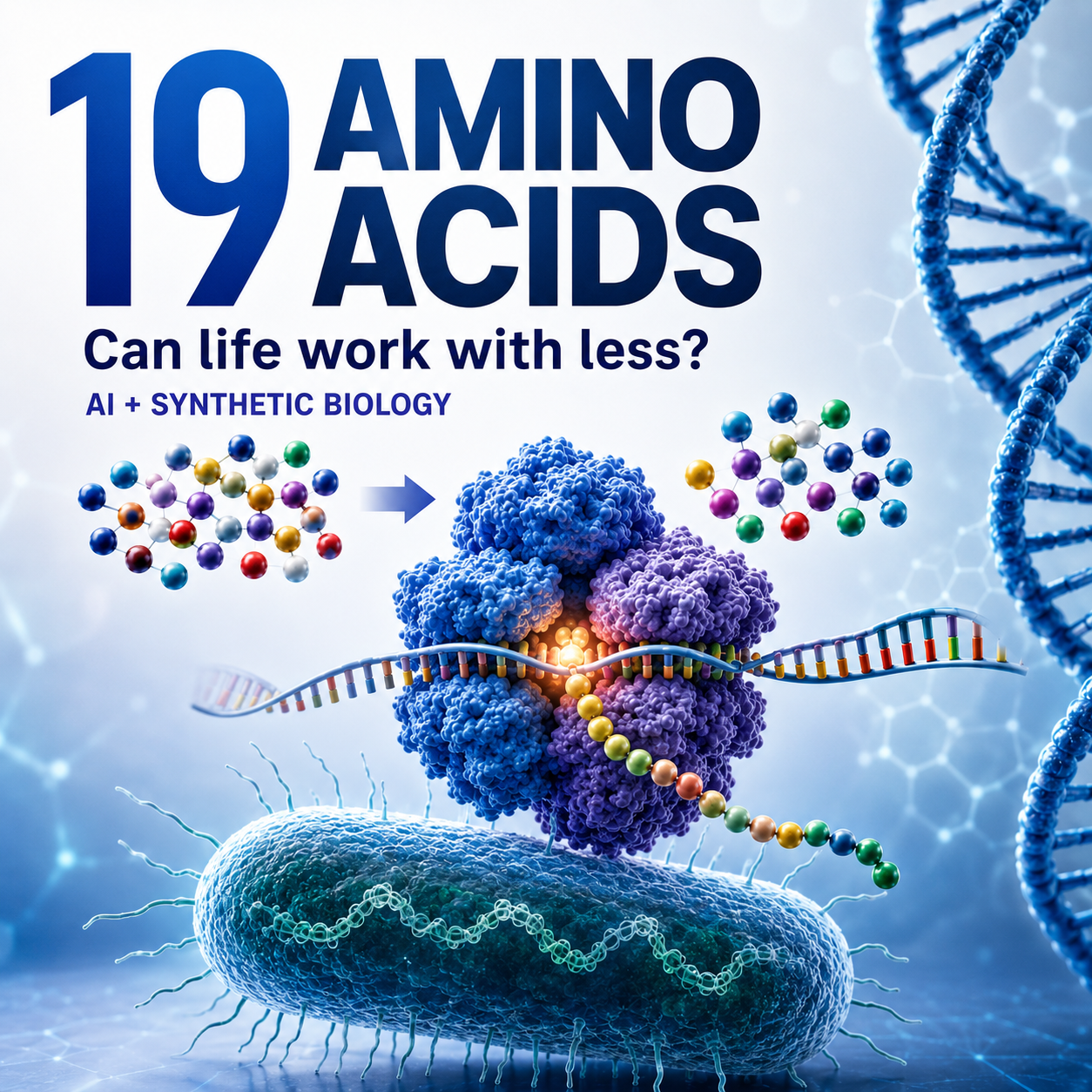
생명의 문법은 반드시 20글자여야 할까? 지구 생명은 20개의 표준 아미노산으로 단백질을 만들며 살아간다. 이 질서는 너무 오래되고 보편적이어서, 마치 생명체가 반드시 따라야 하는 자연의 문법처럼 여겨져 왔다. 그러나 합성생물학은 이제 묻기 시작한다. 생명의 기본 문법에서 글자 하나를 덜어내도 세포는 여전히 살아 움직일 수 있을까.
[Key Message]
* 생명의 문법은 반드시 20개의 아미노산에 고정되어 있지 않을 수 있다. 이번 연구는 세포의 기본 구조가 생각보다 더 유연할 가능성을 보여준다.
* 19개 아미노산 연구는 생명체를 단순히 줄이는 실험이 아니라, 생명이 작동하는 최소 조건을 탐색하는 시도다. 하나를 덜어냄으로써 오히려 생명의 가능성을 더 넓게 묻게 한다.
* 생성형 인공지능은 합성생물학을 생명의 재설계 단계로 끌어올리고 있다. AI는 수많은 단백질 조합 가운데 기능을 유지할 수 있는 설계를 찾는 핵심 도구가 되고 있다.
* 완전한 19개 아미노산 생명체가 만들어진 것은 아니지만, 이번 연구는 중요한 출발점이다. 대장균의 핵심 번역 장치인 리보솜이 더 단순한 아미노산 체계에서도 작동할 수 있음을 보여줬다.
* 이 연구는 인공세포, 최소 생명체, 바이오 제조의 미래와 연결된다. 생명의 문법을 줄이거나 바꾸는 기술은 더 예측 가능하고 통제 가능한 세포 설계로 이어질 수 있다.
***
20개 아미노산이라는 오래된 상식
생명체를 이해하는 가장 익숙한 방식은 DNA에서 출발한다. DNA에는 생명체의 설계도가 들어 있고, 그 정보가 RNA로 옮겨진 뒤 단백질로 번역된다. 이때 단백질을 이루는 기본 재료가 아미노산이다. 지구상의 거의 모든 생명체는 20개의 표준 아미노산을 조합해 단백질을 만든다. 근육도, 효소도, 세포막의 일부도, 신호를 주고받는 수많은 분자 장치도 결국 이 20개의 재료가 접히고 얽히며 만들어낸 구조다.
그래서 아미노산 20개는 생명의 알파벳으로 불린다. 문자가 모여 단어를 만들고, 단어가 모여 문장을 만들듯, 아미노산은 연결되어 단백질이라는 생명의 문장을 만든다. 문제는 이 알파벳이 과연 절대적인가 하는 점이다. 지구 생명은 왜 하필 20개의 아미노산을 선택했을까. 19개로는 부족했을까. 18개라면 불가능했을까. 반대로 더 많은 아미노산을 쓰는 생명체가 더 유리했을까.
이 질문은 오랫동안 생명의 기원을 둘러싼 이론적 상상에 가까웠다. 초기 지구의 생명은 지금보다 더 단순한 재료로 출발했을 가능성이 있다. 복잡한 생화학 체계가 처음부터 완성된 형태로 등장했을 리는 없다. 그렇다면 오늘날의 20개 아미노산 체계는 생명의 출발점이 아니라, 긴 진화의 결과일 수 있다.
2026년 4월, 리위안 리우, 샬럿 로슈로, 사이먼 코즐로, 기욤 우르테쇼 등 컬럼비아대, 하버드대, MIT 공동 연구진이 Science에 발표한 연구는 생성형 인공지능 설계와 합성생물학을 결합해 “19개 아미노산 알파벳으로 생명체를 만들 수 있는가”라는 질문을 실험적으로 다뤘다.
하나를 빼는 일은 하나를 더하는 일보다 어렵다
합성생물학은 그동안 생명의 문법을 확장하는 방향으로 많이 발전해왔다. 자연계가 쓰는 20개의 아미노산에 새로운 비표준 아미노산을 추가하거나, 유전암호를 재배치하거나, 세포가 자연에는 없는 분자를 만들도록 설계하는 방식이다. 이런 연구는 생명체를 일종의 생물학적 공장으로 바꾸는 데 중요한 역할을 했다. 의약품, 효소, 신소재, 바이오연료처럼 기존 화학 공정으로 만들기 어렵거나 비효율적인 물질을 세포 안에서 생산하려는 시도들이 여기에 속한다.
하지만 생명의 문법을 확장하는 일과 축소하는 일은 성격이 다르다. 새로운 글자를 덧붙이는 일은 기존 문법 위에 기능을 얹는 일에 가깝다. 반면 글자 하나를 빼는 일은 이미 수십억 년 동안 굳어진 문장 전체를 다시 고쳐 쓰는 일이다. 단백질 곳곳에 박혀 있는 특정 아미노산을 제거하려면, 단순히 유전자 몇 개를 바꾸는 것으로 끝나지 않는다. 그 아미노산이 맡고 있던 구조적 역할, 화학적 성질, 단백질 접힘 방식, 다른 아미노산과의 상호작용까지 모두 고려해야 한다.
이번 연구는 20개 아미노산 가운데 아이소류신에 주목했다. 아이소류신은 류신, 발린과 화학적 성질이 비슷한 소수성 아미노산이다. 단백질 내부에서 구조를 안정시키는 데 자주 쓰이지만, 비슷한 성격의 아미노산으로 대체될 가능성도 있다. 그렇다고 아이소류신을 단순히 다른 아미노산으로 바꾸면 되는 것은 아니다. 단백질은 단순한 구슬 목걸이가 아니다. 같은 재료가 들어가도 위치가 달라지면 접히는 모양이 바뀌고, 접힘이 달라지면 기능이 사라질 수 있다.
연구진이 겨냥한 곳은 대장균의 리보솜이었다. 리보솜은 세포 안에서 단백질을 만드는 번역 기계다. DNA에 담긴 정보가 단백질로 바뀌는 마지막 단계에서 핵심 역할을 한다. 생명체가 자신을 유지하고 복제하려면 리보솜이 작동해야 한다. 따라서 리보솜 단백질에서 특정 아미노산을 줄여도 세포가 살아남을 수 있는지는 생명의 최소 문법을 시험하는 강력한 실험이 된다.
생명의 문법을 줄이는 데 AI가 쓰이기 시작했다
이번 연구에서 중요한 도구로 등장한 것은 생성형 인공지능 기반 단백질 설계다. 생명체 안의 단백질은 수많은 아미노산 조합으로 이루어진다. 어떤 위치의 아이소류신을 발린으로 바꿀지, 류신으로 바꿀지, 혹은 다른 아미노산으로 바꿔야 할지는 단순한 직관만으로 결정하기 어렵다. 가능한 조합은 너무 많고, 각각의 변화가 단백질 구조와 세포 생존에 미치는 영향은 복잡하다.
이 지점에서 단백질 언어모델과 구조 기반 설계 모델이 사용되었다. 인공지능은 방대한 단백질 서열과 구조 정보를 바탕으로 어떤 치환이 비교적 안정적인지 예측한다. 사람이 모든 경우의 수를 실험실에서 하나씩 확인하는 대신, 먼저 가능성이 높은 설계안을 좁혀주는 것이다. 이는 생명체를 컴퓨터 화면 안에서 완전히 설계한다는 뜻이 아니다. 생명은 여전히 실험실에서 검증되어야 한다. 다만 인공지능은 어떤 설계가 시도할 만한지, 어떤 변화가 너무 위험한지, 어떤 치환이 기능을 유지할 가능성이 높은지를 가려내는 탐색 도구가 된다.
연구진은 아이소류신이 들어간 리보솜 단백질을 단순히 다른 아미노산으로 바꾸는 데서 출발했지만, 단순 치환만으로는 충분하지 않았다. 일부 단백질은 기능을 유지했지만, 많은 경우 세포 성장에 문제가 생기거나 제대로 작동하지 않았다. 그래서 인공지능 모델을 활용해 단순한 일대일 교체가 아니라, 주변 아미노산까지 함께 조정하는 방식으로 단백질을 다시 설계했다. 특정 위치의 아이소류신을 없애면서도 전체 단백질 구조가 무너지지 않도록 보완 변이를 함께 찾은 것이다.
이 과정은 합성생물학의 방향 변화를 보여준다. 과거의 생명공학이 자연이 이미 만든 기능을 찾아 활용하는 데 가까웠다면, 앞으로의 합성생물학은 생명의 문법 자체를 다시 쓰는 단계로 나아가고 있다. DNA를 편집하는 기술만으로는 충분하지 않다. 생명체의 작동 원리를 계산하고, 가능한 설계 공간을 탐색하고, 그 결과를 실제 세포에서 검증하는 방식이 결합되어야 한다.
완전한 19개 아미노산 생명체는 아직 아니다
이번 연구를 이해할 때 가장 조심해야 할 부분은 과장이다. 연구진이 완전한 19개 아미노산 생명체를 만든 것은 아니다. 대장균 전체의 모든 단백질에서 아이소류신이 사라진 것도 아니고, 세포 전체가 19개 아미노산만으로 살아가도록 바뀐 것도 아니다. 핵심은 대장균의 핵심 번역 장치인 리보솜 단백질에서 아이소류신을 대규모로 제거해도 세포가 작동할 수 있는지를 보여준 데 있다.
Science에 발표된 이 연구에서 연구진은 리보솜 단백질에 들어 있는 아이소류신 잔기를 체계적으로 줄여나갔다. 그리고 재설계된 일부 리보솜 구성 단위를 대장균의 원래 유전체 위치에 결합해 생존 가능한 세포를 만들었다. 이 세포는 자연 상태의 대장균과 완전히 같은 수준은 아니지만, 살아남고 증식할 수 있었다. 더 중요한 점은 이런 변화가 단기간의 우연한 생존에 그치지 않고, 여러 세대에 걸쳐 비교적 안정적으로 유지될 수 있음을 보였다는 데 있다.
이 차이는 중요하다. “19개 아미노산 생명체가 완성되었다”고 말하면 과학의 의미가 흐려진다. 그러나 “아직 완성되지 않았으니 별 의미가 없다”고 말하는 것도 정확하지 않다. 생명의 핵심 장치 일부가 20개가 아닌 19개 아미노산 체계로도 작동할 수 있다는 사실은, 생명의 문법이 생각보다 유연할 수 있음을 보여준다. 지구 생명의 20개 아미노산 체계는 매우 강력하고 보편적인 표준이지만, 그것이 가능한 유일한 방식이라고 단정할 수는 없게 된 것이다.
생명은 고정된 규칙이 아니라 조정 가능한 시스템일 수 있다
우리는 생명을 매우 정교하고 깨지기 쉬운 체계로 생각한다. 실제로 생명체는 작은 유전자 변이 하나에도 병이 생기거나 기능을 잃을 수 있다. 하지만 동시에 생명은 놀라울 만큼 유연하다. 돌연변이를 견디고, 환경 변화에 적응하고, 불리한 조건에서도 우회로를 찾아낸다. 생명체의 역사는 완벽한 설계의 역사가 아니라, 수많은 시행착오 속에서도 작동 가능한 해법을 찾아온 역사에 가깝다.
이번 연구는 그 유연성을 생명의 가장 근본적인 층위에서 다시 보여준다. 20개의 아미노산 체계가 오늘날 지구 생명에게 가장 익숙하고 안정적인 표준인 것은 맞다. 하지만 그것이 가능한 유일한 체계라고 단정할 수는 없다. 어쩌면 생명은 우리가 생각한 것보다 더 넓은 설계 공간을 가지고 있을지 모른다. 지구의 생명은 그중 하나의 성공한 버전일 수 있다.
이 관점은 생명의 기원 연구와도 이어진다. 초기 지구의 생명은 지금처럼 정교한 단백질 체계를 갖추지 못했을 가능성이 크다. 아미노산의 종류도 제한적이었을 수 있고, 유전암호도 지금보다 덜 복잡했을 수 있다. 그럼에도 생명 비슷한 시스템이 작동했다면, 현재의 20개 아미노산 체계는 출발점이 아니라 점진적으로 확장된 결과일 수 있다. 이번 연구는 초기 생명이 더 단순한 아미노산 집합으로도 기능했을 가능성을 실험적으로 상상하게 만든다.
또 다른 의미는 외계 생명 탐사와도 연결된다. 우리는 흔히 생명을 지구 생명의 형태로 상상한다. DNA, RNA, 단백질, 20개 아미노산이라는 틀을 기준으로 생명 가능성을 판단한다. 그러나 생명의 문법이 꼭 하나일 필요가 없다면, 다른 행성이나 위성의 생명은 전혀 다른 재료 조합을 사용할 수도 있다. 물론 이번 연구가 외계 생명의 존재를 증명하는 것은 아니다. 다만 생명이라는 현상을 이해할 때, 지금 지구에서 관찰되는 표준을 절대적 기준으로 삼는 태도에는 조심스러워질 필요가 있다.
최소 생명체 연구는 생명의 조건을 다시 묻는다
19개 아미노산 연구는 최소 생명체 연구와도 깊이 연결된다. 최소 생명체란 생명 유지에 꼭 필요한 요소만 남긴 가장 단순한 세포를 뜻한다. 어떤 유전자가 반드시 필요한지, 어떤 대사 경로가 없어도 되는지, 어떤 단백질이 생존의 핵심인지 확인하는 연구다. 이 분야의 목적은 단지 작은 세포를 만드는 데 있지 않다. 생명이 작동하기 위한 최소 조건을 알아내는 것이 핵심이다.
무엇을 빼도 생명은 유지되는가. 어디까지 줄이면 더 이상 생명이라 부를 수 없는가. 어떤 기능은 필수이고, 어떤 기능은 환경에 따라 선택적인가. 이 질문은 생명을 이해하는 방식 자체를 바꾼다. 이번 연구는 최소 생명체의 범위를 유전자 수나 세포 크기에서 아미노산 알파벳으로 확장한다. 즉 생명체가 필요한 부품의 개수만 줄이는 것이 아니라, 부품을 만드는 기본 재료의 종류까지 줄일 수 있는지 묻는다. 이는 더 근본적인 축소다.
이런 축소는 실용적 의미도 가진다. 더 단순한 아미노산 체계를 가진 세포는 특정 환경에서 더 예측 가능하게 작동할 수 있다. 불필요한 대사 부담을 줄일 수도 있고, 특정 물질 생산에 에너지를 집중하도록 설계할 수도 있다. 바이오 제조의 관점에서 보면 세포는 단순한 생명체가 아니라 정교한 생산 플랫폼이 된다. 문제는 세포가 너무 복잡하다는 점이다. 복잡성이 크면 예측이 어렵고, 예측이 어려우면 산업적 활용도 까다로워진다. 최소 생명체 연구는 바로 이 복잡성을 줄이려는 시도다.
더 중요한 가능성은 생물학적 안전장치다. 자연계의 생명체와 다른 문법으로 작동하는 세포를 만들 수 있다면, 그 세포는 외부 환경에서 마음대로 살아남기 어려울 수 있다. 특정 아미노산 체계나 특정 영양 조건에 의존하도록 설계하면, 실험실 밖에서는 증식하지 못하는 생명체를 만들 수 있다. 합성생물학이 산업으로 확장될수록 안전성은 핵심 과제가 된다. 생명의 문법을 줄이거나 바꾸는 연구는 단순한 과학적 호기심이 아니라, 통제 가능한 생명공학을 위한 기반 기술이 될 수 있다.
바이오 제조의 미래는 세포를 다시 설계하는 데 있다
바이오 제조는 세포를 이용해 필요한 물질을 생산하는 기술이다. 이미 인슐린, 백신, 항체의약품, 효소, 발효 기반 소재 등 다양한 분야에서 세포는 생산 공장으로 활용되고 있다. 그러나 앞으로의 바이오 제조는 단순히 자연 세포를 빌려 쓰는 수준에 머물지 않을 가능성이 크다. 더 잘 만들고, 더 적게 낭비하고, 더 안전하게 통제되는 세포를 설계하는 방향으로 이동하고 있다.
이때 19개 아미노산 연구가 던지는 메시지는 분명하다. 세포는 주어진 그대로만 사용하는 대상이 아니다. 세포는 다시 설계할 수 있는 시스템이다. 유전자를 바꾸는 수준을 넘어, 단백질을 구성하는 기본 재료의 체계까지 바꿀 수 있다면 바이오 제조의 가능성은 훨씬 넓어진다. 특정 아미노산을 덜 쓰는 세포, 특정 물질 생산에 최적화된 단백질 체계, 자연계와 다른 유전암호를 가진 세포가 등장할 수 있다.
물론 이런 미래가 곧바로 도래하는 것은 아니다. 생명체의 문법을 바꾸는 일은 매우 어렵고 위험 관리도 필요하다. 세포는 하나의 부품만 바꾼다고 원하는 대로 움직이는 기계가 아니다. 특정 단백질 하나가 잘 작동하더라도, 세포 전체 대사와 성장, 스트레스 반응, 돌연변이 안정성까지 함께 고려해야 한다. 합성생물학의 미래가 밝다고 해서 무조건 빠르게 상용화될 것이라고 단정할 수는 없다.
그럼에도 방향은 뚜렷하다. 생명과학은 이제 생명체를 관찰하고 해석하는 학문에서, 생명체를 설계하고 조정하는 기술로 확장되고 있다. 19개 아미노산만으로 생명체를 설계할 수 있는지 묻는 질문은 단순히 아미노산 하나를 빼는 문제가 아니다. 그것은 생명을 어디까지 다시 쓸 수 있는가를 묻는 질문이다. 자연이 만든 생명의 문법을 이해하는 데서 나아가, 인간이 새로운 생명의 문법을 설계할 수 있는지 시험하는 출발점이다.
생명의 기본 문법을 다시 묻는 시대
이번 연구가 보여준 가장 큰 의미는 생명이 생각보다 더 유연할 수 있다는 사실이다. 20개의 아미노산 체계는 지구 생명에게 매우 성공적인 표준이지만, 그것이 절대적인 한계는 아닐 수 있다. 세포의 핵심 번역 장치 일부가 19개 아미노산 체계로도 작동할 수 있다는 결과는, 생명의 기본 구조가 고정불변의 규칙이 아니라 조정 가능한 시스템일 수 있음을 보여준다.
이 질문은 앞으로 더 확장될 것이다. 특정 아미노산 하나를 제거하는 수준을 넘어, 여러 아미노산의 역할을 재배치할 수 있을까. 자연계에 없는 아미노산을 안정적으로 추가할 수 있을까. 세포가 자연 생명체와 완전히 다른 단백질 문법으로 살아가게 만들 수 있을까. 이런 질문은 생명의 기원과 외계 생명 탐사, 최소 생명체 설계, 바이오 제조, 생물학적 안전성까지 이어진다.
결국 19개 아미노산 연구는 생명체를 줄이는 실험이 아니라, 생명의 가능성을 넓히는 실험이다. 하나를 덜어냈기 때문에 오히려 더 큰 질문이 드러났다. 생명은 지금 우리가 보는 방식으로만 존재해야 하는가. 생명의 문법은 자연이 한 번 정해놓은 불변의 법칙인가, 아니면 다른 방식으로도 다시 쓰일 수 있는가. 합성생물학은 이제 그 질문에 실험으로 답하기 시작했다. 그리고 그 답은 인공세포와 최소 생명체, 바이오 제조의 미래를 향해 천천히 열리고 있다.
Reference
Science, April 2026, Toward life with a 19?amino acid alphabet through generative artificial intelligence design

Can Life Be Designed with Only 19 Amino Acids?
Does the grammar of life necessarily have to consist of 20 letters? Life on Earth makes proteins using 20 standard amino acids. This system is so ancient and universal that it has long been regarded almost like a natural grammar that all living organisms must follow. Yet synthetic biology is now beginning to ask a new question. If one letter is removed from the basic grammar of life, can a cell still remain alive and functional?
[Key Message]
* The grammar of life may not be fixed to 20 amino acids. This study shows that the basic structure of cells may be more flexible than previously thought.
* Research on 19 amino acids is not simply an experiment in reducing life. By removing one letter from life’s alphabet, it asks broader questions about the minimum conditions required for life to function.
* Generative AI is moving synthetic biology toward the redesign of life itself. It is becoming a key tool for finding protein designs that can preserve function among countless possible combinations.
* A complete 19-amino-acid organism has not yet been created, but this study marks an important starting point. It showed that the ribosome, the core translation machinery of E. coli, can function within a simpler amino acid system.
* This research connects to the future of artificial cells, minimal life, and biomanufacturing. Technologies that reduce or rewrite the grammar of life may lead to more predictable and controllable cell design.
***
The Long-Standing Assumption of 20 Amino Acids
The most familiar way to understand living organisms begins with DNA. DNA contains the blueprint of life, and that information is transferred to RNA and then translated into proteins. At this stage, the basic building blocks of proteins are amino acids. Almost all living organisms on Earth make proteins by combining 20 standard amino acids. Muscles, enzymes, parts of cell membranes, and countless molecular devices that send and receive signals are all ultimately structures created as these 20 materials fold and intertwine.
This is why the 20 amino acids are often called the alphabet of life. Just as letters form words and words form sentences, amino acids link together to create the sentences of life known as proteins. The question is whether this alphabet is truly absolute. Why did life on Earth choose exactly 20 amino acids? Would 19 have been insufficient? Would 18 have been impossible? Conversely, would living organisms using more amino acids have had an advantage?
For a long time, this question was closer to a theoretical speculation about the origin of life. Early life on Earth may have begun with simpler materials than those used today. It is unlikely that a complex biochemical system appeared in a fully completed form from the beginning. If so, today’s 20-amino-acid system may not be the starting point of life, but rather the result of a long evolutionary process.
In April 2026, a study published in Science by a joint research team from Columbia University, Harvard University, and MIT, including Liyuan Liu, Charlotte Rouchereau, Simon Cozlow, and Guillaume Urtecho, experimentally addressed the question of whether life could be created with a 19-amino-acid alphabet by combining generative artificial intelligence design with synthetic biology.

Removing One Letter Is Harder Than Adding One
Synthetic biology has developed significantly in the direction of expanding the grammar of life. This has involved adding new nonstandard amino acids to the 20 amino acids used in nature, rearranging the genetic code, or designing cells to produce molecules that do not exist in nature. Such research has played an important role in turning living organisms into a kind of biological factory. This includes efforts to produce medicines, enzymes, new materials, and biofuels inside cells, especially substances that are difficult or inefficient to make through conventional chemical processes.
However, expanding the grammar of life and reducing it are different in nature. Adding a new letter is closer to placing a new function on top of an existing grammar. By contrast, removing one letter means rewriting an entire set of sentences that has been fixed over billions of years. To eliminate a specific amino acid embedded throughout proteins, it is not enough simply to change a few genes. The structural role, chemical properties, protein-folding behavior, and interactions with other amino acids that the amino acid had been responsible for must all be considered.
This study focused on isoleucine among the 20 amino acids. Isoleucine is a hydrophobic amino acid with chemical properties similar to leucine and valine. It is frequently used to stabilize the interior of proteins, but it may also be replaceable with amino acids that have similar characteristics. Still, this does not mean that isoleucine can simply be replaced with another amino acid. A protein is not merely a string of beads. Even when the same materials are used, a change in position can alter the way a protein folds, and when folding changes, function can disappear.
The target of the research team was the ribosome of Escherichia coli. The ribosome is the translation machine inside the cell that makes proteins. It plays a central role in the final stage where the information contained in DNA is converted into proteins. For a living organism to maintain and replicate itself, the ribosome must function. Therefore, whether a cell can survive even after a specific amino acid is reduced in ribosomal proteins becomes a powerful experiment for testing the minimum grammar of life.
AI Has Begun to Be Used to Reduce the Grammar of Life
An important tool in this study was protein design based on generative artificial intelligence. Proteins inside living organisms are composed of countless amino acid combinations. It is difficult to decide by simple intuition whether a particular isoleucine position should be replaced with valine, leucine, or another amino acid. The possible combinations are too numerous, and the effects of each change on protein structure and cell survival are complex.
At this point, protein language models and structure-based design models were used. Artificial intelligence predicts which substitutions are relatively stable based on vast amounts of protein sequence and structure information. Instead of having researchers test every possible case one by one in the laboratory, AI first narrows the field to designs that are more likely to work. This does not mean that life is fully designed on a computer screen. Life must still be verified in the laboratory. However, AI becomes a search tool that helps identify which designs are worth attempting, which changes are too risky, and which substitutions are likely to preserve function.
The research team began by replacing ribosomal proteins containing isoleucine with other amino acids, but simple substitution was not enough. Some proteins maintained their function, but in many cases cell growth was impaired or the proteins did not work properly. The researchers therefore used AI models not merely to perform one-to-one substitutions, but to redesign proteins in a way that also adjusted surrounding amino acids. In other words, they searched for compensatory mutations that could remove isoleucine from specific positions while preventing the overall protein structure from collapsing.
This process reveals a shift in the direction of synthetic biology. Whereas past biotechnology was closer to finding and using functions already created by nature, future synthetic biology is moving toward rewriting the grammar of life itself. Editing DNA alone is not sufficient. The principles by which living organisms operate must be calculated, possible design spaces must be explored, and the results must be verified in actual cells.
A Complete 19-Amino-Acid Organism Has Not Yet Been Created
The point that requires the greatest caution in understanding this study is exaggeration. The researchers did not create a complete 19-amino-acid organism. Isoleucine was not removed from every protein in the entire E. coli cell, nor was the whole cell changed so that it could live using only 19 amino acids. The core achievement was showing whether cells could still function even after isoleucine was extensively removed from ribosomal proteins, the central translation machinery of E. coli.
In this study published in Science, the researchers systematically reduced isoleucine residues contained in ribosomal proteins. They then integrated some redesigned ribosomal components into their original genomic locations in E. coli and created viable cells. These cells did not function at exactly the same level as wild-type E. coli, but they were able to survive and proliferate. More importantly, the researchers showed that these changes were not merely short-term accidental survival, but could be maintained relatively stably across multiple generations.
This difference matters. Saying that a “19-amino-acid organism has been completed” would blur the scientific meaning. But saying that “it is meaningless because it is not yet complete” would also be inaccurate. The fact that part of life’s core machinery can function with a 19-amino-acid system rather than a 20-amino-acid system shows that the grammar of life may be more flexible than previously thought. The 20-amino-acid system of life on Earth is a powerful and universal standard, but it is no longer easy to conclude that it is the only possible way.
Life May Be an Adjustable System, Not a Fixed Rule
We tend to think of life as an extremely precise and fragile system. Indeed, even a small genetic mutation can cause disease or loss of function in living organisms. At the same time, however, life is remarkably flexible. It withstands mutations, adapts to environmental change, and finds detours even under unfavorable conditions. The history of life is less a history of perfect design than a history of finding workable solutions through countless trials and errors.
This study shows that flexibility again at one of the most fundamental levels of life. It is true that the 20-amino-acid system is the most familiar and stable standard for life on Earth today. But it cannot be assumed to be the only possible system. Perhaps life has a broader design space than we have imagined. Life on Earth may be only one successful version within that space.
This perspective also connects to research on the origin of life. Early life on Earth may not have possessed the sophisticated protein systems seen today. The types of amino acids may have been limited, and the genetic code may have been less complex than it is now. If a life-like system nevertheless functioned under such conditions, the current 20-amino-acid system may have been the result of gradual expansion rather than the original starting point. This study allows us to experimentally imagine the possibility that early life may have functioned with a simpler set of amino acids.
Another implication is connected to the search for extraterrestrial life. We often imagine life in the form of life on Earth. We judge the possibility of life based on the framework of DNA, RNA, proteins, and 20 amino acids. However, if the grammar of life does not have to be singular, life on another planet or moon may use an entirely different combination of materials. Of course, this study does not prove the existence of extraterrestrial life. Still, when trying to understand the phenomenon of life, it suggests that we should be cautious about treating the standard observed on Earth today as an absolute criterion.
Minimal Cell Research Asks Again What Life Requires
Research on 19 amino acids is also deeply connected to minimal cell research. A minimal cell refers to the simplest possible cell, leaving only the components essential for sustaining life. It is a field that investigates which genes are absolutely necessary, which metabolic pathways can be removed, and which proteins are central to survival. The purpose of this field is not simply to make smaller cells. Its essence lies in discovering the minimum conditions required for life to operate.
What can be removed while life is maintained? How far can life be reduced before it can no longer be called life? Which functions are essential, and which are optional depending on the environment? These questions change the very way we understand life. This study expands the scope of minimal cell research from the number of genes or the size of a cell to the amino acid alphabet itself. In other words, it asks not only whether the number of parts required by a living organism can be reduced, but whether the kinds of basic materials used to make those parts can also be reduced. This is a more fundamental form of reduction.
Such reduction also has practical meaning. Cells with a simpler amino acid system may operate more predictably in certain environments. They may reduce unnecessary metabolic burdens and be designed to concentrate energy on producing specific substances. From the perspective of biomanufacturing, a cell becomes not merely a living organism but a precise production platform. The problem is that cells are too complex. Greater complexity makes prediction difficult, and when prediction is difficult, industrial application also becomes more challenging. Minimal cell research is precisely an attempt to reduce this complexity.
The more important possibility is a biological safety mechanism. If cells can be created that operate with a grammar different from that of natural organisms, such cells may have difficulty surviving freely in the outside environment. If they are designed to depend on a specific amino acid system or specific nutritional conditions, living organisms that cannot proliferate outside the laboratory could be created. As synthetic biology expands into industry, safety becomes a central challenge. Research that reduces or changes the grammar of life may become not just a matter of scientific curiosity, but a foundational technology for controllable biotechnology.
The Future of Biomanufacturing Lies in Redesigning Cells
Biomanufacturing is a technology that uses cells to produce needed materials. Cells are already used as production factories in various fields, including insulin, vaccines, antibody medicines, enzymes, and fermentation-based materials. However, future biomanufacturing is unlikely to remain at the level of simply borrowing natural cells. It is moving toward designing cells that produce better, waste less, and can be controlled more safely.
The message offered by research on 19 amino acids is clear. Cells are not objects that must simply be used as given. Cells are systems that can be redesigned. If we can go beyond changing genes and alter the basic material system that constitutes proteins, the possibilities of biomanufacturing will become far broader. Cells that use less of a specific amino acid, protein systems optimized for producing specific substances, and cells with genetic codes different from those found in nature may emerge.
Of course, such a future will not arrive immediately. Changing the grammar of a living organism is extremely difficult and requires careful risk management. A cell is not a machine that moves exactly as desired simply because one part has been changed. Even if one particular protein works well, the cell’s overall metabolism, growth, stress response, and mutational stability must also be considered together. The future of synthetic biology may be promising, but it cannot be assumed that commercialization will happen quickly or automatically.
Even so, the direction is clear. Life science is expanding from a discipline that observes and interprets living organisms into a technology that designs and adjusts them. The question of whether life can be designed with only 19 amino acids is not simply a matter of removing one amino acid. It is a question about how far life can be rewritten. It is a starting point for testing whether humans can move beyond understanding the grammar of life created by nature and design a new grammar of life.
An Era That Reexamines the Basic Grammar of Life
The greatest meaning shown by this study is that life may be more flexible than previously thought. The 20-amino-acid system is a highly successful standard for life on Earth, but it may not be an absolute limit. The result that part of the cell’s core translation machinery can function with a 19-amino-acid system shows that the basic structure of life may be an adjustable system rather than an unchanging rule.
This question will continue to expand. Beyond removing one specific amino acid, could the roles of multiple amino acids be rearranged? Could amino acids not found in nature be added stably? Could cells be made to live according to a protein grammar completely different from that of natural organisms? These questions lead to the origin of life, the search for extraterrestrial life, minimal cell design, biomanufacturing, and biological safety.
Ultimately, research on 19 amino acids is not an experiment in reducing life, but an experiment in expanding the possibilities of life. Because one letter was removed, a much larger question emerged. Does life have to exist only in the form we now observe? Is the grammar of life an immutable law once set by nature, or can it be rewritten in other ways? Synthetic biology has now begun to answer that question through experiment. And that answer is slowly opening toward the future of artificial cells, minimal life, and biomanufacturing.
Reference
Science, April 2026, Toward life with a 19?amino acid alphabet through generative artificial intelligence design